Mount Batur Sunrise Hike: A Bali Volcano Trek That Earns Its Selfies
A 2 a.m. start, a steep climb in the dark, and breakfast cooked by volcanic steam.
📍 Mount Batur, Kintamani, Bali, Indonesia
Mount Batur is an active stratovolcano in central Bali, 1,717 metres tall, sitting in the middle of an enormous caldera with a crater lake on its eastern side. It is the smaller and easier of Bali’s two great peaks — the other being Mount Agung at 3,031 metres, which is a serious mountaineering project — and the standard Batur experience is the sunrise hike: a 2 a.m. start, a two-hour climb in the dark with a head torch, and a sunrise on the summit watching the light come over the crater rim.
It is one of the most famous experiences in Bali for a reason. It is also, depending on your fitness, your tour, and the weather on the day, either an absolute highlight or a bit of a slog. I want to be honest about both.
The setup
The trek starts from a village called Toya Bungkah on the western shore of Lake Batur, in the Kintamani region in the middle of the island. Most travellers come on an organised tour from the south coast — Ubud, Canggu or Seminyak — that includes pickup at 1:30 a.m., the drive up to the trailhead (90 minutes from Ubud, two hours from the south), the climb with a guide, breakfast on the summit, and the drive back. Cost: $40–80 per person depending on the tour quality. You can book through your hotel or directly with a Mount Batur Trekking Guides Association (MBTGA) operator.
A note: the climb is officially controlled by the local guides’ association, and tourists are not permitted to climb without one. This is partly safety, partly local economy. The guides know the route, carry a head torch and a flask of hot tea, and most have done the climb hundreds of times. Hire one. It’s not negotiable and it shouldn’t be.
The climb
You are picked up from your hotel between 1:30 and 2 a.m. The drive up to Toya Bungkah is dark and winding, and in the back seat of a minivan after four hours of broken sleep it is easy to question all your life choices. Don’t worry; the choices were good ones. You arrive at the trailhead around 4 a.m., meet your guide (you’ll be in a small group, usually 4–8 people), get a quick briefing, and start walking.

The first hour is the easiest — a flat-ish path through farmland and dry grass on the lower slopes, with the lights of Toya Bungkah behind you and the silhouette of the cone ahead. Your guide will set the pace. The pace will feel slow. Trust it. The volcano gets steeper.
The second hour is the hard one. You leave the soft ground behind and start scrambling up loose volcanic scree — black sand, ash, small rocks that slide under your shoes. Headlamps on. Hands occasionally needed. The path zigzags up the cone in long switchbacks. By an hour in, you’ll be sweating, breathing hard, and seriously questioning whether the photo you’ve seen on Instagram is worth this. It is. Keep going.
You reach the rim of the summit crater about ten minutes before sunrise. There is a small wooden shelter where you can sit and rest. Your guide will produce, from a backpack the size of a school satchel, a thermos of tea, a small bag of bananas, and several hard-boiled eggs that have been cooked overnight in volcanic steam vents. (This is not a metaphor. There are actual steam vents. The eggs are cooked in them.) Drink the tea. Eat an egg. Wait.
The summit
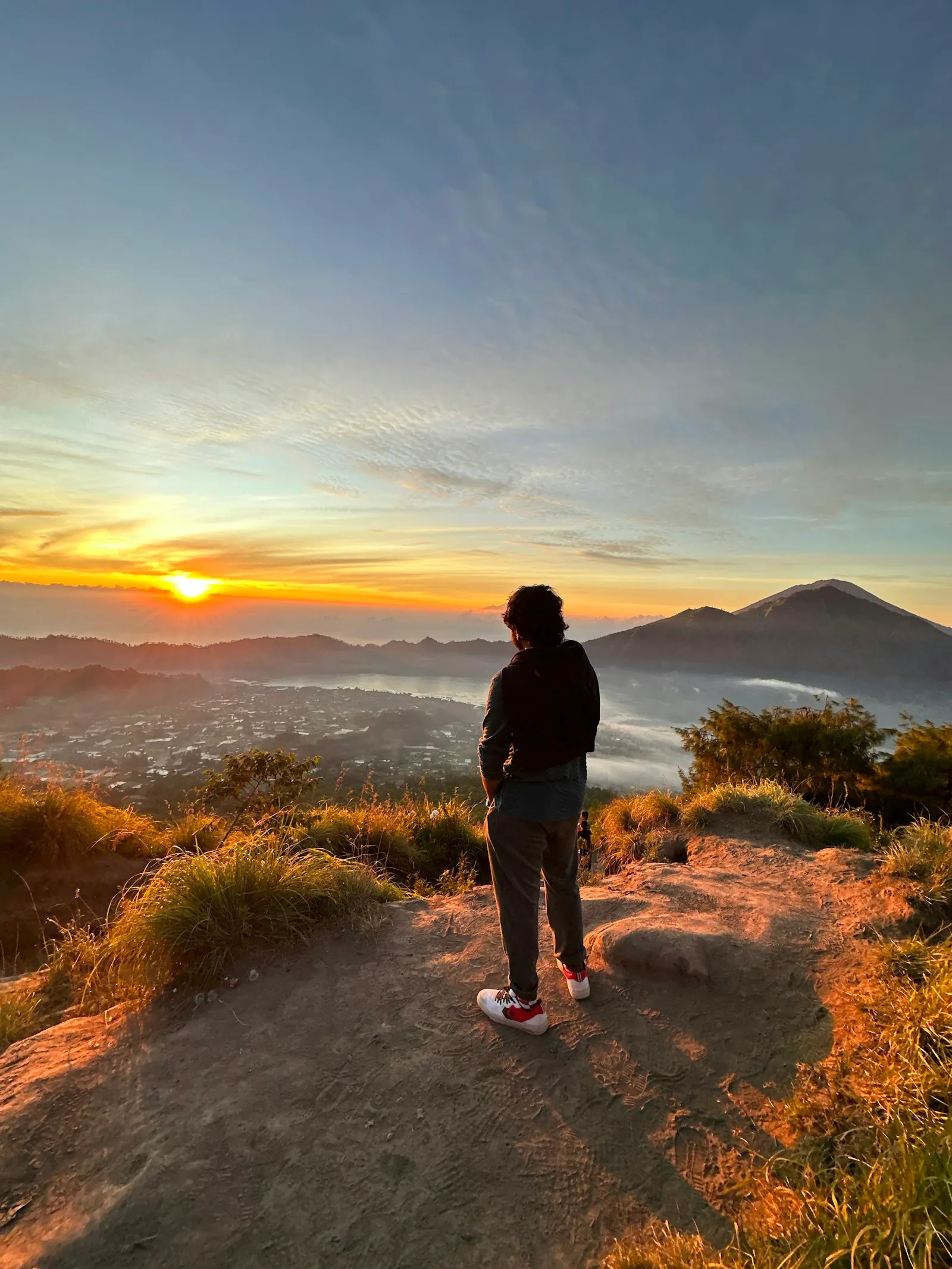
The summit experience is the reason. You sit on a low wall at the rim of an active volcano’s crater, looking east across central Bali. To your left, in the distance, is Mount Agung, often above the clouds. Below you, the caldera lake gleams pewter. To your right, the slopes drop away into the dark. The eastern sky is grey, then peach, then orange. The first edge of the sun appears over the horizon. The clouds below you light up. The mountains in the distance turn from silhouette to colour.

When the light is up, your guide will walk the small group around to a viewpoint where you can look directly into the crater itself — steaming vents, sulphurous yellow patches on the rocks, the unmistakable smell of an active volcano. Stand carefully. Don’t step over the marked rope. Take the photographs.
The descent is harder than the climb in one sense and easier in another. Easier: gravity is on your side. Harder: the same scree you scrambled up is now a sliding surface you’re walking down, and the temptation to half-jog turns most people into ash-coated cartoons within the first ten minutes. Take it slow. Use trekking poles if your guide has loan ones.
You’re back at the trailhead by 9 a.m., back in your hotel by 11. Sleep for the rest of the day. Eat. Repeat.

A note on weather
The summit is often clouded over in the wet season (November to March). I went in May and got a cloudless dawn; people who go in January often see nothing at the top. Most operators run rain-or-shine. If you’re booking, check the forecast a day ahead and consider rescheduling if it’s pouring. The clouds are part of the gamble.
How nice are the guides?
Lovely. The guides are local farmers and former farmers from the villages around the volcano, and they have a quiet, no-fuss professionalism that you appreciate at 4 a.m. on a steep slope in the dark. Mine was a man called Komang (a popular name; Bali’s naming convention assigns one of four names by birth order, and a lot of male first-borns end up Komang or Wayan). He was 41. He had been guiding the climb for fifteen years. He carried my friend’s extra water bottle for the second half of the climb because she was struggling. He told me the names of three constellations he could see overhead. He fielded questions about the volcano’s eruption history with patience. At the bottom, he wouldn’t accept a tip until I’d insisted three times.
If you go
• Book through a reputable operator. The MBTGA is the official body; tour operators like Bali Sunrise Trekking and Bali Eco Trek are well-reviewed. • Wear proper walking shoes, NOT flip-flops or sandals. Lots of grip is essential. Bring a fleece or windproof — the summit is genuinely cold at dawn. • Bring a head torch. Most tours provide one. Bring backup batteries. • Bring water — at least 1.5 litres each. • Don’t go if you’re not reasonably fit. The climb is two hours of steep ascent. If you’re someone who can comfortably walk for two hours uphill, you’ll be fine. If you can’t, this is not the trek for you. • If you’re feeling unwell or it’s pouring rain, reschedule. The mountain isn’t going anywhere.
The Mount Batur sunrise hike is the kind of experience that you spend the climb doubting and the summit unable to stop smiling about. It’s Instagram-famous for a reason — the geometry of the volcano, the lake, the distant Agung silhouette, the dawn light — but the photographs don’t capture the feeling of having earned the view. Do it once. You will not forget it.
Plan your trip to Indonesia
For more, see our Indonesia travel guide and country page, places to visit in Indonesia on BugBitten, tours and experiences in Indonesia.
Useful external resources: the Indonesia country profile on Wikipedia and the official Indonesia tourism site.