Nusa Penida: Kelingking Beach and a Day Trip from Bali You Won’t Forget
Cliff lookouts, Diamond Beach, Angel’s Billabong and the T-Rex coastline that broke the internet.
📍 Nusa Penida, Klungkung, Bali, Indonesia
Nusa Penida is the largest of the three islands sitting in the strait between Bali and Lombok — and the one that, in the last few years, has gone from “almost no one visits” to “the most photographed cliff in South-East Asia” thanks to a single drone shot of a beach called Kelingking. The cliff above Kelingking, with its strange T-Rex profile, ended up on Instagram in 2017, and the island has been adjusting to the resulting wave of day-trippers ever since.
The honest truth: Nusa Penida is one of the most spectacular places I have been to in Indonesia, and a day trip is enough to see the headline sights, and you should absolutely go — but you should also go in with realistic expectations about the roads, the crowds, and the heat. Done right, it’s a phenomenal day. Done badly, it’s ten hours of sweaty mini-bus.
How to get there
The standard option is a fast-boat day trip from Sanur on Bali’s east coast. Boats depart from the pier at Sanur Beach from 7 a.m. onwards, take 30–45 minutes to cross to Toya Pakeh harbour on Nusa Penida, and run last returns around 4 or 5 p.m. Expect to pay around $25–35 round trip for the boat alone, or $50–80 for an all-inclusive package that bundles boat + minibus tour + lunch.
I went with a small-group package. The boat was a 60-foot speedboat with maybe forty people on it. The crossing was choppy enough to be exciting and short enough not to be ill-making. We were in our minibus on Penida by 8:30 a.m. with seven other passengers and a driver-guide called Wayan.
The west coast loop: Kelingking, Angel’s Billabong, Broken Beach
The standard day-trip route hits the west-coast highlights in a clockwise loop. Wayan started us at Kelingking Beach.

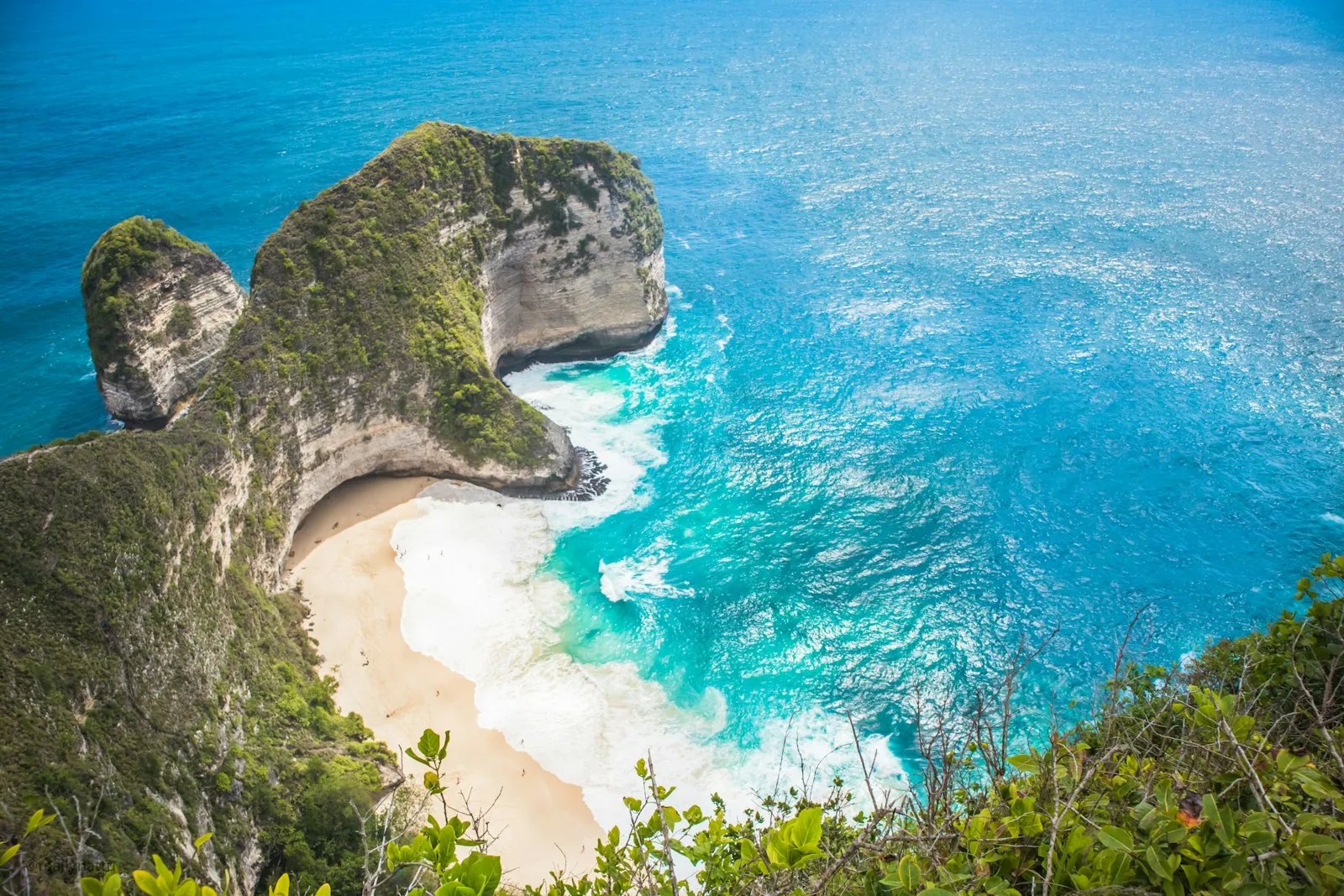
Kelingking is the postcard. You park at the top, walk five minutes through a small village of stalls, and emerge at a viewpoint that looks down a 200-metre cliff onto a perfect arc of white sand. The cliff itself, from the right angle, looks like the head and back of a T-Rex about to lunge into the sea, with the beach as its tongue. The viewpoint is fenced. Below the fence, a path scrambles down the cliff to the beach itself — about an hour each way, partly on rope, partly on bamboo ladders, not for the faint-hearted or the unfit. Do not attempt the descent unless you’re fit, dry, in proper shoes, and have given yourself the time. We watched two people start the descent and turn back within ten minutes.

The viewpoint itself is enough. Sit, take it in, take your photographs, and don’t rush. Nusa Penida’s heat is real and the queue for the viewpoint photo can take a while, so factor in patience.
Next stop: Angel’s Billabong, twenty minutes drive along the west coast. This is a tidal pool carved into the limestone shelf at the edge of a cliff — at low tide, it’s a perfect aquamarine swimming pool right at the edge of the ocean; at high tide, it’s underwater and waves wash across it. You can swim in it (at low tide; check with locals before getting in — people have been swept off the shelf and killed when waves come unexpectedly). Even if you don’t swim, the geology is incredible: the rock is sculpted into ridges and pools and channels by the surf, and the colour of the water is hypnotic.
A short walk away is Broken Beach (Pasih Uug), a circular sea cave whose roof has collapsed, leaving a perfect ring of cliff with the ocean inside it and a single stone arch at one end. You walk a clifftop path around the rim. It is, easily, one of the most strange and beautiful coastal formations I’ve ever seen.
The east coast: Diamond Beach and Atuh
After lunch — usually at a small warung in the centre of the island — the day trips that include the east-coast loop drive across to Diamond Beach. The drive is the part nobody warns you about. Penida’s roads are narrow, steep, and in many places freshly broken by the tropical rain. The cross-island route is rebuilding constantly. A typical drive from west to east takes 90 minutes for what looks on a map like a 30-minute journey. Bring a sense of humour.

But the east coast is worth it. Diamond Beach is tucked at the bottom of a sheer cliff and accessed by a recently-built staircase — about 350 steps down, the same back up. The beach itself is small, white, set against rock spires that lean out into a sea so clear you can see the bottom from the cliff. There’s a freshwater stream at one end. You can swim, with care for the current. There’s no shade. Bring a hat.
Atuh Beach, ten minutes north, is a quieter cousin: a wider sandy bay with a row of warungs serving fresh young coconuts. If you only have time for one east-coast beach, Diamond is the more dramatic; Atuh is the more relaxing.
What I’d skip
Crystal Bay is sometimes added to day trips. It’s a snorkelling beach with a small reef and is genuinely lovely, but it’s an extra hour of driving and on a one-day trip you’ll be exhausted by then. Skip it on day one and come back another time if you want to do snorkelling properly.
Why the boat trip back is the best part
We made the 4 p.m. fast boat back to Sanur with about ten minutes to spare. The strait was calm. The sun was dropping in the west. About fifteen minutes into the crossing, the engines slowed, the captain killed the throttle, and the deckhand pointed off the starboard side. A pod of pilot whales — twenty or thirty of them — was crossing the strait alongside us, surfacing and diving in slow rhythm. The captain stayed there for ten minutes. Nobody on the boat spoke. The crew clearly do this whenever they spot something. The kindness of the small detour was the part of the day I’ll remember longest.
How nice are the people of Nusa Penida?
The communities on Penida have been suddenly thrown into a major tourism economy in the last few years, and they are still negotiating it. Mostly, what I encountered was a lot of warmth, a few new businesses still figuring out the basics, and the same Balinese hospitality that the main island runs on. Wayan, our guide, was a 28-year-old local who had grown up on Penida before the tourism boom. He told us about the changes — some good (jobs, schools), some hard (water shortages, traffic) — without bitterness, and he made sure every traveller in our group had a chance at the photo they wanted. He refused a tip three times before accepting it. The warung lady at our lunch stop pressed a bag of tropical fruit into my hand for the boat ride home. She would not let me pay.
If you go
• Book a small-group tour. The big bus tours are cheaper and miserable. • Wear proper walking shoes, not flip-flops. The clifftop paths are uneven and the steps to the beaches are serious. • Carry water. Lots. The shade is minimal and the heat is real. • Don’t do the cliff descent at Kelingking unless you’re fit and have time. The viewpoint is enough. • Book the boat for an early-morning departure (7 a.m. or earlier). It maximises your day and you avoid the worst of the midday heat.
Nusa Penida in a day is intense, sweaty, and absolutely worth it. The T-Rex coastline is real. The water is real. The people are real. Bring sunscreen, bring sturdy shoes, bring patience, and you will come away with the kind of day you’re still describing months later.
Plan your trip to Indonesia
For more, see our Indonesia travel guide and country page, places to visit in Indonesia on BugBitten, tours and experiences in Indonesia.
Useful external resources: the Indonesia country profile on Wikipedia and the official Indonesia tourism site.