Toledo: A Day Trip from Madrid Through Spain’s Medieval Capital
A long day in the city of three cultures — Christian, Jewish, and Muslim — set on a hilltop above the Tagus river.
📍 Toledo, Spain
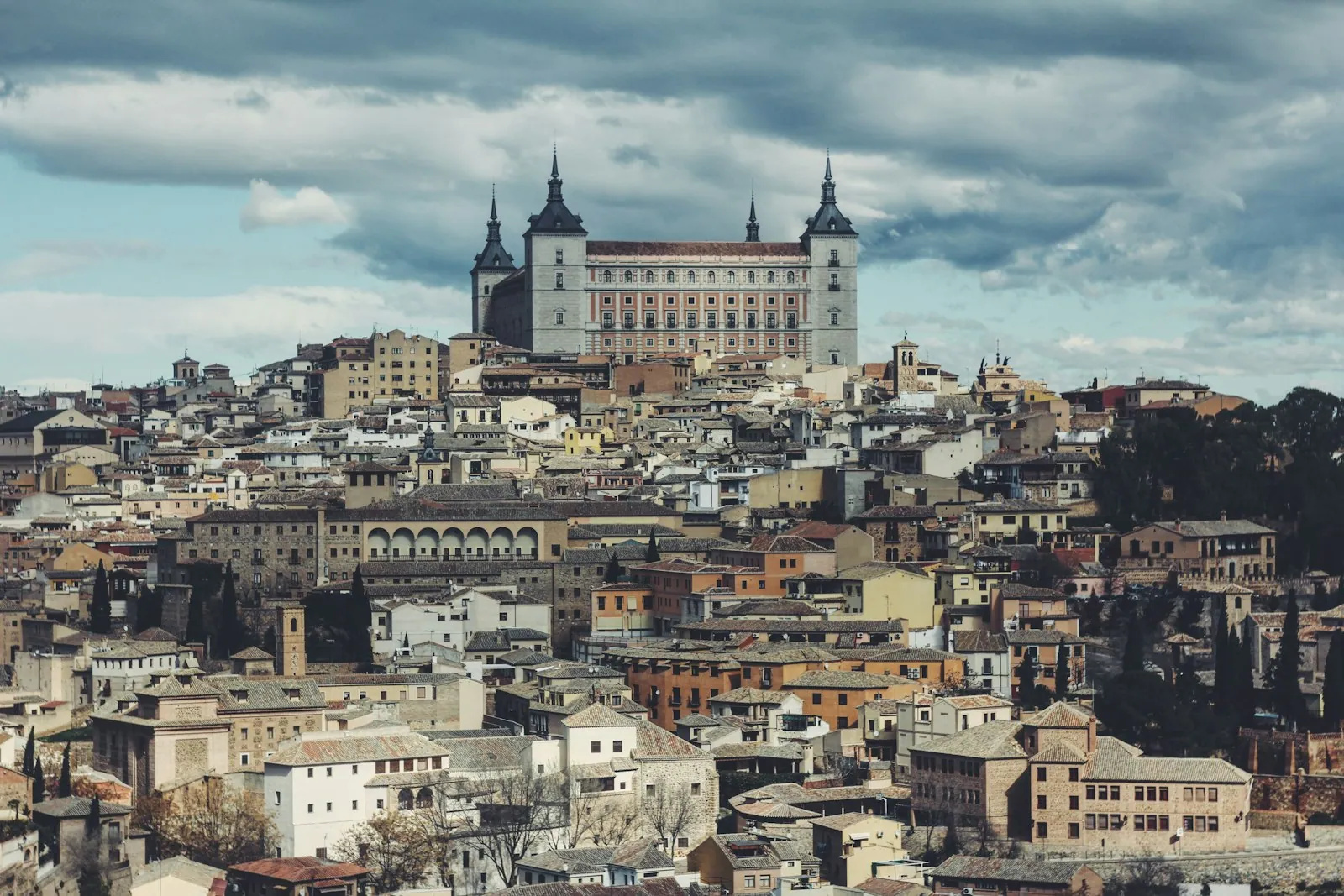
Toledo sits 70 kilometres south of Madrid on a granite hilltop wrapped almost entirely on three sides by the Tagus river — a natural fortress that has made it one of the most strategically important cities in Spain since Roman times. The medieval city was the capital of Spain until 1561 (when Philip II moved the court to Madrid), the religious capital of the country (the Archbishop of Toledo is still the senior Catholic prelate in Spain), and a city where Christians, Jews, and Muslims lived side by side for the better part of seven centuries — the famous “city of three cultures” model that the rest of medieval Europe mostly didn’t manage. Today, the entire historic centre is a UNESCO World Heritage site, and the postcard view of the city — the dense rooftops of pale terracotta and stone, the cathedral spire, the squat Alcázar, all set on the cliff above the river — is one of the most recognisable images in Spain.
A day trip from Madrid is the standard way to see it. Two days is better.
The setup
Take the AVE high-speed train from Madrid Atocha to Toledo. Journey time 33 minutes. Trains run roughly hourly all day. Round trip about €25. The Toledo train station is itself a small Mudejar-style architectural gem — the 1919 building was designed in deliberate echo of the Toledo medieval style.
From the station, it’s about a 20-minute walk to the historic centre, or you can take a taxi (€8) or the local bus. Most visitors buy a day-long combined ticket called the Pulsera Turística (about €12) which gives you access to seven of the main monuments — useful if you’re visiting more than two.
Morning: the Cathedral
Walk to the Cathedral first. Toledo Cathedral is one of the great Spanish Gothic buildings — built between 1226 and 1493, with a vast 120-metre-long nave, a soaring 90-metre tower, and an interior packed with masterpieces. The famous Transparente (an extraordinary 18th-century Baroque altarpiece-skylight that pours natural light into the ambulatory through a hole cut in the ceiling) is one of the most theatrical pieces of religious architecture in Europe. The treasury holds the great gold-and-silver monstrance carried at the city’s Corpus Christi procession (10 kilograms of gold, 180 kilograms of silver, 17,000 pieces). The sacristy is a small picture gallery with paintings by El Greco, Goya, Velázquez, and Caravaggio.
Allow two and a half hours. The cathedral is one of the best in Spain and you should not rush.
After the cathedral, walk the small streets behind it. Toledo’s old town is a tight web of narrow medieval streets, often only wide enough for one person at a time, that wind around the hill. Get lost. Stop at one of the small shops selling damasquinado (the local Toledo gold-on-steel inlay work) or marzipan (Toledo’s famous traditional almond-paste sweet, made by nuns in several convents in the old town).
Lunch and the Alcázar
For lunch, eat in one of the small bistros in the old town or near Plaza Zocodover (the central square). Reliable: Hierbabuena (a bistro with a beautiful interior), Alfileritos 24 (a restaurant in a Mudejar building), or Casa Aurelio (the traditional restaurant of Toledo, since 1926, with the local game and partridge dishes that the city is famous for).

After lunch, walk to the Alcázar — the squat fortress on the highest point of the city. The current building is mostly a 16th-century Renaissance reconstruction (rebuilt after a famous siege in the Spanish Civil War, when Republican forces besieged the Nationalist garrison inside for 70 days), and it now houses the Spanish Army Museum. The view from the terrace and the building’s exterior are the main interest for most visitors; the Civil War siege history inside is interesting but heavy.
Afternoon: the Jewish Quarter and El Greco
Walk west into the Judería — Toledo’s old Jewish quarter, on the western side of the historic centre. The neighborhood was, before the 1492 expulsion, one of the largest Jewish communities in medieval Europe (some 12,000 Jews lived in Toledo at the peak in the 12th century). Two of the three surviving medieval synagogues in Spain are here: the Sinagoga de Santa María la Blanca (a beautiful 12th-century synagogue with horseshoe-arched aisles, converted to a church after 1411 — the white pillars and horseshoe arches are reminiscent of a small mosque) and the Sinagoga del Tránsito (a 14th-century synagogue with extraordinary plasterwork and an in-built museum of Sephardic Jewish history). Both are a short walk apart and both are essential. Allow ninety minutes for the two.
A few minutes’ walk further is the Casa-Museo de El Greco — a museum dedicated to the painter Domenikos Theotokopoulos (El Greco), the Cretan-born Mannerist painter who made his career in Toledo from 1577 until his death in 1614. The museum is set in a 16th-century house once thought to have been El Greco’s home (it actually wasn’t, but the recreation is convincing), with a beautiful courtyard and several major paintings including a View of Toledo. The Iglesia de Santo Tomé, a few blocks away, holds El Greco’s greatest single painting — The Burial of the Count of Orgaz, painted in 1586, displayed in the chapel where the Count was actually buried, four metres from the painting’s subject. It is one of the great paintings in Western art. Pay the small fee, take a few minutes, look. The painting is overwhelming up close.
Late afternoon: the Mirador del Valle
Before catching the train back, take a taxi (€10) or walk down to the Puente de San Martín, cross the Tagus, and walk up to the Mirador del Valle — the famous viewpoint on the south side of the river that gives you the iconic Toledo postcard view: the entire medieval city laid out on its hilltop, with the cathedral spire in the middle and the Alcázar to the east, the Tagus winding around the base. This is the view that El Greco painted and that has been in every Spanish travel poster for a century. Stay for sunset if you can — the light on the city is best in the late afternoon.
End the day with a final coffee at one of the cafes near Plaza Zocodover, then back to the train station for the AVE to Madrid.
How nice are Toledanos?
Castilian-warm. Toledo is a small city heavily geared to day-trip tourism, and the locals have long since adjusted to a constant flow of visitors. The friendliness is professional, polished, and consistently warm. My day included: a Cathedral guide stop her audio guide rental session to give me a longer recommendation list of small chapels I shouldn’t miss; a marzipan shop owner give me a small free sample of three different fillings she wanted me to taste; and a taxi driver back to the station give me a free 5-minute mini-tour of the route along the river “because you’re early for your train, why not.” The Toledo hospitality is real.
If you go
• Take the morning AVE from Madrid (8:50 a.m. or 9:50 a.m.). Arrive by 10 a.m., leave on the 7 p.m. train. Full day on site. • Buy the Pulsera Turística at the first monument you visit — covers most of the small ones. • Wear comfortable shoes. The cobbled streets are uneven and the city is almost entirely uphill. • Stop at the Mirador del Valle. The view is the photograph of the trip. • If you can, stay one night. The city in the evening, after the day-trippers have gone, is one of the most atmospheric places in Spain.
Toledo is the medieval capital of Spain in essentially preserved form. A day from Madrid will give you the cathedral, the Judería, El Greco, and the Mirador. You leave wishing for two days. Many people come back for a long weekend.
Plan your trip to Spain
For more, see our Spain travel guide and country page, places to visit in Spain on BugBitten, tours and experiences in Spain.
Useful external resources: the Spain country profile on Wikipedia and the official Spain tourism portal.