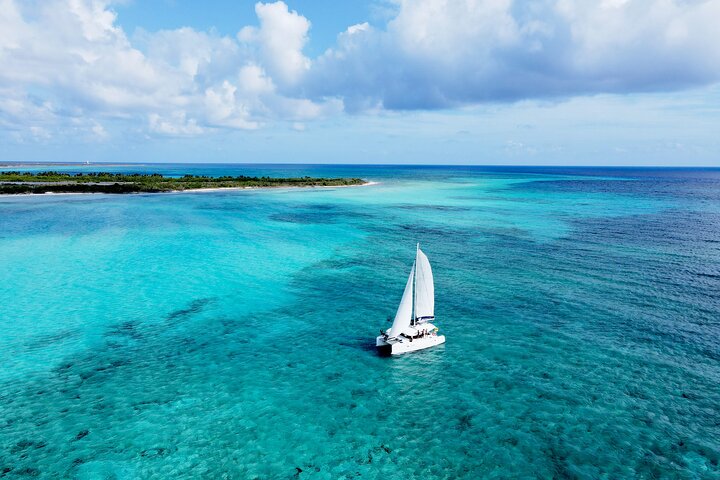
Lagoon 39ft Private Catamaran 5hr - El Cielo Full Experience
5 hours
From AUD 3091.47
Banco Chinchorro sits about 30 kilometres off the Quintana Roo coast near Mahahual, and getting there requires genuine commitment — a two-hour boat crossing that can be rough enough to remind you that this place hasn't been made easy on purpose. That remoteness is exactly what has kept the reef in remarkable shape.
The coral here is some of the healthiest I've encountered in the Caribbean, with dense elkhorn and staghorn formations that feel almost anachronistic given what you find further north along the Mesoamerican Barrier Reef.
Underwater, visibility typically runs 20 to 30 metres, and shallow snorkelling zones max out around 5 metres over coral gardens genuinely worth your time. Scuba diving reaches 18 to 25 metres on the outer walls, where currents can push hard — not violently so, but this isn't a spot for brand-new Open Water divers without a confident guide.
Nurse sharks, eagle rays, green turtles, and dense schools of snapper are reliable company. Between June and September, whale sharks occasionally pass through, though they're not the headline act here.
The headline act is the American crocodiles. A small population inhabits the atoll's interior mangrove lagoons, and licensed operators run structured snorkelling encounters in shallow water — typically 1 metre or less — where you float alongside animals that can reach 4 metres in length. It is odd and wonderful in equal measure, and conducted with a level of care I found genuinely reassuring.
Day trips depart from Mahahual or Xcalak through a small number of licensed operators; liveaboards are not available. Permits are tightly controlled, which keeps visitor numbers low and the experience legitimate.
Go between April and June for calmer crossings and optimal visibility; a minimum of Open Water certification is needed for scuba, though snorkellers of any level are welcome.
When Sophie from our BugBitten team stepped onto the dock at Mahahual at half past five in the morning, the sky was still dark and the air already thick with salt. The boat — a fibreglass panga with two outboard motors and not a great deal of padding on the seats — was loaded with tanks, fins, and a cooler. The captain handed her a dry bag without a word. She took it as fair warning.
The two-hour crossing to Banco Chinchorro is not the sort of transit that eases you into the experience. In the dry season it can be glassy and almost meditative. In other months, the open Caribbean chop between the coast and the atoll will have you gripping a rope and reconsidering your breakfast choices. Sophie hit a moderate swell that morning — enough to wake her up thoroughly, not enough to turn back — and by the time the flat line of the atoll's interior mangroves came into view, she was sunburned on one side of her face, slightly damp, and completely ready.
What followed across the next eight hours was one of those days that is difficult to describe without sounding like you're exaggerating. Crocodiles in shallow water. Coral formations that felt like they belonged to another era of the Caribbean. A green turtle drifting so close overhead during her second dive that she could see the barnacles on its shell. Banco Chinchorro has a way of delivering the kind of wildlife encounters that people on busier reefs spend years chasing.
This piece is Sophie's honest account of what it takes to get there, what you'll find when you do, and what nobody tells you before you book.
Banco Chinchorro is the largest coral atoll in the Northern Hemisphere — a fact that is easy to say and genuinely difficult to absorb when you're floating above it. The atoll stretches roughly 42 kilometres from north to south and sits about 30 kilometres off the Quintana Roo coast, far enough from the mainland that the water clarity, the coral health, and the sheer density of marine life feel almost implausible by modern Caribbean standards.
The reef here has been spared many of the stressors that have damaged coral systems further north. Visitor numbers are tightly controlled by permit. There are no cruise ship stops. The nearest resort town, Mahahual, is itself small and relatively low-key by Riviera Maya standards. All of that means the elkhorn and staghorn coral formations that once defined Caribbean reefs — and that have largely vanished elsewhere — are still present here in quantities that feel almost anachronistic. Sophie described dropping below the surface on her first dive and needing a moment to recalibrate her expectations, because what she saw did not match what she'd become accustomed to seeing on other reefs in the region.
Underwater visibility typically falls between 20 and 30 metres on good days. Nurse sharks rest under coral ledges with the indifference of animals that have never learned to be afraid of people. Eagle rays cross the mid-water column in slow diagonals. Dense schools of snapper hover in formations so tight they move like a single animal. Green and hawksbill turtles are consistently present in the shallower zones.
But the reason most people make the particular effort Banco Chinchorro demands — the early alarm, the rough crossing, the price — is the crocodiles. The American crocodile population living in the atoll's interior mangrove lagoons is small, wild, and completely real. The encounters offered by licensed operators are not a show, not a performance, and not remotely comparable to any zoo experience. They are structured, safety-focused, and legitimately unusual. More on those shortly.
Mahahual, the small town from which most Banco Chinchorro departures run, is worth understanding before you arrive. It sits on the southern Costa Maya and has the slightly unfinished, genuinely relaxed character of a place that only started receiving visitors in the last two decades. There's a long malecon (waterfront promenade), a handful of seafood restaurants, dive shops and tour operators mixed in with small hotels, and an atmosphere that owes more to a fishing village than a tourist resort.
When cruise ships dock at the nearby pier — which does happen on a rotating schedule — the town briefly transforms into something louder and busier. When they leave, which is by mid-afternoon, Mahahual returns to itself. Timing your arrival to avoid cruise days is not essential but it does affect the character of your experience in town.
The alternative departure point is Xcalak, an even smaller village about 55 kilometres south of Mahahual, closer to the Belize border. Xcalak has a reputation among divers and fly-fishing people who've gone looking for something genuinely off the beaten track. There are very few amenities, excellent snorkelling directly off the beach, and a frontier quality that some travellers find charming and others find uncomfortable. The drive from Mahahual to Xcalak is mostly unpaved and takes longer than the map suggests.
The Quintana Roo coast in this southern section is notably different from the Riviera Maya corridor further north. There are no mega-resorts here, no swim-up bars, no wristbands. The more places in Quintana Roo section of the BugBitten site covers some of the contrast well, but the short version is that this part of the coast attracts people who've done the Tulum and Playa del Carmen circuit and are looking for something that hasn't been packaged for them.
Snorkellers have genuine access to excellent reef here, not just a consolation offering while divers have the real experience. The shallow coral gardens sit at depths of around 3 to 5 metres, which means good light, easy visibility, and the ability to surface and re-enter as many times as you like without worrying about decompression. The coral density in these zones is what makes them worth the trip on their own terms — intricate brain and star corals, healthy sea fans, and the kind of fish life (parrotfish, angelfish, wrasse, snapper) that simply isn't as abundant on more heavily visited reefs.
For certified divers, the outer walls of the atoll at 18 to 25 metres are where the scale of the place becomes apparent. The wall dives are subject to currents that can run hard, particularly on the eastern side — not dangerous for competent divers, but the guide briefings are worth paying attention to. A minimum Open Water certification is required, though in practice operators assess their clients and won't put uncertain divers in challenging conditions. The nurse shark and eagle ray encounters on these dives are consistently reported as highlights.
The contrast with the Puerto Morelos Reef further north — which is excellent but far more accessible and therefore far more visited — gives some useful context. Banco Chinchorro is not doing anything structurally different; it simply has fewer people in the water, which compounds over years into meaningfully better coral health and more confident wildlife.
This is the part that requires some mental preparation. The American crocodiles living in the interior mangrove lagoons of Banco Chinchorro are wild animals. They are not fed, not trained, not named (well, some may be named by the guides, but not in a theme-park way). The encounters involve floating in shallow water — typically no deeper than your knees or waist when standing — alongside animals that can reach four metres in length.
The operators who run these encounters are licensed, experienced, and run small groups with guides in the water at all times. The protocol is clear and the safety record is strong. Sophie described the moment when the first crocodile drifted toward her as producing an involuntary physical response — a full-body alertness — that was followed almost immediately by a kind of calm, because the animal was clearly not threatened and not interested in doing anything beyond moving through its own space. It is one of the stranger experiences available in the Caribbean, and it is conducted with more care and expertise than the setting might initially suggest.
The window between April and June is the clearest answer. The sea crossing is at its most manageable, winds are lighter, visibility is at its peak, and the combination makes for the most predictable day-trip experience. This is also the tail end of dry season in the Yucatán, which means pleasant conditions on land.
Between June and September, whale sharks occasionally move through the waters around the atoll on their way along the Mesoamerican Barrier Reef corridor — though Banco Chinchorro is not a reliable whale shark site in the way that Isla Holbox or Isla Mujeres are. If you're specifically chasing whale sharks, your time is better spent further north. The Visit Mexico official tourism site has regional seasonal breakdowns that help with planning around these windows.
July through October brings the risk of tropical storms and hurricane season. Crossings can be cancelled at short notice. If you're visiting during this period, build flexibility into your itinerary — don't plan Banco Chinchorro for the only available day of a tight schedule.
December through February can be cool and windy, with rougher crossings. Visibility is still generally good and the reef is worth it, but the boat journey is harsher.
Mahahual is the practical base. From Cancún airport, you're looking at a four-hour drive south along Highway 307, passing through Chetumal or cutting across via the Tulum junction. There is no direct public transport route that makes this convenient; most visitors either rent a car or arrange a transfer. Chetumal, the state capital of Quintana Roo, is about two hours south of Mahahual and makes a reasonable overnight stop if you're coming from that direction.
From Mahahual, licensed Banco Chinchorro operators run day trips only — there are no liveaboard options and no overnight stays on the atoll. The permit system caps daily visitor numbers, so booking ahead (at least several days in advance, more during the April–June peak) is not optional. Turn up and hope is not a viable strategy here.
The surrounding region has other things worth your time. The Calakmul Biosphere Reserve sits inland in Campeche state and is reachable in a long day from Mahahual — one of the most significant Maya archaeological sites in Mexico combined with dense tropical forest and serious wildlife. It makes for a striking contrast to the coastal experience and rewards the effort considerably.
Closer to Mahahual, Xcalak's reef system is accessible without permits or operators, making it a good warm-up dive or snorkel day before committing to the Banco Chinchorro crossing. The reef there is not in the same league, but the conditions can be good and the town has a character entirely its own. Banco Chinchorro itself is listed adjacent to the Mesoamerican Barrier Reef System, which holds UNESCO World Heritage status — a useful frame for understanding the ecological significance of what you're visiting.
The boat crossing is the most frequent complaint, and it deserves honest treatment. Two hours each way on an open fibreglass panga is genuinely hard going if the sea is up. People with back problems, strong motion sickness tendencies, or a low tolerance for physical discomfort should think carefully. Medication helps — take it well before departure. The return crossing, when you're tired and sun-affected, can feel longer than the outward one.
The cost is higher than most day-trip diving in Mexico. The combination of licensing requirements, fuel for the long crossing, equipment, and the genuine expertise required of the guides means that budget operators don't really exist here. Expect to pay significantly more than a dive day at Cozumel or the Riviera Maya reefs.
The permit system, which is the correct and necessary approach to protecting the site, also means flexibility is limited. If conditions cancel your trip on the day you've booked, rescheduling around travel plans can be stressful. There is also no guarantee the crocodile encounter will produce sightings — the animals are wild and move on their own schedule — though it's a rare trip that sees none at all.
The facilities on the atoll are minimal. There are basic wooden structures operated by local fishermen, no tourist infrastructure to speak of, and no medical facilities. Good operators carry first aid equipment and emergency communication devices, but this is a remote location and any serious medical event would involve a long evacuation.
Banco Chinchorro is not a place that makes itself easy to reach. The crossing, the permits, the cost, the planning required — these are real barriers, and it's worth being honest that not every itinerary has room for them. But if you're in Quintana Roo with any interest in marine environments and a day to spend, the effort compounds into something that is difficult to replicate elsewhere in the Caribbean.
The coral health alone would justify the trip. The crocodiles make it genuinely singular. And the fact that it hasn't been converted into something simpler and more convenient — that the remoteness is structural rather than accidental — is precisely why the experience retains its quality.
Sophie came back off the panga at Mahahual in the early evening with sore shoulders from the crossings, a patch of sunburn that her hat had missed, and a photograph on her underwater housing that she still uses as her phone wallpaper eighteen months later: a crocodile, suspended in impossibly clear shallow water, utterly unbothered by the human floating two metres away with a camera. That image, she says, is an accurate record of what Banco Chinchorro actually is. Which is rare. Most places look better in photos.
This one looks exactly the same.

