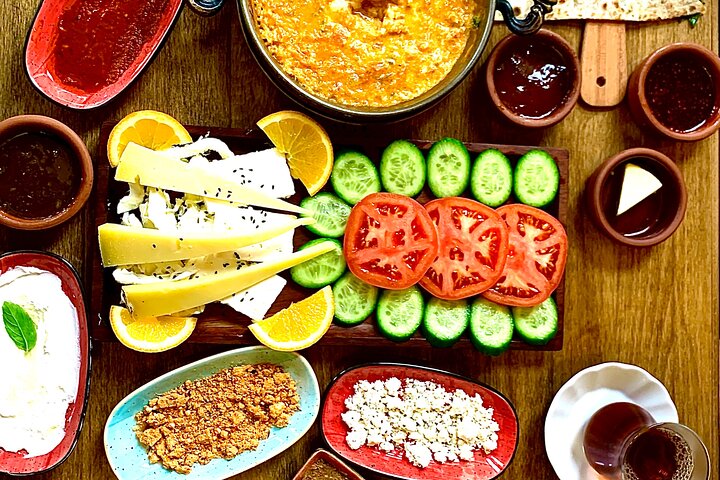
Hidden Beyoğlu Tour
4 hours – 5 hours
From AUD 203.76
Cycling through Cappadocia is one of those experiences that takes a while to fully land. You pedal around a bend, a cluster of fairy chimneys rises out of the volcanic tuff ahead, and you genuinely stop mid-stroke just to stare.
The valley floors between Göreme, Uçhisar, and Çavuşin are relatively gentle — short climbs of thirty to sixty metres between formations — though the plateau edges around Derinkuyu and the underground cities will push you harder.
Most riders spend two to four days here, threading together the Rose Valley, Red Valley, and Love Valley in half-day loops rather than one linear route, which suits the exploratory character of the place perfectly.
Surfaces are the thing to plan around. Dedicated gravel tracks cut through the valleys and are generally firm and well-packed in dry weather, but after rain they turn sticky and slow. Paved roads connect the main villages and carry a steady mix of tour minibuses and agricultural trucks, so morning starts before nine help you claim the quieter hours.
There is no rail access directly into the valleys; most riders arrive by overnight bus from Istanbul or Ankara into Nevşehir or Göreme itself.
Bike hire is widely available in Göreme, ranging from basic mountain bikes to e-bikes, which I would honestly recommend for anyone not used to long riding days at altitude around 1,200 metres. Cave hotels in Göreme and Uçhisar are genuinely comfortable bases, with staff used to storing bicycles and advising on local tracks.
Ballooning happens at dawn and watching dozens of balloons drift silently overhead while you clip into your pedals is a hard thing to beat.
April through June and September through October offer the most manageable temperatures; July and August are hot enough to make a midday climb genuinely unpleasant.
When James from our BugBitten team rolled out of a cave hotel in Göreme just before seven on a Tuesday morning in late September, he wasn't entirely sure what to expect. He'd ridden plenty of gravel paths before — the Otago Rail Trail in New Zealand, a few of the quieter routes through the Dordogne — but nothing quite prepares you for the moment you drop into the Rose Valley with the early light turning the tuff formations the colour of warm terracotta. He stopped mid-stroke somewhere around the first kilometre. Just sat there on the saddle, one foot down, and stared. That sensation — the involuntary full stop — turned out to be a theme for the entire four days he spent threading through these valleys on two wheels.
Cappadocia cycling isn't a single route or a mapped trail with numbered posts. It's more of an open invitation to move slowly through a landscape that looks as though it was designed by a geologist with a loose grip on plausibility. The fairy chimneys, the cave churches, the wind-carved corridors between rock formations — all of it sits at a scale that works extremely well when you're travelling at bicycle pace, which is roughly fast enough to feel momentum but slow enough to actually process what you're looking at.
There are plenty of ways to visit Cappadocia. You can do the bus-and-tour-group circuit, which will get you to the obvious lookout points and back to your hotel in time for dinner. You can hike, which works well for the more intimate valley trails. But cycling sits in a genuinely useful middle ground: you cover more ground than walking, but you're not sealed inside a vehicle, and you can stop as often as you like without worrying about holding anyone up.
The geography rewards this kind of movement. The valley floors between Göreme, Uçhisar, and Çavuşin sit at around 1,200 metres above sea level, and the climbs between major formations are typically short — thirty to sixty metres of elevation gain — before flattening again into broad open corridors. That rhythm suits a relaxed rider well. You're not grinding up extended switchbacks; you're mostly rolling with occasional punchy little rises that keep things interesting without becoming a sufferfest.
What you get in exchange for that modest physical effort is access. Some of the best sections of the Rose Valley and the Red Valley are only accessible on foot or by bike. Tour minibuses can't follow you in there. The result is that you fairly routinely find yourself alone between formations the height of a three-storey building, watching swallows cut through the gaps, with the sound of the wind and your own tyres the only things registering. That's not something you can replicate from a coach window.
The region also carries serious historical weight. Cappadocia is listed on the UNESCO World Heritage List for both its extraordinary natural landscape and its dense concentration of rock-cut churches, underground cities, and Byzantine-era frescoes — many of which you can ride straight to, lean your bike against a rock wall, and walk inside for a few euros.
Nevşehir province is not a wilderness experience. Göreme in particular is a proper tourist town with restaurants, bike hire shops, Instagram-facing cave hotels, and a main street that moves at a decent clip throughout the shoulder seasons. Don't expect isolation when you're in the village itself. What you do get, within about fifteen minutes of pedalling in any direction out of town, is a fairly dramatic shift in atmosphere.
The valley floors carry a particular quality of quiet that's difficult to explain outside of being there. Part of it is acoustic — the rock formations absorb and redirect sound in odd ways, and you can be riding fifty metres from a paved road without hearing traffic. Part of it is visual contrast: the cultivated fields of grape vines and apricot trees that sit at the base of formations create this odd domestic calm right alongside some of the most surreal geology in the world.
The villages along the route — Çavuşin, Ortahisar, Avanos — each have a distinct character and are well worth building into your loops. Avanos sits on the Kızılırmak River and has been a pottery centre for thousands of years; it's a reasonable lunch stop and a useful resupply point if you're staying a few days. Ortahisar is the quieter one, built around and into a castle rock, and it sees noticeably fewer visitors than Göreme. If you want a less-trafficked base, more places in Nevşehir are worth researching before you book — Ortahisar and Uçhisar both have excellent cave accommodation that's considerably calmer than central Göreme.
The light in this region is something professional photographers get on planes for. The low angle of morning and late afternoon turns everything gold-amber on the tuff formations, and the shadows cut sharp and dramatic across the valley walls. If you're at all interested in photography, you will take more images in Cappadocia than anywhere else on a long trip. Budget the time accordingly.
Most riders work through Cappadocia in half-day loops rather than linear routes, which suits the topography and the density of interesting stops perfectly. A few specific routes worth prioritising:
This is the classic for good reason. Start from Göreme, drop into the Rose Valley via the track east of town, and work through the corridor past the cave churches before joining the Red Valley for the return. The full circuit runs around 18–22 kilometres depending on how many detours you take, and it involves the best concentration of fairy chimneys and rock-cut architecture anywhere in the region. Give it a full morning and don't plan anything that requires you to be clean and on time immediately afterwards.
A gentle paved and gravel mix of around 12 kilometres that connects two of the more characterful villages via the open plateau above Göreme. Good views of the full valley spread from the high point, and Çavuşin has a ruined village church worth stopping at. This route runs past several balloon launch sites, and if you're up early enough — before six in peak season — you'll have hot air balloons over Cappadocia drifting in dozens directly overhead as you pedal. James described this as borderline absurd in the best possible way.
If you want harder riding, the route south towards Derinkuyu and the underground cities pushes you out onto the open plateau where the elevation changes become more sustained and the wind is no longer broken by valley walls. This is solidly intermediate territory and is better suited to a third or fourth day once you've found your legs at altitude. The underground city itself is one of the more genuinely astonishing things in the region — eight storeys of carved tunnels and chambers where early Christian communities sheltered — and pairing it with a full-day ride gives the visit more depth than a quick coach trip allows.
April through June and September through October are the practical windows. Temperatures sit between 15 and 25 degrees Celsius across those months, the light is excellent, and the gravel tracks are typically dry and firm. October specifically tends to offer the most stable conditions with noticeably thinner crowds than September.
July and August are hot. Not difficult-hot in the mornings, but by ten o'clock the exposed plateau sections become genuinely unpleasant, the paved roads shimmer, and any climb that seemed manageable at eight in the morning becomes a different proposition at noon. Riders who go in summer should plan strictly early starts — on the saddle by six-thirty, off the trails by midday — and accept that the afternoons will be hotel-and-shade time.
Winter (December to February) brings cold, occasional snow, and dramatically reduced tourist infrastructure. Some bike hire shops close entirely. The landscape is striking under snow, but route conditions become unpredictable and e-bike battery performance drops significantly in low temperatures. Unless you're specifically set on a cold-weather riding trip with full self-sufficiency, it's not the ideal season.
There is no rail line directly into Cappadocia. The standard approach is an overnight bus from Istanbul (around 10–12 hours) or Ankara (around 3.5–4 hours) into either Nevşehir or directly to Göreme's small otogar. The Nevşehir bus terminal connects to Göreme by dolmuş (shared minibus) which runs regularly through the day. Kayseri Airport, about 80 kilometres east, handles domestic flights from Istanbul and Ankara and is the fastest option if you're short on time; transfers to Göreme take around 90 minutes by shuttle or taxi.
Bike hire in Göreme is plentiful and reasonably priced. Expect to pay between 200–400 Turkish lira per day for a basic mountain bike and significantly more for e-bikes, which are worth the premium for anyone less accustomed to extended riding at altitude. Most hire shops will also loan you a rough paper map of the valley tracks, which is more useful on the ground than phone navigation in areas with patchy signal.
If you're planning a broader Turkish trip, the Turkey Turquoise Coast is a natural pairing — fly or bus from Kayseri to Antalya and you have a genuinely different half of the country to explore. The contrast between Cappadocia's lunar interior and the Aegean coast is about as complete as travel contrasts get.
For official entry requirements, visa information, and transport links, Go Türkiye is the most reliable first stop before you book anything.
Honest talk: the paved roads between villages carry real traffic. Tour minibuses run constantly through the shoulder season and agricultural trucks move at their own pace with limited interest in sharing the lane. Morning starts before nine help, but they don't eliminate the issue. If you're not comfortable riding with vehicles passing close at speed, stick to the designated gravel valley tracks and plan your inter-village connections carefully.
The gravel tracks after rain are a legitimate nuisance. Cappadocia's volcanic tuff soil turns sticky and adhesive when wet — the kind of mud that packs into your brakes and adds a kilogram to each wheel within fifty metres. If it rains overnight, give the tracks a full morning to drain before heading out.
E-bike availability is good but not unlimited. Book ahead if you're visiting in September or October and want a specific style of bike. Several hire shops run out of e-bikes by mid-morning on peak-season weekends.
Altitude is real at 1,200 metres, particularly if you've arrived directly from sea level. The first day tends to feel harder than expected. Go easier than you think you need to on day one.
Finally, signage on the valley tracks is inconsistent. Some junctions are clearly marked; others leave you choosing between two identical-looking gravel paths heading into formations that all look similar from ground level. Download an offline map with the track overlays before you leave your hotel. It saves a lot of doubling back.
Cycling Cappadocia is one of those rare situations where the activity and the landscape are genuinely matched to each other. The scale of the valleys, the density of interesting stops, the way the terrain shifts every few hundred metres — it all works at bicycle pace in a way that it simply doesn't at coach pace. You earn the views slightly, which makes them stick.
Four days is the honest minimum if you want to cover the main valley loops without feeling rushed. Two days is possible and still worth doing, but you'll leave with a list of tracks you didn't get to. Go in autumn if you can. Take an e-bike if you haven't ridden at altitude before. Start early every morning. And build in at least one morning where you don't look at the route, you just ride in a direction that looks interesting and see what you find. That's where Cappadocia tends to give its best.