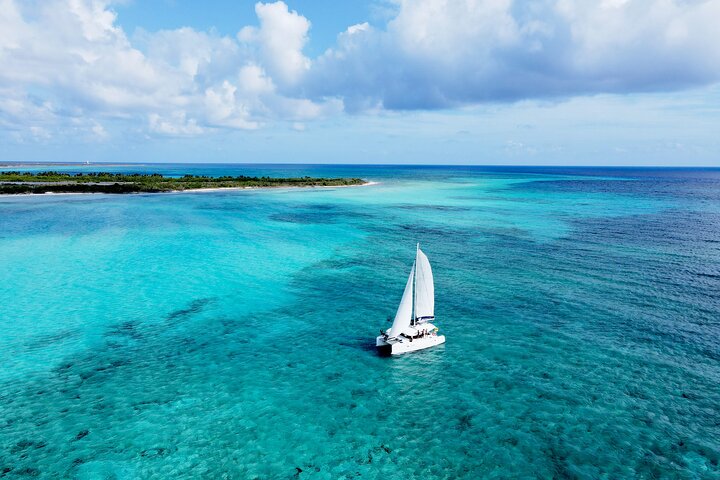
Lagoon 39ft Private Catamaran 5hr - El Cielo Full Experience
5 hours
From AUD 3091.47
The reefs around Isla Mujeres sit in that sweet spot where genuinely spectacular marine encounters meet straightforward logistics — and that combination is rarer than you'd think. Most sites run between 5 and 20 metres, with visibility typically hitting 15 to 25 metres on a good day.
Currents vary considerably; the channel sites between the island and the mainland can push hard, but the sheltered western-side reefs are calm enough for confident beginners.
The whale shark aggregation off Isla Mujeres and nearby Holbox from June through September is the headline act, and it earns the attention — snorkelling alongside 30 or 40 of these animals in a single morning is genuinely disorienting in the best possible way.
Below the surface, the reef structures at sites like El Farito and the Cave of the Sleeping Sharks deliver their own rewards: Caribbean reef sharks patrolling mid-water, nurse sharks tucked into ledge crevices, hawksbill turtles, and dense schools of grunts and snapper.
Coral health is mixed — bleaching events have taken a toll on some shallower sections, and anchor damage is visible near busier sites — but deeper structures remain in reasonable condition and recovery is patchy but present.
Day-boat operations dominate here; there are no liveaboards based out of Isla Mujeres itself, though some Cancún operators run overnight trips further afield. The island has a handful of small, competent dive shops offering two-tank morning dives, PADI courses, and whale shark snorkel tours. Ferries from Cancún run frequently, making a day trip entirely feasible, though staying on the island gets you earlier water entry and far fewer crowds.
**Best months:** June to September for whale sharks; November to April for clearer reef diving. Open-water certification is sufficient for most sites; beginners are well catered for.
When Priya from our BugBitten team stepped off the dive boat at half past six in the morning, the sky above the Yucatán Peninsula was still doing that bruised-orange thing it does before the sun fully commits. The water was flat. The captain had the engine idling in neutral while the crew kitted everyone out in snorkel vests and masks, and nobody was talking much — not because the mood was tense, but because the briefing had just finished and the spotter plane had radioed in a contact about four kilometres north-east. There were whale sharks up there. Possibly thirty of them.
What followed was one of those mornings that resists neat description. Not because it was transcendent in some vague, unearned sense, but because the scale of the thing — a seven-metre fish passing two metres beneath you at a leisurely pace that still somehow covers ground faster than you can swim — simply does not fit comfortably inside a sentence. Priya came back to the island dock at eleven, ate a taco, and sat very quietly for a while.
That is the particular quality of the reefs and waters around Isla Mujeres: they deliver experiences that require a bit of processing time afterwards.
Isla Mujeres sits roughly thirteen kilometres north of Cancún, and the reef systems surrounding it benefit from being at the northern tip of the Mesoamerican Barrier Reef — the second-largest coral reef system on the planet. That geography matters. The nutrient upwellings that pulse through the channel between the island and the mainland bring in pelagic action that genuinely surprises people who've only dived the more famous sites further south.
The reef structures themselves range from broad shallow terraces on the western, sheltered side to steeper drop-offs and channel walls on the eastern and northern flanks. Sites like El Farito — a small lighthouse shoal on the south-eastern tip — consistently deliver dense fish aggregations: schools of French grunt stacked so thick you can barely see through them, hawksbill turtles grazing on the coral heads, and Caribbean reef sharks doing slow mid-water circuits that feel deliberate and unhurried. The Cave of the Sleeping Sharks, made famous in the 1970s by underwater filmmaker Ramon Bravo, sits in a channel system on the north-eastern edge of the island. Nurse sharks rest in the ledge crevices in a state that looks profoundly restful, though researchers have debated for decades exactly why this site attracts so many of them — the slightly brackish, oxygenated water flowing through the cave system appears to be part of the answer.
None of this requires advanced certification. Most sites sit between five and twenty metres, and the more sheltered western reefs are genuinely gentle — calm, clear, and manageable for someone who completed their open-water course six months ago and has logged maybe a dozen dives since. The channel dives on the eastern side are a different proposition and can push hard when the current is running, but operators are generally honest about conditions and won't put beginners in over their heads.
Isla Mujeres is small enough that you can walk the length of it in under an hour, and the island's pace reflects that. The northern tip, around the town centre and ferry dock, is busier — restaurants, golf carts for hire, beach bars — but it never tips into the kind of relentless tourist churn you get in parts of central Cancún. The southern end, near Punta Sur and the cliff gardens, is quieter still, with that dry scrubby vegetation you get on the windward side of Caribbean islands.
The dive and snorkel operations are clustered near the main ferry dock and along the northern beach strip. They range from one-person outfits with an old panga and impeccable local knowledge to slightly larger shops with newer boats and formal PADI course structures. Both types have their place. For whale shark tours specifically, bigger boats mean more passengers, which can crowd the water during the in-water rotations; smaller operators with a hard cap on group size are worth seeking out even if they cost a little more.
Staying on the island rather than day-tripping from Cancún changes the experience measurably. Day-trippers arrive on the eight and nine o'clock ferries, and by mid-morning the main beach is noticeably busier. Guests staying on the island can be on the boat before the first ferry docks, which matters for whale shark tours especially — the aggregations are most active in the early hours, and the tour groups that get out first get the animals to themselves, or close to it.
Between June and September, a large aggregation of whale sharks gathers in the warm surface waters north-east of Isla Mujeres to feed on fish spawn. The aggregation has numbered in the hundreds on peak days, though thirty to fifty animals in a given area during your tour is a more typical encounter. You enter the water in small groups — regulations limit in-water numbers near each shark — and snorkel alongside them as they feed. It is not diving. It is snorkelling, often in choppy open water, and you need to be a competent swimmer even if you're not a certified diver.
The regulations governing these tours are worth understanding before you book. Mexican environmental authorities (CONANP) set rules around minimum distances, no-touch policies, and group size limits. Reputable operators follow them. If a captain suggests bending the rules to get a closer look, that's a signal to use a different operator next time.
El Farito is the site most operators visit first because of its consistent fish life and reliable conditions. Two-tank morning dives are the standard structure, often pairing El Farito with a second site based on conditions — sometimes a shallower garden site, sometimes one of the channel walls if the current is manageable. Caribbean reef sharks appear regularly at El Farito and at several of the channel sites; they're not a guarantee on any given dive, but they're common enough that you shouldn't be surprised to surface having seen two or three.
Hawksbill turtles are genuinely frequent. The island sits within a marine protected zone, and the turtle population reflects that protection — you'll see them grazing calmly on coral and resting on sandy patches, largely indifferent to divers who maintain reasonable distance. For those interested in turtle ecology elsewhere in the region, Akumal Bay to the south offers a different but equally rewarding encounter with green turtles in shallower water.
If whale shark season has passed or you're not keen on open-ocean snorkelling, the western-side reefs are accessible by swimming from shore at a couple of spots, or by short panga ride. The coral health here is patchy — more on that below — but the fish life is genuinely good, and for non-divers wanting a Caribbean reef experience without committing to a course, these sites deliver.
June to September is whale shark season, and if that's your primary goal, this is when you come. The trade-off is that this overlaps with the Caribbean rainy season. Afternoons can be heavy with cloud and brief downpours, humidity is high, and the occasional tropical storm system will shut down boat operations for a day or two. Water temperatures are warm — around 28 to 30 degrees — and visibility at reef sites can dip during periods of heavy rainfall and runoff.
November through April is widely considered the best window for pure reef diving. Visibility stretches to 25 metres on good days. The northeast trade winds keep temperatures pleasant, the crowds are thinner outside of Christmas and Easter, and the marine life is no less interesting — in fact, cooler-season diving often produces better encounters with the resident reef shark population.
April and May are a shoulder period worth considering: water visibility is often excellent, whale sharks haven't arrived yet, and prices haven't peaked. Easter week (Semana Santa) is a firm exception — the island fills up, boats fill up, and you should book everything weeks in advance or avoid the dates entirely.
The Mexican tourism authority's Visit Mexico site carries regional travel advisories and event calendars that are worth checking before you finalise dates.
The ferry from Puerto Juárez, just north of Cancún's hotel zone, runs frequently — roughly every thirty minutes during daylight hours — and takes about fifteen minutes. The crossing costs around 70 pesos each way and is the standard approach for most visitors. Ferries also depart from the main hotel zone pier in Cancún, though these are slower and more expensive. Either way, you're on the island within the hour from most Cancún accommodation.
If you're combining this trip with other reef destinations, the Riviera Maya to the south offers a full menu of options. The northern end of the Mesoamerican Barrier Reef that runs past Isla Mujeres is part of the broader reef system that extends down through Belize and Honduras — sections of which feature on the UNESCO World Heritage List due to their ecological significance. That context is worth holding in mind when you're in the water.
For more places in Isla Mujeres, BugBitten has a growing collection of spots across the island worth exploring between water sessions — from the cliff garden at Punta Sur to the quieter beach stretches on the western side.
On the island itself, a golf cart hire is the easiest way to move around once you've arrived. The main strip is walkable, but the distance between the northern town and southern tip is more comfortably covered on wheels, especially in the midday heat.
Coral bleaching has hit the shallower sections of the reef hard over repeated thermal events, and it shows. Some of the sites that looked spectacular in photographs from ten years ago now have noticeably reduced live coral cover in the upper five metres. The deeper structures are in better shape, and there is patchy but real recovery occurring in some areas, but anyone expecting pristine untouched reef throughout will be disappointed. This is the reality of Caribbean reef diving post-2015, and Isla Mujeres is not an exception.
Whale shark tours can feel crowded if you book with a large operator. The regulations require rotation systems to limit in-water numbers around each animal, but on busy days in peak season there can be several boats clustered in the same area, and the experience loses something when you're treading water waiting for your turn while another group finishes their rotation. Booking with smaller, reputable operators and going out mid-week rather than on weekends mitigates this considerably.
Seasickness on whale shark tours is a legitimate issue. These trips go into open ocean in a panga, and if the weather is producing any swell — which it often does in summer — the ride out can be rough. Take medication if you're susceptible, eat lightly beforehand, and sit near the bow.
Finally, the island itself is not cheap by Mexican standards. Accommodation, restaurants, and dive packages are all priced for the international tourist market. You can find value, but don't come expecting budget backpacker prices.
Isla Mujeres works because the logistics are simple and the payoff is large. You don't need to charter a liveaboard, plan months in advance, or hold an advanced certification to have a genuinely remarkable experience in the water here. The whale shark aggregation is one of the most extraordinary wildlife encounters available anywhere on the planet, and the resident reef life — the sharks, the turtles, the absurd density of fish at sites like El Farito — provides plenty of substance even outside whale shark season.
Come with reasonable expectations about coral condition, book with operators who take the regulations seriously, and try to stay on the island rather than day-tripping. Get on the water early. Bring motion sickness tablets if you're prone. And after your whale shark morning, follow Priya's example: find a decent taco, sit somewhere quiet, and let the scale of what you just saw settle in properly.

