Hidden Beyoğlu Tour
4 hours – 5 hours
From AUD 203.76
The coastal stretch of the Lycian Way between Fethiye and Antalya is one of those routes that earns every view. Most riders cover the 300 kilometres in seven to ten days, which gives you time to actually stop rather than simply survive.
The terrain is relentless in places — expect cumulative elevation gain well north of 4,000 metres as the road climbs repeatedly from sea level into cedar-forested ridges before dropping back to the coast. The climbs around Kaş and the switchbacks above Olympos are genuinely demanding, so be honest with yourself before committing to the harder sections.
The surface is mixed, and that word is doing real work here. Stretches of smooth tarmac alternate with broken asphalt, gravel farm tracks, and rough cobbles through ancient sites. You are sharing the road with trucks and tourist minibuses on the busier coastal sections, particularly the D400 between Kaş and Demre, so a rear light in daylight is not optional.
Quieter inland detours around Patara and Xanthos reward the extra effort with far less traffic and genuinely extraordinary ruins sitting in empty fields.
Accommodation is easier than you might expect. Pensions and small guesthouses line the route in Ölüdeniz, Kaş, Kalkan, and Çıralı, and most owners are accustomed to cyclists needing a secure corner for the bike. Bike hire is available in Fethiye and Antalya but quality varies considerably, so if you are renting, inspect the tyres and brakes properly before leaving the shop.
Riding west to east — Fethiye toward Antalya — keeps the prevailing wind largely at your back through spring.
April to early June and September to October are the sensible windows; summer heat above 40°C on exposed coastal climbs is genuinely dangerous.
When Priya from our BugBitten team rolled out of Fethiye on a loaded touring bike just after dawn, the waterfront was still empty. The fishing boats hadn't moved, the tea houses were pulling their shutters up, and the road heading south-east was hers alone for about twenty minutes before the first minibus blew past close enough to rearrange her hair. That pretty much set the tone for everything that followed: moments of extraordinary quiet earned between bouts of genuine grit. By day three, climbing above Kalkan with the Gulf of Antalya spread below her and cedar trees pressing in from both sides, she decided the suffering had been worth it. By day seven, coasting into Çıralı with a creaking knee and a very bad sun tan on her left arm only, she was already talking about riding it again from the other direction.
That's what the coastal Lycian Way does. It does not coddle you. It offers something more valuable — a route that treats you like an adult, throws the full weight of the Turkish coast at you, and lets you work out what you're made of somewhere between Kaş and Olympos.
Three hundred kilometres of cycling along the Antalya coast sounds like a number until you understand what those kilometres actually contain. You're pedalling through some of the most archaeologically dense coastline in the Mediterranean, where Lycian rock tombs are carved into cliff faces above the road, where ancient cities sit in open fields with almost no fencing and sometimes no other visitors. The landscape shifts repeatedly — turquoise bays visible from clifftop switchbacks, pine forest that smells almost medicinal in the morning heat, orange and lemon orchards beside village roads that Google Maps doesn't know exist.
The cumulative elevation gain across the full route sits well above 4,000 metres, which is not a figure to skim past lightly. This is proper climbing, not rolling hills. The ascents above Kaş, in particular, come at you in long grinding ramps rather than short sharp punches, which means your legs feel fine for the first twenty minutes and thoroughly misused by the fortieth. The descent into Kaş itself is one of those moments where you earn back every metre of height with interest, the town appearing below you like a reward — white houses stacked on terraces, the Greek island of Meis sitting just offshore.
What distinguishes this from simply "a hard ride through pretty scenery" is the layering. You are crossing Lycia, a region that functioned as a distinct civilisation with its own language, democratic federation, and architectural traditions for centuries before Rome absorbed it. The ruins are not side trips from the cycling — they are built into the route itself. Patara, which sits inland from the coast near Kalkan, was the capital of the Lycian League and contains one of the longest natural sand beaches in Turkey alongside a theatre, a triumphal arch, and a lighthouse that once rivalled Alexandria's. You can push your bike through it at dusk when the tour groups have gone and have the entire site to yourself.
The Antalya coast in shoulder season operates on its own rhythm, one that hasn't fully synced with mass tourism yet. The big resorts around Antalya city and Ölüdeniz are exceptions — those pockets run on a different, louder frequency — but the stretches between, especially once you push past Kalkan heading east, feel genuinely provincial. Villages where the main square has four chairs and a man with a backgammon board. Roadside stalls where the person selling you tomatoes doesn't particularly care whether you buy them or not.
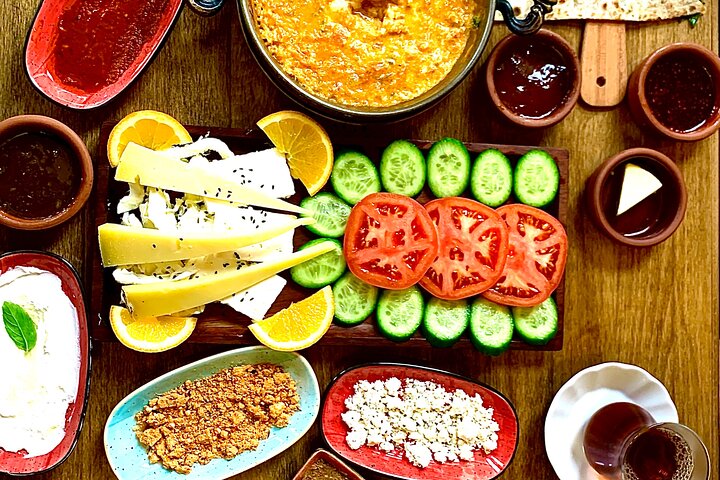
Pension culture on this coast is excellent for cyclists. Owners in Kaş, Çıralı, Kalkan, and Olympos have been watching laden touring bikes roll in for years, and the drill is familiar. Someone will gesture toward a shed or courtyard for the bike without being asked. Breakfast will be enormous — olives, white cheese, eggs, honey, bread that didn't come from a factory — and usually included in the room price. The price of the room will feel startlingly fair by Western European standards, even in peak shoulder season.
The food in general deserves a proper mention because cyclists are basically professional eaters and the Turkish coast is very good at carbohydrates. Pide (the boat-shaped flatbread topped with cheese or minced meat), lahmacun, köfte, fresh-caught sea bream with olive oil and lemon — these are not fancy restaurant discoveries, they are what appears at ordinary lokanta restaurants along the road for very ordinary prices. The meze spread at a decent coastal fish restaurant, particularly in Kaş, competes with anything you'd find at twice the price in Greece.
For a sense of the broader region and its cultural weight, the Go Türkiye (official) site provides useful orientation on Lycian heritage sites, regional festivals, and practical entry requirements that are worth reviewing before you commit to a departure date.
The spine of the trip is the cycling itself, and the decisions you make about which road to take on any given day shape the experience considerably. The D400 highway is the default route in places and it is genuinely unpleasant in sections — heavy trucks, fast minibuses, narrow shoulders. Wherever you can take the inland alternative, take it. The detour around Patara and through the Xanthos Valley adds a handful of kilometres and subtracts most of the traffic, replacing it with fertile flatlands, storks nesting on telegraph poles, and the ruins of Xanthos itself — a UNESCO World Heritage site with extraordinary rock tombs and a theatre that you can read more about on the UNESCO World Heritage List alongside other Lycian sites that fall under the same designation.
The section between Kaş and Demre is the section to treat with the most respect. It combines serious climbing with traffic density on a road that was not designed with cyclists in mind. A rear light running in daylight is basic sense here, not caution theatre. A bright orange or red jacket helps. Leaving early in the morning reduces the traffic meaningfully — by the time the tour minibuses are moving in numbers, you want to already be halfway up the next hill.
Çıralı is one of the few places along this coast that earns genuine affection without trying particularly hard. It sits at the base of a long valley, backs onto a beach where Caretta caretta sea turtles nest, and has a flat, car-free access road that makes it feel genuinely peaceful after days of highway riding. The eternal flame at Chimaera — a hillside vent that has been burning from underground methane since antiquity, mentioned in the Iliad — is a thirty-minute walk from the village and is best visited at dusk when the flames become visible against the darkening sky. It is strange and ancient and completely worth the detour.
This is not incidental advice. The water on the Antalya coast is exceptionally clear, the colour genuinely is that improbable shade of blue-green you see in photographs, and on a loaded touring bike in 30-degree heat, a roadside cove is not a luxury. It is physiologically necessary. There are pull-offs with direct beach access at multiple points between Ölüdeniz and Olympos. Use them.
April through to early June is the ideal window for most riders. The wildflowers are out along the hillside sections, the temperatures are manageable (high teens to mid-twenties at sea level), the tourist infrastructure is open but not crushed, and the prevailing winds from the west make a Fethiye-to-Antalya direction significantly more pleasant than the reverse. The roads dry out quickly after any late-spring rain, and the light is extraordinary in the golden hours.
September and October work almost as well for autumn riders. The sea temperature has had all summer to warm up, the summer crowds drop sharply after the first week of September, and the conditions are comparable to spring. The risk in October is occasional rain — not typically prolonged, but the mountain descents become genuinely sketchy on wet roads with a loaded bike, so check forecasts carefully.
July and August: do not. The temperature on exposed coastal climbs regularly exceeds 40°C. This is not challenging, it is dangerous. Heat exhaustion at the top of a switchback above Kaş with no shade and limited water is not a story that ends well. If July and August are your only windows, consider a different route or a different region.
Fethiye is the natural starting point for a west-to-east ride and is accessible by bus from İstanbul (long) or by flight into Dalaman Airport, which sits about an hour's drive from the town centre. Transfers from Dalaman are easy and cheap by Turkish standards, and local guesthouses are generally happy to arrange pickup if you're arriving with a bike box.
Antalya city, at the eastern end, has its own international airport with good connections from European cities, which makes it a practical finishing point — fly in somewhere smaller, ride to Antalya, fly home. The city itself is worth a day at each end of the trip. The old quarter (Kaleiçi) is compact, genuinely lovely, and gives you Roman-era city walls to walk along while your legs recover.
Bike hire is available in both Fethiye and Antalya. Quality varies substantially between operators, so inspect any rental bike with the same seriousness you'd apply to hiring a car: tyres for wear and pressure, brakes for response, gears for indexing, and the fit of the saddle height before you leave the car park. Bringing your own bike is a better option if you're a serious rider — most airlines carry boxed bikes as oversized luggage for a manageable fee.
The route connects the Antalya coast to a broader Turkish itinerary. BugBitten covers a range of more places in Antalya coast if you want to extend your trip before or after the cycling. Further afield, the cultural pull of Istanbul is obvious, and the Hagia Sophia Grand Mosque in Istanbul represents one of the most significant architectural sites on earth if you're building a longer Turkey trip around the ride. For something completely different in western Turkey, the surreal thermal pools at Pamukkale are accessible from the inland road and combine well with a visit to the Cotton Castle Textile Outlet Centre if you need a shopping stop mid-journey.
Let's be direct about the problems, because they are real and they matter for trip planning.
The D400 sections are genuinely grim. Turkish drivers are not hostile to cyclists in intent, but the standard of driving on the highway sections — overtaking with minimal clearance, trucks that seem unaware of their own width — requires constant attention. You cannot zone out on the D400. You are always managing your position in relation to the next vehicle. It is tiring in a way that has nothing to do with physical effort.
The surface quality is inconsistent in ways that a description of "mixed" does not fully capture. You can be rolling on smooth tarmac and hit a stretch of broken asphalt that vibrates your handlebar bag open, then transition to cobblestones through an old village that would be charming if you weren't carrying 15 kilos of gear. A gravel-capable tyre with decent volume — 35mm minimum, 40mm preferred — handles the variation much better than a road-specific tyre. Puncture frequency goes up sharply on bikes with narrower tyres.
Water availability is less reliable than it looks on maps. In spring especially, some of the inland sections pass through villages with nothing open. Carry at least two litres of capacity and fill every time you see a tap or a shop, even if your current bottles are still half full.
The heat. Even in shoulder season, the exposed south-facing climbs get serious by 11am. Starting before 7am, resting through the midday hours, and riding again in the late afternoon is a much smarter approach than powering through. Turkish culture naturally accommodates a long lunch rest, and you should too.
The coastal Lycian Way by bike is not aspirational riding in the sense of requiring elite fitness or specialist gear. It requires honest fitness, decent preparation, the right tyres, and the willingness to look a long climb in the face and start pedalling without overthinking it. What it gives back is proportional to that investment in a way that very few routes manage.
You will finish days exhausted in ways that are hard to explain to people who weren't there. You will also pull over at an unmarked viewpoint somewhere between Kalkan and Kaş, look back along a coastline that drops in tiers of limestone and cedar to the most improbable blue water you've ever seen, and understand exactly why Priya was already planning the return trip before she'd even cleaned her chain.
It's a hard ride. It's worth it. Pack properly, ride early, swim often, and eat everything.