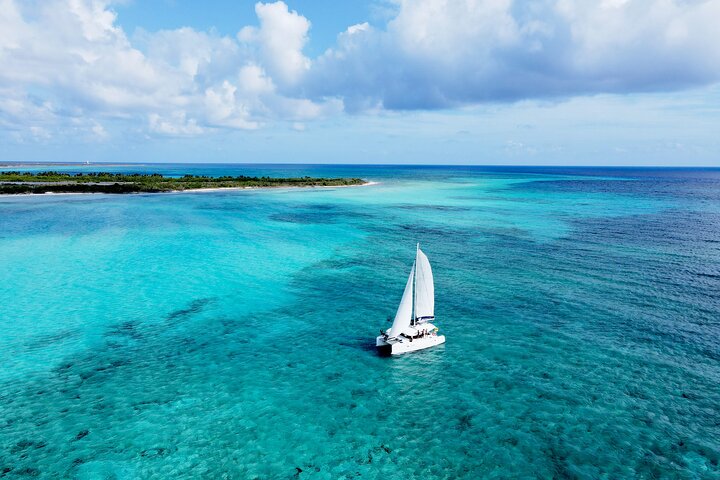
Lagoon 39ft Private Catamaran 5hr - El Cielo Full Experience
5 hours
From AUD 3091.47
The Socorro Islands sit roughly 400 kilometres south of Cabo San Lucas, and getting there means committing to a liveaboard — there are no day-boat options, no resort infrastructure, and that remoteness is precisely the point. Most operators depart from San José del Cabo or Cabo San Lucas, with crossings taking around 18 to 24 hours of open Pacific.
Budget 7 to 11 nights aboard, and choose your vessel carefully; a handful of reputable Mexican operators run these routes, with spaces filling months in advance for the November–May season.
The diving itself is pelagic in character. Depths range from around 15 metres on the shallower seamount shoulders down to 40-plus where the walls drop away, and visibility typically runs 20 to 35 metres in calm conditions, though swells and surge can hit hard on exposed sites. Currents vary from negligible to genuinely demanding depending on the site and tidal phase, so solid buoyancy control and drift experience matter here.
San Benedicto's Boiler is the signature site — a submerged volcanic cone where oceanic manta rays approach divers with remarkable curiosity, sometimes hovering close enough that you have to resist reaching out.
Beyond the mantas, you can reasonably expect silky and Galapagos sharks, schooling hammerheads at depth, bottlenose dolphins that often join divers mid-water, and humpback whale encounters during the winter months. The reef structure itself is volcanic basalt rather than classic coral garden, and while some encrusting coral exists, the draw here is unambiguously the open-water megafauna.
Conservation context: the archipelago is a UNESCO World Heritage Site and a federally protected biosphere reserve, which has meaningfully helped sustain these animal populations.
Advanced certification minimum is strongly recommended; this destination is not suited to newly qualified open-water divers.
When Tara from our BugBitten team first spotted the Socorro Islands marked on a liveaboard itinerary, she almost dismissed it. Four hundred kilometres of open Pacific between her and the nearest proper shore? No resort bar to decompress at after a dive? Eighteen hours of ocean crossing before you even get wet? She booked it anyway, mostly because a dive instructor she trusted had said, quietly and without any particular drama, "It's the best diving I've ever done." That's the kind of recommendation that sits with you.
Tara's vessel left San José del Cabo just after sunset on a November evening, slipping past the marina lights and into a darkness that stayed solid until the following afternoon when the silhouette of San Benedicto Island finally broke the horizon. By that point, most of the fourteen passengers had already made peace with the motion — or hadn't, which told them something useful about the next ten days. But when the briefing room filled with reports from the crew about three oceanic manta rays seen circling The Boiler that morning, the queasy faces sharpened up fast.
What followed was a week that Tara has since described as "difficult to explain to anyone who hasn't done it, and completely unnecessary to explain to anyone who has." That is about as high a commendation as Socorro gets from most people who've been there.
The short answer is megafauna — and plenty of it, reliable enough across the November to May season that experienced divers plan their year around this window. But that framing somewhat undersells what Socorro actually delivers, because the encounters here aren't just a question of numbers. The character of the interactions is what separates this archipelago from most other big-animal diving destinations.
Oceanic manta rays at Socorro are behaviourally unusual. Marine biologists have noted for decades that the population at San Benedicto and Socorro Island itself displays a degree of curiosity towards divers that isn't replicated in many other places. These aren't animals that sweep past while you cling to a rock hoping for a good frame — they approach, circle, and sometimes hover almost stationary in the water column directly above a diver, apparently investigating. The working theory is that they associate divers with cleaning behaviour and have, over generations, learned that humans are not a threat. Whether or not that full explanation is correct, the result is that you may spend an entire forty-five minute dive with the same manta making pass after pass, close enough to see the intricate patterning on its ventral surface, close enough to need to back-kick to keep a respectful distance.
Then there are the humpback whales. Between December and March, humpbacks move through these waters to calve and mate, and while an actual dive encounter with a whale is never guaranteed, the chances at Socorro are meaningfully higher than almost anywhere in Mexican Pacific waters. Hearing whale song through your tank while you're twenty metres down on a basalt wall is an experience that resets your sense of what diving can be.
The Revillagigedo Archipelago — pronounced, approximately, reh-vee-yah-heh-HEE-doh, though most English-speaking divers just say "the Socorros" and leave it at that — comprises four volcanic islands: Socorro, San Benedicto, Roca Partida, and Clarión. You won't visit Clarión; it hosts a Mexican naval station and is off-limits to civilians. The other three are your itinerary.
The landscape, from the boat, is stripped back and dramatic. San Benedicto is a cone-shaped island of bare dark rock that last erupted in 1952, its slopes scraped clean of most vegetation. Socorro itself is larger and greener, home to a small Mexican navy detachment. Roca Partida is the one that stops conversations — a narrow column of rock jutting about thirty metres above the surface, with virtually nothing above water and an enormous, wildlife-dense wall plunging away beneath. Frigatebirds and boobies nest on the rock face above, and you can hear them from the water between dives.
There is no infrastructure here in any civilian sense. No dock, no café, no phone signal, no internet worth speaking of. Your world contracts to the boat, the water, the other passengers, and whatever appears below the surface. Most divers report this as a feature rather than a bug — after two days you stop reaching for your phone and start paying attention to the briefings instead.
The seabed itself is volcanic basalt, not the bleached sand and coral gardens of somewhere like Akumal Bay on the Caribbean coast. Encrusting coral exists in patches — sea fans, some wire coral, hydroids — but this is not a reef dive in any conventional sense. The hard architecture is just something to hover above while you watch what's moving in the blue water around you.
You will dive four to five times per day on a well-run liveaboard, including night dives where schedules and conditions allow. The main sites each have distinct characters.
The Boiler at San Benedicto is the signature dive and deservedly so. It's a submerged volcanic cone whose summit sits at around ten metres, surrounded by open water on all sides, and the manta rays use the surrounding upwellings as a kind of cleaning and looping ground. You descend, find a stable position on the rock without touching the substrate, and wait. Usually you don't wait long. Visibility permitting, you may also encounter silky sharks and schooling hammerheads at depth as you drift along the seamount shoulders.
Roca Partida is a different experience entirely — a vertical wall dive with strong currents at certain tidal phases, where Galapagos sharks patrol in numbers and schooling fish gather in dense columns around the rock. The current here can be demanding, and drift experience genuinely matters. This is not a dive to attempt if you're not comfortable with moving water.
Socorro Island's Canyon and nearby sites offer intermediate difficulty and excellent shark diversity, including whitetips and the occasional lone hammerhead working close to the wall.
Between dives there's reasonable whale-watching from the boat deck during humpback season — the crew will usually call out sightings over the speaker system — and seabird observation is worthwhile if you're that way inclined. Frigatebirds, masked boobies, and red-footed boobies are common. Some operators schedule a brief, regulated shore visit to Socorro Island (permission-dependent), though the emphasis is firmly on the water.
The dive season runs from November through May. This timing aligns with humpback whale presence (peak December to March), calmer sea states relative to the summer months, and the best overall visibility windows. Water temperature ranges roughly from 22°C in November to 28°C by April and May, so a 5mm wetsuit is comfortable for most of the season, with a 7mm or drysuit layer an option for the earlier months if you run cold.
The crossing from Cabo can be rough regardless of season — this is open Pacific, not a sheltered bay — but the summer and early autumn months bring heavier swells, storm risk, and reduced visibility below, which is why reputable operators don't run Socorro trips outside the November-May window.
Book early. Spaces on quality vessels fill four to six months in advance. Liveaboards with strong safety records and experienced naturalist guides tend to go first — checking aggregator sites and the Visit Mexico official tourism resources can help you identify licensed, registered operators.
The gateway is Los Cabos — specifically San José del Cabo or Cabo San Lucas, served by direct international flights from major Australian hubs via the United States. Fly into Los Cabos International Airport (SJD), spend a night or two adjusting to the time zone, and join your vessel at the marina.
If you're building a broader Mexico diving trip, the country rewards planning. The Baja Pacific coast, the Sea of Cortez, and the Caribbean coast around Cancún all offer decent diving at more accessible price points — useful for building confidence before committing to Socorro's more demanding sites. BugBitten maintains a growing guide to Tours in Mexico if you want to compare options or add on a pre- or post-liveaboard land itinerary.
Let's be direct about the challenges, because they are real.
The crossing is brutal for some people. Eighteen to twenty-four hours of Pacific swell on a vessel that, however well-appointed, is still a fairly small boat in a big ocean. Seasickness medication is not optional — it's tactical. Talk to your doctor before you go, bring patches and tablets, and eat carefully on the crossing day.
The cost is significant. A quality Socorro liveaboard runs anywhere from AU$3,500 to AU$6,000+ for a 7–11 night trip, before flights. This is not a budget destination.
The certification requirement is real, not just marketing caution. Advanced open water as a minimum, and dive operators will ask about your logged dives. If you have fewer than fifty logged dives with genuine open-water experience, you will likely struggle at sites like Roca Partida and may limit your depth options at The Boiler. Do the dives elsewhere first — the Socorros will still be there.
Limited communication. No reliable internet or phone signal for the duration. If this is a professional or personal problem for you, factor it in carefully.
Weather windows can close. Swells and surge can make certain sites undiveable on any given day, and itineraries flex around conditions. You may not dive every site you hoped for. This is the ocean; it doesn't run to a schedule.
The UNESCO World Heritage designation that covers the archipelago means strict conservation rules apply: no touching marine life, no collecting, no anchoring on the reef. Operators who work these waters professionally take this seriously, and so should you.
Socorro isn't trying to impress anyone. There's no marketing, no infrastructure, no beach bar waiting when you surface. What it offers instead is a direct encounter with marine life on a scale and at a proximity that most divers don't encounter anywhere else on the planet — and a level of physical isolation that either refreshes you completely or teaches you something useful about yourself.
Tara came back quieter than she left. Not subdued, but recalibrated. She spent a lot of time on the return crossing just watching the water. When she finally got signal and a coffee back in San José del Cabo, she started looking at liveaboard availability for the following November.
That's pretty much the Socorro effect, and the BugBitten team has heard the same story from nearly everyone who makes the trip. Plan carefully, go prepared, and take it seriously. If you do, this stretch of Pacific will return the favour.

