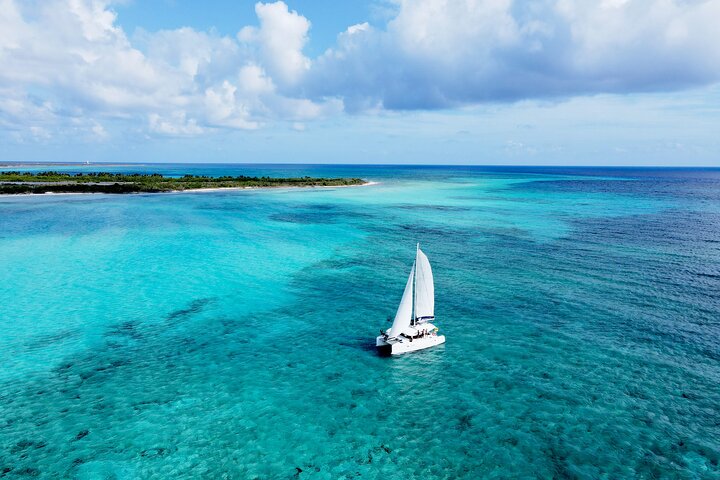
Lagoon 39ft Private Catamaran 5hr - El Cielo Full Experience
5 hours
From AUD 3091.47
The southern tip of the Baja Peninsula sits at one of the Pacific's great geographical pivot points, where the Sea of Cortez pours into open ocean and the land ends in an arch of eroded granite that has become something of a sailor's landmark.
It is dramatic from the water and best appreciated on a morning day sail before the swell builds and the afternoon wind picks up from the northwest.
October through May brings reliable northwest Pacific swells wrapping the cape, while the Cortez side stays comparatively sheltered — you learn quickly to favour Los Frailes or Bahía de la Paz for overnight anchorages rather than pushing your luck off the exposed Pacific beaches.
Wind conditions are generally manageable for confident beginners between November and April, with light northwesterlies typical inside the Sea of Cortez and stronger afternoon gusts funnelling through gap passages. December through March is humpback and grey whale season, and you will likely drift alongside both if you stay patient and slow.
Mobula rays leap in loose schools almost any month; sea lions haul out on the rocks near the arch and are entirely unbothered by your inflatable.
Charter bases cluster around the Cabo San Lucas marina and, better still, La Paz — roughly three hours north by road — which gives you cleaner access to the Cortez islands. Provisioning from La Paz supermarkets is solid; fuel and ice are readily available. Bareboat operators expect valid sailing CVs, and Mexican customs paperwork for a foreign-flagged vessel requires a zarpe clearance document for each port, which catches people out.
Avoid July through September entirely — hurricane season is active, humidity punishing, and the fishing crowd thins for good reason.
When Priya from our BugBitten team stepped aboard a 38-foot sloop in the Cabo San Lucas marina at half six in the morning, the sky was still that particular shade of washed-out indigo that belongs only to the Pacific in November. The skipper — a sun-cured bloke from Sonora who had been running day sails out of the marina for fifteen years — handed her a thermos of black coffee and pointed south-east without a word. He didn't need to explain. The reason you get up before sunrise in Cabo is to reach the Arch before the tourist pangas descend and the afternoon chop turns the water into a washing machine.
The Arch of Cabo San Lucas, that eroded granite formation standing sentinel where the Sea of Cortez meets the open Pacific, is the kind of geographical feature that looks like it was placed there deliberately — a punctuation mark at the end of a very long peninsula. By seven in the morning, with the swell still modest and the light going gold-orange off the rock face, Priya counted four sea lions sunning themselves on the lower ledge without so much as opening an eye as the boat drifted past at about two knots. Twenty minutes later, a school of mobula rays broke the surface in a loose, leaping scatter off the port bow. No announcement, no performance — just the ocean doing what it does down here between October and May.
This piece covers what it actually takes to charter or join a day sail in and around Cabo San Lucas and the wider southern Baja coast: what the conditions are really like, where to base yourself, what you'll see, and what nobody tells you before you book.
The southern tip of the Baja Peninsula is not a complicated pitch. You have a world-recognised geological landmark — the Arch — sitting at a point where two bodies of water with very different characters collide. On the Pacific side, open-ocean swells roll in from the north-west, building as the season progresses and keeping that coast rough enough to be interesting without being stupid. On the Cortez side, the water is generally calmer, warmer, and astonishingly clear; on a good day you can see the bottom in twelve metres of water and count the fish.
What makes this more than just a pretty postcard is the wildlife calendar, which runs almost without interruption through the charter season. From December through March, humpback and grey whales move through these waters in numbers that would make a marine biologist embarrassingly excited. Humpbacks breach dramatically — they're showing off and they know it. Grey whales are quieter, surfacing in a low, rolling exhale that you feel more than see from the deck. If you're patient, anchored in light northerlies off the Cortez side of the cape, you will drift alongside at least one whale on a multi-day trip; it is simply a matter of time.
Mobula rays are the constant companion across most months, leaping in loose formations that don't follow any obvious rhythm. Sea lions are practically domesticated around the Arch rocks — they'll swim up to investigate your hull with the confident energy of an animal that has decided it owns the ocean and is merely allowing you to use it briefly.
For those who want to extend their Baja sailing into a broader Mexico adventure, more places in Pacific Mexico covers the wider region across many categories beyond just water activities.
Cabo San Lucas has a split personality that you need to understand before you arrive. The strip — Medano Beach, the marina promenade, the cluster of open-air bars — is a full-volume resort town that could genuinely be anywhere. It is loud, it smells of sunscreen and fried fish, and the marina boardwalk on a Friday night in January looks like a travel poster for places that have given up trying to be subtle. None of that is a criticism exactly; it is what it is, and it serves a purpose.
But you get fifty metres offshore and it disappears. The moment the marina breakwater is behind you, the town recedes remarkably fast. The coastline south of Cabo is almost entirely undeveloped — brown volcanic rock, cacti, the occasional osprey nest on a headland. The water goes from the murky green of the marina to proper blue-green within minutes of clearing the entrance. This transition — from resort bustle to something genuinely wild — happens faster here than almost anywhere else on the Pacific coast of Mexico.
La Paz, three hours north by road up the Baja Highway, has a completely different feel. It's a working city with a proper malecón, decent restaurants serving Baja-style fish tacos that are not performing for tourists, and a marina that serves as the main charter base for access to the Espíritu Santo archipelago. If Cabo is the flashier option, La Paz is where the sailors actually base themselves for serious passage-making and multi-day island cruising. For context on what the coastline further south along the Mexican Pacific looks like, the Mexico (Riviera Nayarit) section on BugBitten gives a useful point of comparison — different vibe, same Pacific, but lush jungle coast rather than desert.
The most accessible entry point is a crewed day sail departing Cabo San Lucas marina. Charter operators cluster along the main dock; prices are roughly in the USD 80–150 range per person for a half to full day, depending on boat size and whether lunch is included. The better operators use sailboats rather than the motor-assisted pangas that dominate the tourist trade — the difference in experience is significant. Ask specifically for a sailing-focused trip rather than a snorkel-and-booze tour; they exist, and they'll take you out to the Arch, around Land's End, and up into the calmer Cortez waters north of town.
For anyone with a valid sailing CV and some offshore experience, La Paz is the correct base. Bareboat operators here offer 34–50 foot monohulls and some catamarans; most expect evidence of offshore miles, a skipper's licence or recognised certification, and will require you to complete a zarpe clearance document for each port of entry — this is Mexican customs paperwork, and it catches out even experienced sailors who have done Caribbean charters. Budget a full morning for check-in bureaucracy.
The Espíritu Santo archipelago — part of the Islands and Protected Areas of the Gulf of California, which sits on the UNESCO World Heritage List — is the main draw for multi-day passages from La Paz. Anchorages at Los Islotes (the sea lion colony), Ensenada Grande, and Bahía Candelero are easily achievable on a 5–7 day circuit and offer the kind of quiet, clear-water overnight anchoring that makes all the paperwork worth it.
December through March is the window. Grey whales calve in the lagoons of Baja's Pacific coast further north, but humpbacks congregate in the open water off the cape. You don't need to book a dedicated whale-watch trip; simply being on the water between Cabo and Cerralvo Island on a calm morning between December and March is usually sufficient. Ask your charter skipper to work the 50-metre depth contour on the Cortez side — that's where the humpbacks tend to feed.
October through May is the window. Full stop.
Within that window, there are meaningful distinctions. October and May are shoulder months — the weather is good, the crowds thinner, and the marina is less chaotic. The sea temperature is comfortable for swimming in October (around 26°C) and still reasonable in May before it gets genuinely hot.
November through April is the core season. Wind on the Cortez side runs light northwesterly, typically 10–18 knots, which is entirely manageable for confident beginners on a crewed boat and pleasant for experienced sailors. December through March adds the whale factor, which tips the balance heavily in favour of this sub-window for anyone interested in marine wildlife.
June through September: the Gulf of California sits inside an active hurricane corridor. Humidity is extreme, average temperatures push well above 35°C, and the risk of tropical storms is real. Most reputable charter operators haul out or relocate their fleets. The town empties of everyone except die-hard fishing charter clients and locals. There is no sailing-focused reason to be here during these months.
The Copper Canyon Cycling route in northern Mexico is worth considering as a complementary land-based trip if you're building a broader Mexico itinerary around the October shoulder season — the canyon is spectacular in autumn, and the climate is much more forgiving than Baja in summer.
Flights: Los Cabos International Airport (SJD) receives direct international flights from most major Australian hubs via Los Angeles, with total journey times around 18–22 hours including the LAX layover. From the airport to the Cabo San Lucas marina is around 45 minutes by taxi or shared shuttle; agree a fare before you get in.
Road to La Paz: If you're basing yourself in La Paz for charter sailing, the drive north from Cabo on Mexico Federal Highway 1 takes around three hours in reasonable traffic. Car hire at Los Cabos airport is straightforward; the highway is sealed and generally well-maintained, though overnight driving is not recommended due to loose livestock on the road.
Provisioning: La Paz has two large supermarkets within easy reach of the marina — Ley and Walmart. Both are well-stocked for passage provisioning. Cabo San Lucas has similar options but at resort-town prices. Ice and diesel are available at both marinas.
Nearby stops: Beyond the immediate Cabo-La Paz corridor, Todos Santos on the Pacific side of the peninsula is worth a half-day detour — a small town with a functioning art scene and some very good food that hasn't fully tipped into tourist territory yet. East Cape (the stretch between Cabo and La Paz along the Cortez coast) offers several small marinas and anchorages useful for passage breaks. The official tourism overview and entry requirements are covered at Visit Mexico (official), which is also useful for confirming current visa conditions for Australian passport holders.
Let's be honest about a few things.
The Cabo marina is chaotic. Checking in, fuelling, and navigating the panga traffic in the inner harbour requires patience. The tourist boat operators treat the water as a theme park and are not always watching for sailing vessels on restricted manoeuvre. Give yourself more time than you think you need for any departure or arrival.
Zarpe paperwork is a genuine pain. Multi-port itineraries in Mexican waters require customs clearance at each stop, and the process varies unpredictably by port. Some clearances take an hour; others take most of a day. Build buffer into your itinerary and carry photocopies of every document in waterproof bags. This is not optional.
The afternoon wind in the strait passages is not a joke. Wind funnelling through the gap passages between the Baja coast and the Cortez islands can spike to 25–35 knots in the early afternoon between December and February. Day sails that depart late in the morning often bash home into a short, steep chop that is unpleasant even on a well-found boat. The local knowledge — get out early, get back early — is not just preference; it is practical.
Cost. Baja is not cheap for sailing. Bareboat charter rates run higher than equivalent boats in the Caribbean due to import costs for equipment and the relatively small fleet. Day sail operators charge resort-town prices. Budget accordingly and don't try to bargain down the safety-related extras.
Drinking water. Tap water is not safe to drink. Bottled water for cooking and drinking is essential; most charter boats will have a watermaker, but check before you depart.
Baja sailing is not a smooth or effortless experience — there's paperwork, there's heat, there's a marina that operates at maximum volume from about 8am onwards. But the payoff for getting offshore before the pangas launch and the afternoon breeze builds is some of the most rewarding day-sailing in the Pacific. The combination of geological drama, wildlife density, and genuinely pristine anchorages on the Cortez islands is difficult to match anywhere else in this part of the world.
If you're building a longer Mexico trip, treat Cabo as the southern anchor and work your way north with intent — La Paz for sailing, the East Cape for quiet, and the peninsula's Pacific side for scenery that looks like it belongs in a nature documentary. October and November are the sweet spot months: water still warm from summer, crowds manageable, whales just beginning to arrive. If you can arrange a bareboat charter out of La Paz for that window, take it. The zarpe is worth the fuss.


