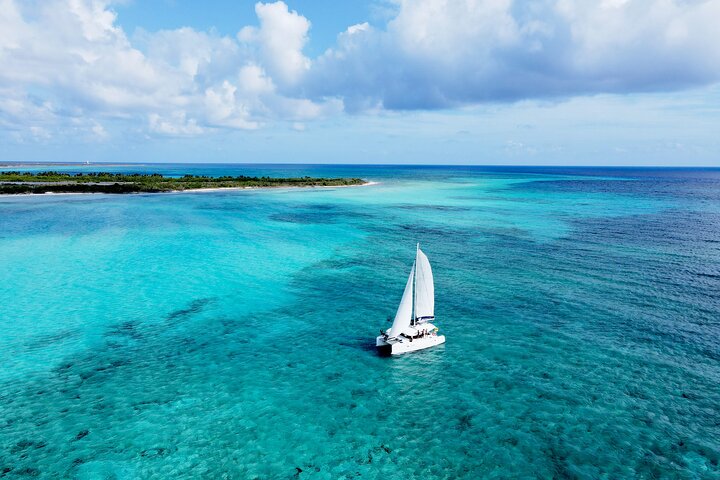
Lagoon 39ft Private Catamaran 5hr - El Cielo Full Experience
5 hours
From AUD 3091.47
The stretch of coast running north from Puerto Vallarta through Riviera Nayarit sits in the rain shadow of the Sierra Madre, which keeps the winter months reliably dry and delivers a daily thermal sea breeze out of the north-northwest, building through the afternoon to 15–20 knots before easing at dusk.
Swell arrives from the northwest with some regularity, so passages between anchorages are generally comfortable when you leave in the morning calm, before the chop gets up. The overall character is relaxed: short day sails between anchorages, cold cervezas at anchor, and underwater life that will stop you mid-tack.
The Marietas Islands are the centrepiece, a protected biosphere reserve where humpback whales gather from December through March and spinner dolphins are practically constant company. Access to the famous hidden beach is restricted and timed, so sort your permit before you leave the dock. Punta Mita has a sheltered bay for an overnight stop and a growing cluster of restaurants that reward the walk ashore.
Sayulita is worth a slow afternoon – surf culture, good tacos, and a mellow anchorage off a beach that stays busy until late.
Most charters depart from Puerto Vallarta's Marina Vallarta, which has competent bareboat operators and a handful of skippered options if you want local knowledge for the currents around the Marietas. Provisioning is straightforward in PV; buy your fresh fruit and ice there because supply drops off quickly north of town.
Check-in for foreign-flagged vessels requires a zarpe from the port authority – allow a morning for the paperwork and do not skip it.
November through February is the sweet spot; anyone uncomfortable with lumpy afternoon seas should be off the water by 1 pm.
When Priya from our BugBitten team stepped aboard a 42-foot catamaran at Marina Vallarta just before six in the morning, the Pacific was doing its best impersonation of a millpond. The sky to the east had gone that particular shade of bruised pink that Pacific Mexico does so well in November, and the pelicans were already working the surface in slow, prehistoric loops. By the time the dock lines were stowed and the chartplotter had found its satellites, a thin thermal had begun to whisper out of the north-northwest — exactly on cue, exactly as the locals said it would be.
That morning set the tone for the whole fortnight. The Riviera Nayarit charter circuit is not the sort of sailing that demands heroics. It is the sort that demands cold beer in the icebox, a snorkel mask on a hook near the companionway, and a willingness to be off the water by early afternoon when the chop makes itself known. For Australians used to the brutality of the Southern Ocean or the fickle squalls of the Whitsundays, it feels almost too easy — and that is, if you ask the BugBitten team, precisely the point.
The geography here works in your favour from the moment you open a chart. The Sierra Madre Occidental runs parallel to the coast and sits close enough to cast a pronounced rain shadow over the littoral zone during the winter months, meaning that from November through April, reliable sunshine is less a marketing promise and more a meteorological fact. Daily rainfall during those months is negligible. The thermals that build each afternoon out of the north-northwest deliver a predictable 15 to 20 knots of breeze — plenty of power for a day sail, not enough to make your crew miserable.
What the chart cannot convey is the character of the water itself. Between Puerto Vallarta and the Marietas Islands, the Pacific sits in a shallow convergence zone where cold upwelling mixes with warmer surface water, producing conditions that are genuinely productive for marine life. Humpback whales use this stretch of coast as calving and nursing grounds from December through to late March, and encounters under sail — engine off, boat moving quietly — are not the manufactured kind you get from a tourist panga. They happen because the animals are simply present in large numbers, and a sailing vessel on a slow reach is just another large thing moving through their space.
For sailors coming from elsewhere in Mexico, the comparison with the Caribbean is worth making plainly. The anchorages here are less crowded, the provisioning more straightforward, and the passages between stops more forgiving. If you've already explored Cozumel Reefs and want to see a different side of Mexican waters, Riviera Nayarit is the obvious counterpart on the Pacific side — warmer, drier, and with a different marine ecosystem entirely.
The rhythm of a charter week here settles into itself quickly. You leave whatever anchorage you're in before nine — ideally by eight — while the water is still flat and the engine can push you along comfortably in the morning calm. By midday you're at your next stop, sails down, anchor set, and the afternoon thermal is beginning to ruffle the surface in a way that looks pretty from the cockpit rather than threatening. This is when the snorkelling happens, or the dinghy runs ashore to whatever village or beach the chart indicates.
Ashore, the culture of the Nayarit coast is unhurried in a way that is not a performance. Sayulita, the surf town roughly 40 kilometres north of Puerto Vallarta, moves at a pace that seems physically incapable of acceleration. The tacos are made properly — small tortillas, a protein that has been cooking since dawn, a salsa with actual heat to it. The anchorage off Sayulita's beach is open and can get swell rolling through after dark, which is the one honest caveat about overnighting there, but the town itself rewards a slow afternoon ashore more than almost anywhere else on the route.
Punta Mita, further north, offers a more sheltered overnight option in its bay. The restaurant scene here has been growing steadily and is now genuinely good rather than just adequate — fresh fish prepared without fuss, a cold Pacifico that appears without having to chase anyone down for it. The walk from the dinghy landing to the restaurants is about fifteen minutes and entirely worth the sand in your shoes.
The overall atmosphere is relaxed without being lazy. There is real sailing to be done, real navigation decisions to make (particularly around the currents near the Marietas), and the kind of quiet competence required by any coastal passage. But the stakes are low and the rewards are immediate, which is exactly the right balance for a charter holiday.
The Marietas Islands are the centrepiece of any Riviera Nayarit charter, and for reasons that go beyond the famous Playa del Amor — the enclosed beach inside a collapsed lava tube that has been photographed into near-myth. The islands themselves are a protected biosphere reserve, and the marine life inside that protection shows it. Spinner dolphins are almost constant company on the approach, riding the bow wave with the slightly smug energy of animals that have never had a reason to fear boats.
The Marietas appear on the UNESCO World Heritage List as part of the Islands and Protected Areas of the Gulf of California, which tells you something about the ecological significance of this stretch of Mexican Pacific coast. Access to the hidden beach requires a timed permit obtained in advance through the national park authority — do not assume you can sort this on arrival, because you cannot. Allow time before departure to organise it, and add it to your pre-charter checklist alongside the zarpe paperwork.
The zarpe is a clearance document required by the Mexican port authority for any vessel moving between ports, and obtaining one at Marina Vallarta requires a visit to the Capitanía de Puerto. Budget a full morning for this process — it is not complicated, but it is not quick, and marina staff can point you toward the right building. Foreign-flagged vessels should not skip this step; it matters for insurance as much as for compliance.
Supply quality drops notably once you head north of the city. Puerto Vallarta's markets and supermarkets stock everything you need for a week or more afloat — fresh fruit, vegetables, good-quality ice in useful quantities, and all the provisions a galley crew could want. The Mercado Municipal is the honest choice for produce; the supermarkets near the marina carry the international goods that some crews prefer. Either way, fill the boat in PV and top up opportunistically in the villages north of it.
The underwater life along this coast is a genuine surprise for first-timers. Manta rays congregate in the shallower bays between November and March. Moray eels, octopus, and reef fish are abundant around the rocky points between anchorages. The water clarity is good rather than spectacular — it does not match the Caribbean at its best — but the sheer volume of animal life more than compensates.
November through February is the sweet spot, full stop. The thermal pattern is at its most reliable, the humpbacks are present in meaningful numbers from December onwards, the rain shadow holds, and the anchorages are not overwhelmed by the Easter holiday crowds that descend from March into April. January and February are the peak whale months; if that is a priority, plan accordingly.
March and April still work reasonably well, but the afternoon chop arrives earlier in the day and can be more persistent. Anyone who suffers on lumpy water should be off the water before noon during these months rather than the more forgiving one o'clock window available in November and December.
The wet season runs from June through October and effectively eliminates this coast as a charter destination. Humidity is high, tropical storms are a real possibility, and the thermal pattern that makes the sailing so pleasant simply does not exist in the same form. The Visit Mexico official tourism resource has current seasonal information and is worth checking alongside your charter operator's local advice.
Puerto Vallarta's Licenciado Gustavo Díaz Ordaz International Airport handles direct flights from Sydney and Melbourne via Los Angeles or Mexico City. The airport is roughly ten minutes from Marina Vallarta by taxi — one of those rare situations where the logistics actually work in your favour. The marina itself has multiple bareboat charter operators and a handful of skippered options; if your crew lacks experience with the currents around the Marietas, a local skipper for the first couple of days is money well spent.
For those wanting to extend a Pacific Mexico sailing trip, more places in Pacific Mexico are worth researching alongside this route, and if you're the sort of sailor who likes to compare regions, Baja (Cabo San Lucas) offers a very different Pacific Mexico experience — drier, starker, and with a different wind regime entirely.
Nearby stops on the Nayarit circuit include Lo de Marcos (a quiet village anchorage good for a single night), La Cruz de Huanacaxtle (a proper marina with fuel and provisioning if you need to top up mid-trip), and Chacala, which is further north and less visited, with a beach that earns the detour if your schedule allows.
Honest travel writing requires honesty about the awkward parts, and there are a few worth knowing about before you book.
The afternoon thermal is the defining feature of this sailing ground and also its main inconvenience. By two o'clock on most days between December and March, the chop on open stretches between anchorages is genuinely uncomfortable — short, steep, and directly on the nose if you're heading north. Crews who do not enjoy lumpy conditions need to plan passages accordingly, which effectively means a hard cutoff on departure times and a genuine commitment to the early-morning start culture. This is not a circuit where you can linger over breakfast and still have a comfortable passage.
The paperwork burden — the zarpe, the park permits for the Marietas, the entry documentation for foreign-flagged vessels — is not excessive by the standards of other cruising grounds, but it is more than some bareboat sailors are used to. None of it is genuinely difficult, but all of it requires planning and none of it can be improvised on the day.
Mobile coverage is patchy north of La Cruz de Huanacaxtle, which is relevant for weather updates and navigation apps that rely on data. Download offline charts before you leave the marina and treat connectivity north of that point as a bonus rather than a given.
Finally, the Marietas hidden beach has been so thoroughly photographed and publicised that managing your expectations is worth doing. The beach itself is extraordinary — a cathedral ceiling of volcanic rock open to the sky, soft sand, turquoise water — but the timed permit system means you share it with other permit holders, and the experience is less solitary than the photographs imply.
The Riviera Nayarit charter circuit is one of those sailing grounds that rewards underestimation. Come expecting an easy, pleasant week of short passages between good anchorages and you will get exactly that, plus humpback whales surfacing at close range, spinner dolphins at the bow, and a quality of light over the Pacific in the late afternoon that is genuinely difficult to describe without sounding like you're overselling it. The sailing is not technically demanding. The experience is.
Priya came back from her fortnight with a sunburnt nose, a deep and lasting enthusiasm for Sayulita's taco stands, and a memory of a humpback mother and calf surfacing fifty metres off the beam on a quiet Tuesday morning that she mentions, unprompted, in conversations that have nothing to do with sailing. That seems like the right measure of a destination.
Plan the paperwork early, leave the dock before eight, and be anchored with a cold drink in hand by early afternoon. The rest takes care of itself.


