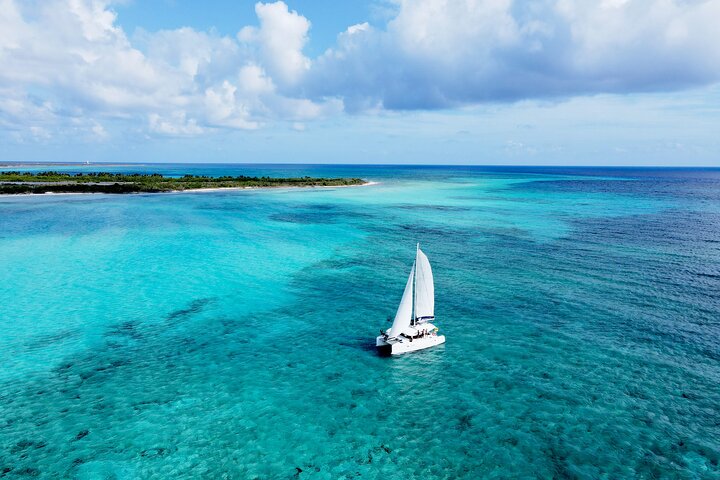
Lagoon 39ft Private Catamaran 5hr - El Cielo Full Experience
5 hours
From AUD 3091.47
Cozumel sits above one of the most intact sections of the Mesoamerican Barrier Reef, and the moment you drop into Palancar Gardens you understand why divers keep coming back. Visibility regularly hits 30 metres or better, the water runs a clear cobalt blue, and the coral architecture — towering sponge columns, overhanging elkhorn formations, swim-throughs lined with seafans — is genuinely world-class.
Depths across the main sites range from a comfortable 8 metres at Santa Rosa Wall's shallower terraces to well beyond 30 metres where the wall drops into the abyss. You won't need to chase anything here; the reef brings it to you.
The drift diving is the defining experience. The Yucatán Current runs northward along the island's western leeward coast, and most dives involve a current-assisted glide across the reef face while your boatman tracks your bubbles from above. Green and hawksbill turtles graze on sponge with complete indifference to divers.
Eagle rays cruise past in small groups at sites like Punta Sur and Maracaibo, and nurse sharks rest in sandy pockets beneath coral heads. Reef fish density is impressive — queen angelfish, spotted drums, French grunts in vast schools.
Reef condition is genuinely good by Caribbean standards, though coral bleaching events in recent warm years have left some shallower sections patchy. The conservation-focused zoning under the national marine park has largely protected it from the anchor damage and overcrowding that has hammered other Caribbean destinations. Cruise ship day-trippers do flood certain shallow snorkel sites between 10am and 3pm; timed shore dives or early-morning boat departures solve that.
Day boat operations run year-round from San Miguel, with dozens of reputable operators and no need for a liveaboard. Best diving is November through May; strong currents at advanced sites like Maracaibo make an Open Water certification the bare minimum, though Advanced is more appropriate.
Cozumel was the first proper diving I ever did. Janine had been on at me about it for years — she got her open water in Phuket back in the nineties — and finally in 2019 we both went over for two weeks based out of San Miguel and I have to say, fair dinkum, the diving was as good as everyone reckons.
I'd done a few resort dives in the Whitsundays as a younger bloke, nothing serious. Cozumel is where I actually learned what coral diving is supposed to feel like. We did fifteen dives over the two weeks, and I came home with my advanced cert and a slight obsession that has cost me money ever since.
[IMAGE: https://images.unsplash.com/photo-1582967788606-a171c1080cb0?w=1600&q=80&auto=format&fit=crop | A drift dive over the deep wall at Palancar reef on Cozumel — visibility around 30 metres, the wall dropping away into deep blue]
Cozumel is an island off the eastern coast of Mexico, about 50 km long, 15 km wide, sitting on the western edge of the Mesoamerican Reef — the second-largest barrier reef system in the world after the Great Barrier. The reefs run along the southern and south-western shore of the island. Most of them are protected as the Cozumel Reefs National Marine Park (Parque Nacional Arrecifes de Cozumel), established in 1996.
The defining feature of Cozumel diving is current. The Yucatan current pushes north at one to three knots most days, which means almost every dive here is a drift dive — you splash in at the southern end of the reef, the current carries you, and the boat picks you up at the northern end about an hour later. You barely have to kick. Saves your air. Means you cover a lot of reef. Magical once you get used to it.
About twenty named sites in the marine park. The main ones:
Palancar reef. The headline. Actually a system of four sub-reefs (Gardens, Horseshoe, Caves, Bricks) running about five kilometres along the south-western coast. Vertical wall dropping from about eighteen metres to over fifty, with cuts and swim-throughs and overhangs covered in big fan corals and sponges. Excellent for advanced divers — current can rip on a strong day.
Santa Rosa wall. Another vertical wall site, north of Palancar. More dramatic in some ways — the wall starts shallower, drops further. Caverns and swim-throughs at the top. Big black grouper, sometimes a passing eagle ray.
Columbia reef. Deep dive site, 25-40m, with massive coral pinnacles rising from the bottom like cathedrals. The deep visit. We dove this on day eight of the trip.
Paradise reef. The shallow easy site — 10-15m, gentle current, accessible from the shore at the south end of the island. Where most cert classes do their final dives. Good for night dives — the octopus come out.
Chankanaab. Even shallower. A protected lagoon inside the Chankanaab park. Good for snorkellers and Discover Scuba beginners. Less interesting for certified divers but worth a dip if you have a non-diving day.
There are about forty operators on the island. Some are excellent. Some are factory-style with too many divers per group.
Things I look for, having been around the block on this:
We dove with Liquid Blue Divers — they were good, six-divers-max boat, knowledgeable divemasters, free coffee on the boat. Aldora and Blue Angel were also recommended by locals. There's a couple of others in the same bracket.
Avoid the big resort-based operators — they're set up for cruise-ship walk-ups and the experience is much less personal.
December through April is the dry season — best vis (25-30m+), calmest seas, cooler air. December and January are peak (and most expensive). February-March is the goldilocks. We went in late February.
May-October is the rainy season but the diving is still excellent — vis stays good, the rain comes in afternoon thunderstorms. Hurricane season runs June-November and you can lose a day to weather but rarely a whole trip.
November is shoulder — usually fine, occasional storm.
San Miguel is the only proper town on the island. Stay there. Walking distance to the main dive shops, restaurants, the seafront promenade. We stayed at Casa del Mar on the south end of San Miguel — about 150 USD a night, balcony with a sea view, attached to a dive shop. Worked well.
Avoid the all-inclusive resorts up the coast unless you specifically want a holiday-from-thinking experience. They're disconnected from the island and the food is buffet-and-mediocre.
Most dive shops will pick you up from anywhere in San Miguel.
San Miguel is small but has decent food. Three places we kept going back to:
El Coffee Cozumel. Breakfast — proper huevos rancheros, fresh juice, strong coffee. About fifteen USD with everything.
La Choza. Mid-range Mexican kitchen run by the same family for thirty years. The chiles en nogada (when in season, August-September) is the headline; the cochinita pibil is the year-round star.
Mercado Municipal. The town market. Walk in, sit at the food counter, point at what looks good. About five USD for a substantial lunch.
Avoid the strip of restaurants right at the cruise pier — they exist for cruise-ship walk-ups and are universally mediocre.
If you've done your dives and want a non-diving day:
Punta Sur Eco Park. South end of the island. Mangrove lagoons, nesting sea turtles (in season — May-October), a small Mayan ruin, a lighthouse with a view. Half-day. About 14 USD entry.
El Cedral. Small Mayan ruin in the centre of the island. Tiny — just the foundation of one building — but worth the stop on a road tour around the island.
The road around the island. Rent a scooter for about 25 USD a day and ride the perimeter road. Three hours total, with stops. Quiet beaches on the eastern (windward) side, shallower water on the west.
The natural extension is the mainland — Tulum, Playa del Carmen, the cenote country inland, the Mayan ruins at Coba and Chichen Itza. The ferry from Cozumel to Playa del Carmen runs every hour. From Playa, Akumal Bay for the turtle snorkel is an easy 45-minute drive south. The Mexico country guide covers the wider routes month by month, and tours in Mexico lists various dive-anchored multi-region itineraries.
For other reef destinations to compare, Aruba's reefs sit at a similar level of accessibility but with a different coral-fish mix.
Bring: a 3mm full wetsuit (water's about 26-28 degrees but in current you'll feel it after the first dive), reef-safe sunscreen (mineral zinc, oxybenzone is banned in protected marine areas in Mexico), a torch for night dives, your own dive computer, and a small surface marker buoy if you have one (the dive boats provide them but it's good practice).
Don't bring: a wetsuit thicker than 3mm — you'll cook on the surface intervals. Cash for the dive shops — most take cards or USD now.
The CONANP (national protected areas) page for the Cozumel Reefs has the marine park rules and current visitor caps. UNESCO's biosphere page for the Mesoamerican Reef covers the wider ecosystem context if you want the long-version reading.
The marine park has been a real success story but it isn't perfect. Cruise-ship arrivals (Cozumel is the most-visited cruise port in the Caribbean) have produced years of high pressure on the shallower reefs near San Miguel — Paradise Reef has visibly less coral cover today than it did in the 90s. The deeper offshore sites (Palancar, Santa Rosa, Columbia) have held up much better, partly because they're harder to reach and partly because the marine park has stricter mooring rules out there.
The current pressure for divers is real but well-managed: marine park fees are charged per dive (about 4 USD), funding goes to enforcement and reef monitoring, and the dive operators police each other on bad behaviour (touching coral, anchoring outside designated points, getting too close to wildlife). On the whole, Cozumel is one of the better-managed dive destinations I've been to.
Cozumel's been a serious diving destination since the early 1960s when Jacques Cousteau filmed the reefs here for his French television series and put the place on the map. Sixty years later, the diving is still some of the best in the Caribbean — the protected marine park has been good for the coral, the operators are professional, and the drift-dive style is genuinely addictive once you get the hang of it.
Janine and I have been back twice. Reckon we'll go a third time. Two weeks minimum. Twelve to fifteen dives. Pick a small operator. Stay in San Miguel. Eat at the market for lunch. Drift along the wall at Palancar at sixty feet with the bottom dropping away into the blue. That's the trip. Good as gold.

