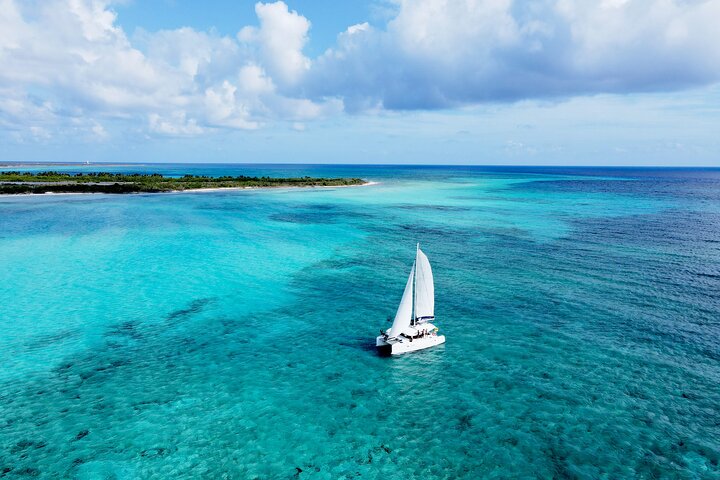
Lagoon 39ft Private Catamaran 5hr - El Cielo Full Experience
5 hours
From AUD 3091.47
Akumal Bay sits about 95 kilometres south of Cancún along the Riviera Maya, and it has earned a genuine reputation as one of the most reliable places in the Caribbean to find green sea turtles without boarding a boat.
The bay is shallow — most snorkellers are working in two to four metres of water — and the turtles graze on seagrass beds so close to shore that you can wade in from the beach and encounter them within minutes. Visibility typically runs eight to fifteen metres on a calm day, though afternoon boat traffic can stir up fine sediment and knock that back considerably.
The reef itself is a mixed picture. The coral has taken repeated hits from hurricane damage, bleaching events, and historical anchor damage, and you will notice significant areas of degraded structure. That said, the fish life remains genuinely impressive — parrotfish, angelfish, spotted eagle rays, and the occasional nurse shark resting on the sandy bottom.
The turtles, obviously, are the centrepiece, and on a good morning you might share the water with eight or ten individuals feeding calmly around you.
Snorkelling is by far the dominant activity here, and it is genuinely accessible to non-swimmers with a life vest. Several small operators on the beach rent gear and offer guided swims for a modest fee; some are more careful about enforcing turtle-distance rules than others, so ask before you hire. There is no liveaboard infrastructure at Akumal — this is purely a day-trip destination.
Nearby Playa del Carmen and Tulum have full dive centres if you want tank dives on the outer reef or the famous cenotes.
November through April delivers the calmest water and best visibility; no certification is needed for snorkelling, but non-swimmers should hire a guide.
So Akumal — okay, full disclosure: I went here on a stupid impulse from Tulum in 2023. My cousin Maeve and I had been doing two weeks of slow surf trips on the Yucatan coast when someone in the hostel said "you have to go swim with turtles at Akumal" and we just hopped on a colectivo the next morning. Spoiler: the turtles were great. The way Akumal's set up to receive tourists is honestly a bit of a mess. Both things are true.
[IMAGE: https://images.unsplash.com/photo-1583212292454-1fe6229603b7?w=1600&q=80&auto=format&fit=crop | A green sea turtle gliding above seagrass beds in the shallow water of Akumal Bay, Mexico]
Akumal = "place of turtles" in Maya. About 100km south of Cancun, 35km north of Tulum. The bay's a shallow protected cove with extensive seagrass beds about 50m offshore — and the seagrass is what the green turtles come to feed on every day. There's a permanent population of around 70-80 individual turtles that hang out here year-round, plus visiting hawksbills.
The bay itself is small — like, properly small — maybe 400m wide. The visitor pressure when I went was bonkers. We rocked up at 11am on a Wednesday and there were already 200+ people in the water with the turtles. Not great for the turtles. Not great for the experience either honestly.
So this is important and the websites don't always make it clear. There's two ways to swim with the turtles:
Option 1: Through a licensed tour operator. ~50 USD per person, includes a guide who goes in the water with you, a snorkel kit, and access to the protected zone where the turtles actually hang out. The guides are required to keep you behind a marker line so you don't crowd the turtles. This is the legit way.
Option 2: Walk in from the public beach. Free, but you can only swim in the public part of the bay (north end) — not the protected turtle zone. You might still see turtles in the public area on a quiet day. Less reliable, but free.
What you absolutely shouldn't do: hire a guy on the beach who's not affiliated with one of the licensed cooperatives. There's been a serious problem with unlicensed operators taking tourists in, crowding the turtles, sometimes touching them (which is illegal and harms them). The licensed cooperatives have green lanyards and laminated permits. Check.
I went with Centro Ecológico Akumal (CEA) which is the local conservation group that runs a non-profit education centre and licensed tours. Slightly cheaper than the commercial operators, money goes to turtle research, much smaller groups. Found them through a recommendation in the hostel — booked in advance from Tulum. Highly recommend.
Once you're in the water, the turtles are there. Like, really there. We saw maybe twelve in 90 minutes — most just chilling on the seagrass beds munching, a couple swimming languidly past at face level, one absolute unit of a green turtle that was easily a metre long and entirely unconcerned with us.
Plus stingrays (small ones, sandy bottom), the occasional small barracuda, schools of grunts and surgeonfish, parrotfish working the small reef sections at the bay edges.
Visibility was around 8-10m — not the crystal clear of the open Caribbean, because the seagrass and shallow water keep some sediment moving. But more than enough.
The whole snorkel was about 90 minutes which honestly was the right amount of time. After that you're cold (water's not as warm as you'd think), a bit waterlogged, and have ticked the box.
Akumal has more going on than just the turtle bay if you stay overnight (which I'd recommend doing rather than day-tripping):
Yal-Ku Lagoon. A small protected lagoon at the north end of Akumal where freshwater cenote water meets the sea — fewer turtles, but extraordinary visibility (think 25m+) and amazing reef fish. Calm enough that small kids can snorkel. Entry fee around 250 pesos (12 USD), kit rental extra. Better snorkel than the main bay if you ask me.
Cenote Manati. Just inland, about 3km from town. A freshwater cenote you can swim in, with no current and zero crowds compared to the famous cenotes further inland. About 100 pesos entry. Bring a swim cap if you've got hair to keep out of your face — there's no clear surface to push it back from.
Half Moon Bay. Small public beach just north of Akumal. Quieter than the main bay, no turtles per se but lovely water for actually swimming.
Akumal town itself is small — maybe one main street and a few side roads. Eating options:
La Lunita. Local Mexican kitchen near the entrance to the main bay. Fish tacos, ceviche, agua frescas. Cheap, honest, exactly what you want after a snorkel.
La Buena Vida. Beachside, more upmarket, palapa roofs, swing seats at the bar. Goes a bit overpriced but the location's lovely for sunset.
The local taco stalls along the highway. Where you'll get the best food on the Yucatan, full stop. Two or three pastor tacos for 50 pesos (3 USD), eat them standing up, locals everywhere. The little stand opposite the colectivo stop in town does the best ones I had on the trip.
Two options basically:
Stay in Akumal town. Few small guesthouses in the village proper, costs around 80-150 USD a night. Quiet, walking distance to the bay, low-key.
Stay in Tulum and day-trip. Tulum's 30 minutes south by colectivo (50 pesos = 3 USD), has way more accommodation and food choices, but means you're doing a 6am bus to be at the bay before the crowds. We did the day-trip from Tulum and honestly regretted it — would stay in Akumal next time.
The big all-inclusive Bahia Principe resort dominates the coast just south of Akumal but you don't want to stay there if you have any interest in the actual place.
Year-round destination but:
The Yucatan is set up for an easy 7-14 day road trip. Cancun → Tulum → Akumal → Coba (Maya ruins, climbable!) → Valladolid (colonial town with cenotes) → Chichen Itza (the famous ruins) → back to Cancun. The Mexico country guide covers the wider routes. If you're the booking-it-all-up-front type, tours in Mexico has a few Akumal-anchored snorkel-and-cenote combos. For other reef-snorkel destinations, Aruba's reefs are an easy onward Caribbean stop.
Bring: reef-safe sunscreen (mineral-based zinc, NOT chemical sunscreens with oxybenzone — these are banned in protected marine areas in Mexico and you'll be turned away if they catch you with them), a rash vest for sun protection, your own snorkel and mask if you have one (rentals are fine but always slightly leaky), cash (a lot of small operators don't take cards).
Don't: touch the turtles (it's a 5,000+ peso fine and you can damage their shells), use flash photography (stresses them), follow them swimming away from the seagrass beds (that's them telling you they're done), or feed any wildlife.
The Centro Ecológico Akumal (CEA) site has the conservation context, the licensed-operator list, and the visitor rules. The Mexican Tourism Board's Riviera Maya page covers the broader area.
Most people don't realise you don't need to rent a car or pay 80 USD for a private transfer. The colectivos (shared minibuses) run constantly between Cancun, Playa del Carmen, Akumal, and Tulum. From Cancun bus terminal, take an ADO bus down to Playa del Carmen (~80 pesos, one hour). From Playa, walk to the colectivo stand on Calle 2 Norte and grab a Tulum-bound colectivo — they pass Akumal en route, just tell the driver "Akumal" when you get on (about 50 pesos, 45 minutes). Total cost from Cancun airport to Akumal: about 8 USD if you do it the local way. The taxi guys at the airport will quote you 80-120 USD for the same journey. Don't.
Coming back is even easier — flag any northbound colectivo from the Akumal highway entrance.
Akumal's a properly special place even if the management is a bit of a balagan. The turtles are real, the water's good, the wider Yucatan is genuinely one of the best easy-travel destinations in the Americas. Go with a licensed guide. Skip the unlicensed beach hustlers. Stay overnight if you can. And honestly, if you've come this far, do one of the cenote snorkels too — the freshwater stuff inland is some of the most surreal swimming on Earth. Maeve's planning her own trip back this winter. I might tag along again low-key.


