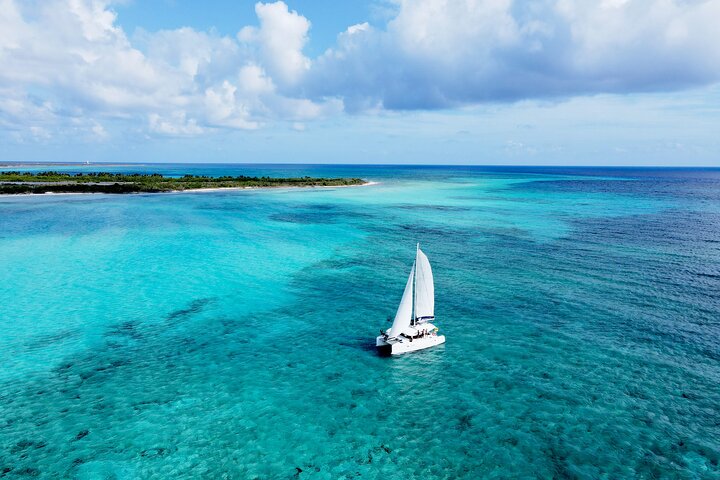
Lagoon 39ft Private Catamaran 5hr - El Cielo Full Experience
5 hours
From AUD 3091.47
The cenotes of the Riviera Maya are unlike anything else in diving — and I mean that quite literally. These flooded limestone sinkholes are not coral reef systems in the conventional sense; there's no salt spray, no coral heads, no reef fish darting through branching staghorn.
What you get instead is arguably stranger and more beautiful: crystal-clear freshwater threading through cathedral caverns draped in stalactites, the whole system punctuated by that eerie halocline layer where fresh and salt water meet and the world appears to melt and wobble around you.
Visibility regularly exceeds 50 metres, sometimes nudging 100 metres in dry season. Depths in the cavern zones sit mostly between 5 and 15 metres, though cave diving routes push considerably deeper. Currents are negligible.
You'll see ancient Mayan artefacts in some systems, fossilised bones, and the occasional freshwater fish, but the draw here is geological rather than biological — it's about light shafts cutting through tannin-stained water, the weight of limestone overhead, and a silence that feels genuinely prehistoric.
Day-trip operators run out of Playa del Carmen, Tulum, and Puerto Morales, with introductory cavern dives available to Open Water certified divers under guide supervision. Full cave diving requires a dedicated cave certification, and it's non-negotiable — these systems have claimed lives.
Liveaboards aren't the format here; most people base themselves on land and travel to individual cenotes, with Dos Ojos, Gran Cenote, and Tajma Ha among the more accessible entry points. Snorkelling is genuinely worthwhile in several, particularly Gran Cenote.
Go between November and April for maximum visibility before the rainy season clouds the freshwater; Open Water certification is sufficient for cavern dives, but serious cave exploration demands full cave training.
The water was so clear that I could count the stalactites hanging from the ceiling without looking up. When our BugBitten team descended into Gran Cenote on a Tuesday in February, my dive computer read 8 metres but the limestone cathedral around us felt infinite—light from the sinkhole opening above carved white pillars through the water, and everything beyond our torch beams dissolved into a blue-black that suggested the cave went on forever. Our guide, Miguel, hung suspended in the middle of the shaft, pointing to the halocline layer beneath us: where the freshwater we'd waded into gave way to saltwater rising from the underground river system, the whole thing creating this wobbly, heat-shimmer effect like looking through hot air on a bitumen road. The boundary between water densities bent light itself. For a moment I stopped thinking about the limestone roof overhead—the thing that keeps most divers' brains locked in controlled-breathing mode—and just stared. This wasn't the Caribbean I'd been expecting. It wasn't a reef at all.
The cenotes of the Riviera Maya exist in a category of diving that doesn't really have a sensible name. They're not caverns in the spelunking sense, though they started that way. They're not reefs, though they're absolutely worth your certification and your travel cost. They're flooded sinkholes formed when the limestone bedrock of the Yucatan Peninsula collapsed, exposing massive cavern systems that drain directly to underground rivers and eventually the Caribbean. The entire region—declared a UNESCO World Heritage Site—contains more than 6,000 of these cenotes, though only a handful are developed for diving and snorkelling access.
What sets diving here apart from anywhere else on the planet is the halocline effect. Fresh and saltwater don't mix instantly; where they meet, you get this optical illusion that frankly messes with your spatial awareness at first. Objects shimmer, refract, and seem to hang suspended between two realities. Some divers find it unsettling. Most—once they understand what they're looking at—find it genuinely mesmerising. The halocline isn't a barrier, but it's visible, tangible, almost tactile in the way light behaves around it. You can dive through it. You can move from the freshwater zone where visibility regularly exceeds 50 metres into the saltwater layer below, watching the density gradient do optical tricks that no Photoshop filter could properly capture.
Visibility in the dry season—November through April—sits at an average of 50 metres, with some dives pushing toward 100 metres of unobstructed clarity. No current to speak of. Water temperature hovers around 24–26°C depending on season (you'll want a 3mm or 5mm wetsuit, not the tropical 2mm you'd wear on a reef). The silence is absolute. Unlike the ambient noise of reef diving—the crackle of snapping shrimp, the gentle knock of parrotfish on coral—cenote diving gives you nothing but your own breathing and the occasional drip of water from stalactites above.
The geology is the real draw. You're diving through a museum of limestone formation: stalactites hanging from ceilings that haven't seen daylight in millennia, stalagmites rising from the floor, flowstone ribboning down walls in colours that shift from cream to rust to charcoal depending on mineral content and tannin staining. Some systems contain pottery and human remains left by the ancient Maya, who used cenotes as water sources and, scholars believe, as sacred ritual sites. You won't see active reef fish—the fauna here is minimal and adapted to cave life—but you might spot freshwater fish, the occasional eel, crayfish, and once you descend past the halocline, the odd saltwater species migrating through the underground rivers. The draw isn't biodiversity. It's something older and stranger.
Cenote diving doesn't feel like tropical tourism, despite being situated in one of Mexico's most developed resort zones. The entry points themselves—Gran Cenote, Dos Ojos, Tajma Ha, Cenote Azul—range from commercial to understated. Some have restaurants and gift shops. Others have a single guide service, a rope down the limestone face, and not much else. Once you're underwater, though, the commercial infrastructure evaporates. You're in a massive underground chamber with a handful of other divers, moving slowly through water that hasn't been disturbed by weather in recorded history.
The vibe is contemplative, almost meditative. There's none of the reef-diving competitiveness (spotting the biggest fish, chasing the best photo, ticking rare species off a list). Nobody's rushing. The guides aren't trying to jam ten dive sites into a day. You descend, you move, you ascend in your own time. The limestone overhead creates a natural psychological weight that keeps everyone's attention inward—on their breathing, their buoyancy, the geometry of the space. Some divers find it claustrophobic. Most find it grounding.
The towns serving these cenotes—Playa del Carmen, Tulum, Puerto Morelos—are bustling Caribbean beach destinations, all international resorts and tourist infrastructure. But the cenotes themselves feel removed from that world. You're driving 20 minutes inland from Tulum, turning off a main highway, and suddenly you're in scrubby jungle with limestone formations breaking through the canopy. The cenote entrances often sit within local ejido (communal land) territory, managed by the communities that live there. Some operators work closely with these groups; others treat the cenotes as just another tick on a tourist itinerary. There's a meaningful difference in how those experiences feel.
For non-divers, snorkelling is genuinely worthwhile. Gran Cenote in particular is perfectly suited to snorkellers; the freshwater is bathwater-warm, the clarity is unreal, and you can see stalactites and the limestone formations without any certification required. Expect to pay 200–300 MXN (about £10–15) for entry, and another 300–400 MXN if you want rental gear. The water feels slightly different from ocean—less buoyant, strangely still—but you'll adapt within minutes.
For certified divers, the progression is straightforward. Open Water certification is sufficient for cavern dives, which are guided, shallower (5–15 metres typically), and limited to zones where natural light from the cenote opening remains visible. These are genuinely stunning—you get the geological drama and the halocline effect without the overhead environment overhead that true cave diving involves. Most operators run cavern dives as standard day trips: 90 minutes in the water, costs ranging from 1,500–2,500 MXN (£75–125) per person.
Full cave diving requires dedicated cave certification (usually an Advanced Cavern cert minimum, leading to Full Cave), non-negotiable and for good reason. These systems have claimed lives—experienced divers with top-tier training, sometimes through equipment failure, sometimes through navigation errors, sometimes through physiological issues exacerbated by the psychological environment. If you're considering cave diving, do your full training before you arrive. Several operators in Playa del Carmen run NACD or IANTD cave courses, but you're better off completing your cavern work at home, then coming to Mexico fresh and focused.
Multi-dive packages are standard. Book two or three cenotes over consecutive days: Dos Ojos (actually two connected sinkhole systems, the most famous in the region) pairs well with Gran Cenote or Tajma Ha. Each has slightly different characteristics—different lighting, different geological features, different halocline behaviour. Your second and third dives will feel noticeably calmer because you're already accustomed to the silence and the overhead environment.
Snorkelling and diving can also be combined: many operators offer a snorkel-friendly cenote in the morning, a harder dive in the afternoon. This suits groups with mixed experience levels. Tours in Mexico listed through BugBitten connect to several reputable operators working these sites, though booking direct with the cenote management is often cheaper and more transparent.
The dry season—November through April—is the obvious window. Visibility is maximum, the weather is reliably stable, air temperatures are warm but not crushingly hot, and the dive operations run at full capacity. You'll share dive sites with other groups, but the cenotes are large enough that it doesn't feel crowded underwater.
The rainy season—May through October—is actually ridiculously underrated. Yes, the freshwater gets cloudier as more rain percolates through the limestone. Visibility can drop from 50+ metres to 15–20 metres. But you'll have cenotes practically to yourself. The water is warmer, the air is greener, and the experience of diving a cavern system in tropical downpour season has a particular intensity. Costs also drop notably. If you're experienced and comfortable with variable visibility, the shoulder months (late April, early November) offer a sweet spot: most of the dry-season clarity, fewer divers, and lower prices.
Hurricane season proper runs August through October, with highest risk in September. Operators will close if a storm is forecast, and travel logistics become iffy. May through July is safer weather-wise but typically wet. April and November are genuinely ideal: warm, stable, decent visibility, and the crowds are thinner than peak season.
Riviera Maya is easily accessed through Cancun International Airport—you'll land there regardless of which coastal town you're heading to. From Cancun, it's about 45 minutes to Playa del Carmen (main hub for cenote operators), 1.5 hours to Tulum (closer to many of the cenote sites themselves), and 20 minutes to Puerto Morelos (the smallest, quietest of the three and honestly worth considering as a base if you want to avoid resort saturation).
Renting a car is strongly recommended. Public transport runs to major towns, but cenote sites often require a turn inland, and scheduling your own drives means you're not dependent on tour operator timings. A basic car rental from Cancun runs 30–50 USD per day. Roads are reasonable; signage is decent. Driving is on the right.
Once you're based somewhere, individual cenotes are scattered across the interior jungle. Dos Ojos is about 40 minutes south of Playa del Carmen. Gran Cenote is just outside Tulum (10 minutes from the town centre). Tajma Ha is even closer to Tulum. Cenote Azul is further south. Most operators offer hotel pickup if you'd rather not self-drive, but expect to pay 30–50 USD on top of the dive cost for that convenience.
If you're building a broader Riviera Maya itinerary, Akumal Bay is 20 minutes south of Tulum and worth a dedicated snorkel day (it's a sea turtle sanctuary, genuinely remarkable). Puerto Morelos Reef is also nearby and offers a completely different diving experience—shallow reef system, coral, fish, the conventional tropical dive. Combining cenote dives with a reef day or two makes for a well-rounded Riviera Maya diving trip. Three days of cenote work, two or three days of reef diving, and you've covered both ends of the regional diving spectrum.
Let's be direct: cenotes require a baseline of comfort in confined spaces and overhead environments. If you're claustrophobic, cavern diving might push your limits even in guided, well-lit conditions. Many people discover they're less comfortable than they thought once they're actually underwater. It's fine to try and decide it's not for you—better to realise that on a shallow cavern dive than to push yourself toward full cave diving.
The halocline effect, while visually striking, can disorient newer divers. Your sense of depth can get confused. Objects appear to float at impossible heights. It takes mental adjustment. Experienced divers adapt within a dive or two. Less experienced divers sometimes spend the whole dive feeling subtly wrong, which isn't dangerous but isn't fun either.
The Riviera Maya as a whole is heavily touristed. Cenotes are marketed as an exotic experience, but they're actually quite accessible, which means they're busy during peak season. You won't find solitude. Some dive operators are genuinely professional and engaged with the sites; others are volume-driven, getting divers in and out as quickly as possible. Research your operator carefully. Read recent reviews. Ask questions about guide training, group sizes, and whether they're actually interested in the geology or just the revenue.
Water quality can vary. Some cenotes near resort development have documented pollution issues (runoff, waste, the usual resort-zone complications). Gran Cenote, being popular and well-managed, is generally clean. Dos Ojos has a strong reputation. But not all cenote systems are equally well-maintained, and a few have seen algae blooms tied to agricultural runoff from the surrounding jungle. This is improving as awareness grows, but it's a real issue.
Safety protocols are non-negotiable, and enforcement varies by operator. Find someone with current, verifiable certifications. Avoid operators who downplay risks or promise to take uncertified divers into overhead environments. The cenotes are genuinely safe if you're properly trained and guided responsibly. They become dangerous very quickly if you're not.
The wildlife angle is overstated in marketing. You won't see much beyond limestone formations, the occasional freshwater fish, and possibly some Mayan artefacts if you're diving the deeper, more restricted systems. If biodiversity is your diving priority, reef diving (including nearby Puerto Morelos) is better value. Cenotes are about geology, psychology, and silence—not about ticking species off a list.
Finally, cenote diving is travel-intensive. You need to get to the Riviera Maya, then you need to get to the cenotes. It's not a hop from your resort. Budget time for driving, for acclimatising to the cave environment, for proper rest days. Trying to cram five cenote dives into two days is possible but stupid. Give yourself a minimum of three days to do this justice.
When our team first dove into cenote systems, we expected something archaeological or novelty-driven—an Instagram moment and a good story. What we actually found was something closer to meditation. The cenotes strip away the noise of reef diving: the competition for sightings, the focus on species, the busyness of the surface world. What remains is just you, your breathing, limestone cathedral architecture that's millions of years old, and this strange optical effect where freshwater and saltwater dance against each other in ways physics alone can explain but your brain struggles to accept.
It's not for everyone. Some divers find the overhead environment genuinely claustrophobic. Some prefer the bustling biodiversity of reef systems. Some want social diving experiences and community rather than meditative silence. That's fine. But if you're a diver looking for something that feels genuinely different—something that pushes your spatial awareness without necessarily being dangerous, something that's scientifically interesting and visually striking in equal measure—the cenotes of the Riviera Maya deliver.
Visit Mexico's official tourism resources (Visit Mexico) have information on broader Riviera Maya planning, and the UNESCO World Heritage designation (UNESCO World Heritage List) covers the cenote systems themselves, though the bureaucratic language undersells how remarkable these spaces actually are when you're moving through them.
Book with operators who take the environment seriously. Do your training beforehand, not on arrival. Give yourself enough time to acclimatise and actually enjoy the sites rather than rushing through them. Plan your dives around the dry season unless you're experienced enough to handle reduced visibility. And prepare yourself for silence—real, complete, underwater silence. It's rare. It's worth seeking out.


