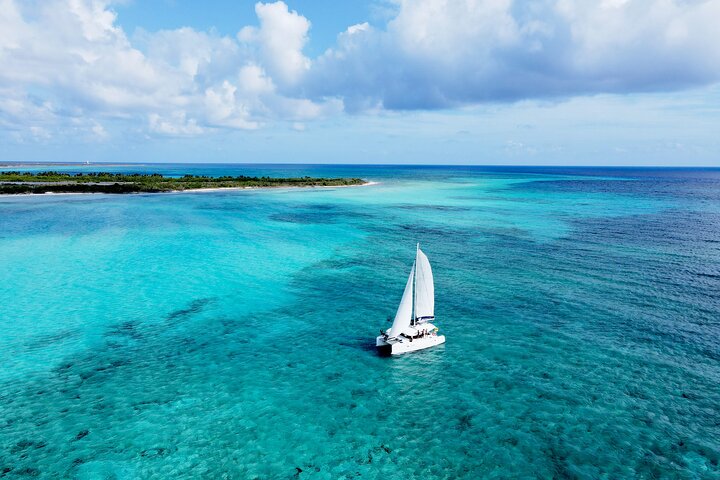
Lagoon 39ft Private Catamaran 5hr - El Cielo Full Experience
5 hours
From AUD 3091.47
Puerto Morelos sits quietly between the tourist machinery of Cancún and Playa del Carmen, and its reef is all the better for it. Designated a National Marine Park in 1998, the site benefits from genuine protection — anchoring is prohibited, and mooring buoys are in use throughout.
That said, the reef has taken its share of hurricane hits and bleaching events over the years, and honesty requires acknowledging that sections of the shallow platform look patchy. What keeps me coming back is the active restoration work: you'll often spot coral nurseries suspended mid-water, tended by local operators and research groups replanting staghorn and elkhorn fragments across damaged zones.
Depths here are forgiving — the reef crest sits at roughly two to four metres, sloping to around fifteen metres along the outer wall. Visibility is typically fifteen to twenty metres, occasionally more during the dry season. Currents are mild and predictable, making this one of the more relaxed drift experiences on the Mesoamerican Barrier Reef.
Entry is almost exclusively by day boat; there are no liveaboards operating from Puerto Morelos itself, but the town has a solid cluster of small independent dive shops offering two-tank morning trips at reasonable prices.
The marine life is genuinely rewarding. Green and loggerhead turtles are a near-certainty at most sites, grazing on the seagrass beds or resting on coral heads. Eagle rays pass through regularly, and nurse sharks are common on the sandy bottom. Parrotfish, angelfish, and schooling grunts fill out the picture on any given dive.
Snorkellers can access the reef directly from the beach with a guide, though boat-based entry reaches the better sections faster. November to April offers the clearest water and calmest conditions; open-water certification is sufficient for all dive sites here.
The boat cut its engine about thirty metres from the mooring buoy, and our guide—a quietly competent local named Marco—tossed a line to secure us in place. No anchoring here. No churning sand clouds or coral-shredding chains. Just a gentle bob on turquoise water whilst the Riviera Maya sprawled behind us: the concrete skyline of Cancún barely visible to the north, Playa del Carmen's development horizon hazy to the south, and between them, Puerto Morelos—unremarkable from the water, deliberately preserved from above.
When a member of the BugBitten team descended on a sticky November morning, the first thing that struck wasn't the reef's picture-postcard appeal (there's plenty of that), but rather the absence of the crowded, chaotic energy that plagues other Riviera Maya dive sites. The visibility that morning sat at a solid eighteen metres. The current was almost imperceptible. And within the first five minutes of settling on the sandy slope at twelve metres, we'd spotted three sea turtles—one green turtle methodically grazing on turtle grass, two loggerheads gliding past like underwater pilots making their rounds. No jostling crowds. No guide frantically waving torches at sleeping nurse sharks to justify the fee. Just quiet, honest reef life doing its thing whilst we watched.
That's the heart of Puerto Morelos: a place where protection has teeth, where the marine park designation actually means something, and where the diving experience rewards patience over spectacle.
Puerto Morelos Reef became a National Marine Park in 1998, and unlike some protected areas that exist mainly on paper, this one operates with genuine enforcement. Anchoring is flat-out prohibited. Mooring buoys dot the reef, and operators are required to use them. The result is a reef that, despite its share of hurricane damage and coral bleaching events, still functions as a living system rather than a ravaged monument.
The restoration work here is tangible and ongoing. You'll regularly spot coral nurseries suspended in the water column—fragments of staghorn and elkhorn coral being tended by local dive operators and research groups before being outplanted to damaged zones. It's not abstract conservation. You're swimming past the actual repair work. Some divers find it heartening; others find it sobering to see patches of the reef that need replanting. Both reactions are honest. The shallow platform sections do look patchy in places—hurricane Wilma left marks that remain visible, and the 2015 bleaching event affected broader areas. But the protection framework means those damaged sections aren't being bulldozed by boat traffic or smothered in silt from poorly managed tourism.
The reef structure itself is generous with divers. The crest sits between two and four metres, shallow enough that snorkellers can access genuine reef habitat without needing a boat, yet the outer wall drops away to around fifteen metres, creating variety across a single site. Visibility typically ranges from fifteen to twenty metres, and during the dry season (November through April), you might push beyond that. Currents are mild and predictable—nothing like the freight-train drift dives you'll encounter elsewhere on the Mesoamerican Barrier Reef. Open-water certification is more than sufficient. You won't need advanced navigation skills or exceptional fitness to enjoy yourself.
The marine life abundance here justifies the trip on its own. Green and loggerhead turtles are practically guaranteed—not as occasional sightings, but as multiple encounters per dive. They graze on seagrass beds scattered across the sandy bottom, or rest on coral heads during their downtime. Eagle rays drift through with regularity. Nurse sharks are common on the sand and coral rubble. Parrotfish crunch away at the reef structure (a vital, if noisy, part of reef ecology). Angelfish, surgeonfish, and schooling grunts round out the scene. The reef supports genuine biodiversity rather than a thin veneer of fish.
Puerto Morelos town itself occupies a strange cultural pocket. It's small enough to have retained a functioning fishing community—you'll see working boats, actual fish markets, locals conducting real business—yet developed enough to support a handful of dive shops, restaurants, and accommodations without feeling like a resort strip. The central plaza still functions as a gathering point for residents, not just tourists.
The reef sits close enough to shore that you can make out the palm trees onshore from the water. It's not a remote outer-atoll experience. It's intimate, accessible, local-scale tourism. Most divers are day-trippers on two-tank morning dives, back onshore by early afternoon. There's no liveaboard infrastructure in Puerto Morelos itself, which means the reef experiences seasonal tourism pressure rather than constant heavy use. You'll meet a handful of dive groups, but not the conveyor-belt operations that characterise Cozumel or the more established Playa del Carmen sites.
The water temperature varies seasonally—expect 27–28°C in summer months, dropping to a brisk 24°C in winter (November–March). A three-millimetre shortie suits most people year-round; winter visitors sometimes add a hood or light full-suit. The sun is intense, water reflection doubling down on exposure. Reef sharks—mostly nurse sharks, occasionally reef sharks on the outer wall—are present but docile. No cage-diving hysteria. No aggressive posturing. They're simply part of the ecosystem.
The prevailing mood onshore is relaxed but serious about the marine environment. Dive shops enforce briefings about the mooring buoys, minimum distances from coral, and proper buoyancy control. It's not draconian—just respect-based. Staff are accustomed to working with mixed-ability divers and adjust accordingly without condescension.
Most divers experience Puerto Morelos Reef via two-tank morning boat dives, typically departing between 8 and 9 a.m. and returning by early afternoon. A standard dive shop package runs around 1,200–1,500 MXN (roughly AUD $85–110) including guide, boat, and cylinders. Equipment rental is additional if needed. Small independent operators dominate; you won't find the franchised dive factory experience here.
The reef has several named sites, though they blur together somewhat because the overall structure is fairly continuous. The Barracuda site tends to be slightly deeper and sits on the outer wall. The Turtle site prioritises the turtle-grass meadows and shallower coral heads. La Boca site sits closer to the channel entrance. A good guide will select based on conditions and your group's interests rather than rigidly following a booking sheet.
Snorkelling is viable directly from the beach at Puerto Morelos with a local guide, usually arranged through dive shops or your accommodation. The effort-to-reward ratio is reasonable—you'll reach the reef fringe within minutes and see genuine marine life. However, boat-based snorkelling gets you to better coral coverage and deeper water faster. Budget roughly 800–1,000 MXN (AUD $56–70) for a guided boat snorkel, usually departing around 10 a.m. for a couple of hours in the water.
Combination trips are common: morning dive, lunch onshore, afternoon snorkel session. The town has enough restaurants and casual cafes to make this practical without breaking the bank. Fresh seafood tacos from beach vendors run about 60–80 MXN per order. Sit-down restaurants near the plaza charge AUD $15–25 for mains.
If you're interested in diving, you might also consider branching out to nearby sites. Akumal Bay lies about thirty minutes south and offers a different reef environment with its own turtle population. The Cenotes Reefs represent a more specialised experience if you're interested in freshwater-marine convergence zones. Puerto Morelos itself is also positioned well for broader Riviera Maya exploration if you're planning a multi-site trip.
Many visitors also use Puerto Morelos as a base for land-based activities: cenote swimming (several freshwater sinkholes are within 20–30 minutes drive), visiting the town market, or simply spending time in a place that hasn't been wholly consumed by resort development. If you're researching destinations, Visit Mexico's official tourism site provides practical logistics, though BugBitten's own destination guides tend to cut through the marketing language more directly.
November through April delivers the best conditions: water visibility tops out around 20 metres, currents remain minimal, and the sea state is generally calm. Weather is warm but not oppressively hot. Hurricane season is essentially finished by November. If you're factoring in calendar constraints, this five-month window is optimal.
May through October is the wet season. Heat climbs into the mid-30s Celsius. Visibility drops to 12–15 metres on average—not terrible, but noticeably reduced by the end of summer. Tropical downpours are common and brief. The trade-off is fewer tourists and lower prices. Dive shops continue operating, and you'll still see turtle, rays, and healthy coral, but the "picture-perfect" visibility window closes.
Hurricane season technically runs June through November, but severe impacts are less common than the statistical possibility suggests. That said, Puerto Morelos has taken direct and indirect hurricane hits—Wilma in 2005 left visible damage—so the risk isn't theoretical. If you're visiting August–October, monitor weather forecasts and be prepared for trip cancellations.
The reef itself experiences stress from thermal bleaching. El Niño events and unusually warm water years can trigger bleaching, which is what occurred in 2015. Recent years have seen variable outcomes—some recovery, some ongoing stress. The mooring-buoy system and restoration work help, but the reef's long-term resilience depends on broader climate stability, not local management alone.
December and January are busiest in terms of tourism—European school holidays and Australian summer holidays coincide. If you prefer quieter conditions, early November or late April are sweet spots: good water, fewer divers per boat.
Puerto Morelos sits directly on Highway 307, the main Riviera Maya spine, roughly 30 kilometres north of Playa del Carmen and 45 kilometres south of Cancún. If you're flying into Cancún International Airport, the drive to Puerto Morelos takes about 45 minutes in moderate traffic, longer during peak hours. Standard rental-car rates apply; shuttles and pre-arranged transfers are also available through accommodation or tour operators.
The town itself is small enough to navigate on foot. The main drag runs parallel to the beach. Dive shops cluster near the central plaza and waterfront. Parking is straightforward outside peak season; during holidays, spaces fill quickly near the beach.
If you're already exploring the Riviera Maya, Puerto Morelos works as a day trip from Playa del Carmen (30 minutes drive) or Cancún (45 minutes). Many travellers base themselves in Puerto Morelos for 2–3 nights to focus on diving and exploring the town at a proper pace, then move on to other sites.
The nearby cenote ecosystems merit a day trip. Several cenotes are within 20–30 minutes drive of the town. The freshwater diving experience is fundamentally different—cooler, clearer water, often dramatic cave formations—and some operators offer combination trips (reef diving in the morning, cenote diving in the afternoon). Tours in Mexico listings can help coordinate multi-day itineraries if you're planning a broader Quintana Roo adventure.
Public transport exists but is slower. Collectivo (shared van) services run along Highway 307, connecting Puerto Morelos to Playa del Carmen and Cancún. Budget extra time and expect basic comfort. Most divers prefer independent transport or pre-arranged transfers for flexibility around dive-shop departure times.
The reef has sustained genuine damage. Hurricane Wilma in 2005 and coral bleaching events (most notably 2015) left visible scars. Some shallow platform sections look patchy. Certain coral heads show recovery, whilst others remain stressed. If you're expecting pristine, cathedral-like reef structures, you might feel disappointed. The reef is functional and genuinely rewarding, but it's not flawless.
Water quality degrades during heavy rains. The Riviera Maya's porous limestone bedrock means runoff from development inland reaches the reef system. Visibility can drop to 8–10 metres during and immediately after storms. Late summer and early autumn (August–October) see the most variable conditions.
Sargassum (brown seaweed) washes ashore seasonally, particularly June–August. When accumulation is heavy, it can affect snorkelling from the beach and create unpleasant swimming conditions. Boat-based diving is less affected because the sargassum typically floats at the surface, but the smell and visual clutter onshore are real.
The dive-operator landscape is honest but unregulated in the way that small independent operations tend to be. A couple of the smaller shops operate with older equipment and minimal creature comfort. Boat amenities are basic—no shade, limited freshwater rinse, basic toilets. If you're accustomed to the polished infrastructure of larger tourist destinations, expect a step down. That said, standards are safe and guide quality is generally solid; you're trading luxury amenities for a more authentic, local-scale operation.
Nitrogen narcosis isn't a technical concern given the shallow maximum depths, but the sandy bottom below the reef can tempt deeper exploration. Stay conservative on depth and bottom time. The reef itself is the attraction—no need to push limits.
Accommodation in Puerto Morelos ranges from budget beachfront cabañas (AUD $40–60 per night) to mid-range hotels (AUD $80–150). The supply is limited compared to Playa del Carmen. Book ahead during peak season to avoid scarcity and price inflation.
Puerto Morelos Reef rewards divers who value quiet over flash, restoration ecology over untouched wilderness, and genuine community engagement over theme-park tourism. It's not a destination that sells itself on superlatives. The reef won't take your breath away with sheer biomass density or dramatic wall structures. What it offers instead is access to a functioning marine protected area, predictable conditions, solid marine life encounters, and a modest, functional town that hasn't been wholly repurposed around visitor accommodation.
The mooring-buoy system and active coral restoration work suggest that protection frameworks actually function when enforced. You're diving a reef where human intervention is directed toward repair rather than extraction. That's genuinely rare on the Mexican coast.
For divers with open-water certification seeking a two-day or three-day reef experience, Puerto Morelos works particularly well. Snorkellers can access the reef without advanced training. The town supports a low-pressure pace: dive, eat, explore cenotes, swim off the beach, repeat. You won't need a week here, but 2–4 days allows genuine engagement rather than hit-and-run tourism.
The UNESCO World Heritage List includes the Belize Barrier Reef, the broader Mesoamerican Barrier Reef system, and various other marine protected areas across the Caribbean. Puerto Morelos isn't technically a UNESCO site, but it sits within the broader Mesoamerican ecosystem and operates under similar conservation principles. Understanding that context—that you're diving part of a regionally significant system—adds weight to the experience beyond the immediate underwater view.
If your Riviera Maya trip has space for a day or two of focused diving in a place that takes marine conservation seriously, Puerto Morelos merits your time. The reef isn't the flashiest on the Caribbean coast, but it's real, it's working, and the locals who manage it clearly care about keeping it that way.


