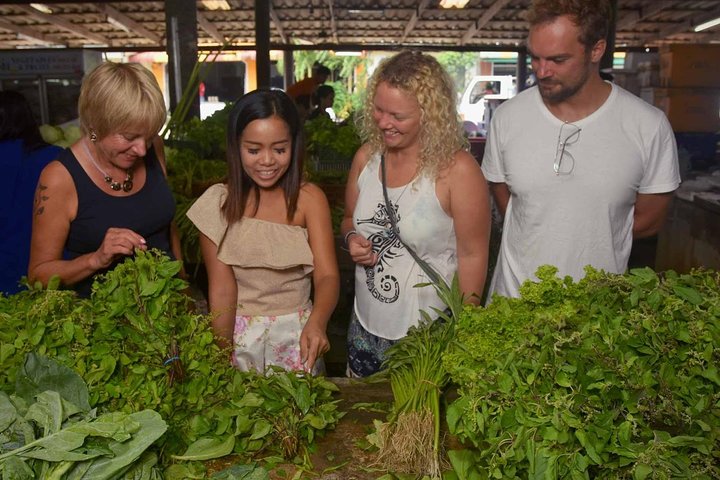
Cooking Class by Samui Native Instructor Geng and O Family
4 hours
From AUD 111.17
Safari World sits in the Khlong Sam Wa district on Bangkok's eastern fringe, a long haul from the old city that requires either a taxi or a dedicated BTS-plus-taxi combination. Founded in 1938, it holds the distinction of being Thailand's oldest zoo, and that age shows — parts of the site carry the worn, concrete-heavy aesthetic of mid-century zoo design, with enclosures that prioritise containment over naturalistic space.
That honesty is worth stating upfront.
Within its 19 hectares you'll find the collection is modest but genuinely interesting in places. The white rhinos draw steady attention, large and unhurried in their paddock, and the hippos are reliably compelling at feeding times, which typically run in the late morning — check the board at the entrance gate the moment you arrive.
The reptile house is one of the more satisfying stops, dark and cool against the Bangkok heat, with a solid range of Southeast Asian species including large pythons and monitor lizards in reasonable conditions.
The zoo hosts around half a million visitors annually, and weekends can feel genuinely congested near the larger mammal enclosures. Weekday mornings before 10 a. m. are noticeably quieter. The grounds offer limited shade on open pathways, so a hat, sunscreen, and a water bottle are not optional in any month. Most visitors cover the site comfortably in three to four hours.
Pushchairs manage the main paths, though some side tracks are uneven. There is no significant published conservation or in-situ breeding programme of note at this zoo.
Arrive by 9 a.m. on a weekday, check hippo and rhino feeding times at the gate, and bring cash for the entrance fee, which is not always card-friendly.
When Priya from our BugBitten team made the trek out to Safari World on a muggy Tuesday in late February, she half expected to be underwhelmed. Bangkok's eastern fringe is not exactly where you imagine the city's most compelling experiences to live — the taxi ride from Sukhumvit alone takes the better part of an hour through a tangle of elevated expressways and low-rise industrial sprawl. But she arrived at the gate just before nine, paid in cash at the booth (card machine reportedly out of order, as it often is), and walked into something that, for all its rougher edges, held her attention for nearly four hours straight.
That's the Safari World experience in a nutshell: not polished, not Instagram-perfect, not the sort of place that turns up on glossy travel listicles. But if you go in with your eyes open and your expectations calibrated, there's genuine substance here — animals you rarely get to observe this closely, feeding sessions that are legitimately engrossing, and a reptile house that is, hand on heart, one of the more impressive collections of Southeast Asian species you'll find on the continent. The trick is knowing what you're walking into before you get there.
Safari World occupies 19 hectares in Bangkok's Khlong Sam Wa district, and it holds the distinction of being Thailand's oldest zoo, founded in 1938. That age is written into the architecture whether you like it or not — the concrete is thick, the enclosures bear the functional geometry of mid-century zoo design, and there's no attempt to disguise any of it with landscaping or interpretive theatre. If that sounds like a criticism, it's meant as context rather than condemnation. Knowing what kind of place this is frees you to appreciate what it actually does well.
What it does well starts with the white rhinos. They are large, genuinely unhurried animals, and their paddock gives you extended, unobstructed sightlines that are rare in more heavily designed modern facilities where naturalistic vegetation tends to obscure the animals behind aesthetics. You can stand at the fence and simply watch them for ten minutes without any particular rush or crowd jostling, at least on a weekday morning. There is something unexpectedly meditative about it.
The hippos are the other major draw, and the key to getting the most out of them is timing. Feeding sessions typically run in the late morning — usually around 10 or 10.30 — but the schedule changes and is posted on a board at the entrance gate. Checking that board the moment you walk in is not optional advice; it is the single most important logistical step of your visit. The hippo feeding brings a concentrated burst of activity from animals that otherwise spend large portions of the day underwater and still. When they surface, open their enormous mouths, and lunge for food, the scale of them becomes immediately apparent in a way that photographs genuinely fail to convey.
Beyond the headline animals, the bird collection is broader than most visitors expect, with a reasonable range of Asian hornbills and wading species that ornithology-inclined travellers will find worth a slow circuit. The overall collection is modest rather than encyclopaedic, which — depending on your outlook — is either a limitation or a feature that keeps the visit from feeling overwhelming.
Khlong Sam Wa is not a neighbourhood that gets much attention in travel writing, and truthfully the immediate surrounds of Safari World are unremarkable — a stretch of road flanked by car dealerships, convenience stores, and the kind of low-density Bangkok fringe development that looks the same in every direction. The zoo is not embedded in a park or a green precinct; it sits in the middle of ordinary urban sprawl, and once you're inside the walls, the city doesn't disappear so much as recede slightly.
Inside, the atmosphere is functional and lived-in. Paths are mostly concrete or compressed gravel, wide enough for pushchairs on the main routes though uneven in spots on the smaller side tracks. There is genuine shade in sections — the reptile house, some of the covered walkways near the large mammal enclosures — but open stretches between exhibits can feel punishing on a hot day, which in Bangkok means most days of the year. The grounds have a canteen-style food outlet near the centre of the site serving basic Thai dishes and cold drinks, and there are vending machines at intervals along the main paths. Neither is remarkable, but both are functional when the heat catches up with you.
On weekends, particularly Saturday afternoons, the zoo draws families in numbers that make the bigger enclosures genuinely crowded and the walkways slow going. The contrast with a weekday morning before ten is significant enough that it should influence your planning directly. What feels spacious and calm on a Tuesday at nine o'clock feels cramped and loud by noon on a Saturday.
This is the single most satisfying stop on the Safari World circuit, and if you're only going to linger anywhere, linger here. The building is cool, dim, and properly climate-controlled in a way that feels like genuine relief after the open paths. The collection covers a solid range of Southeast Asian species: large reticulated pythons in enclosures that give you a real sense of their scale, water monitors, various gecko and skink species, and a handful of crocodilians in a rear section. The glass is generally clean and the sightlines are good. Plan on thirty to forty minutes minimum if you have any interest in reptiles at all.
As mentioned above, the white rhinos are the anchor exhibit for most visitors and earn their status. Arrive early, before the crowds build, and you'll likely have stretches of the fence nearly to yourself. There is no particular interpretation or signage of note — this is an area where the zoo's age shows in its approach to visitor education — but the animals themselves do not require narration.
Check the board, confirm the time, and position yourself at the hippo enclosure at least fifteen minutes early to get a decent spot at the barrier. The feeding itself lasts only a few minutes but is worth the planning. The hippos at Safari World are well-habituated to the routine and perform it reliably, which is to say they do what hippos do with complete indifference to human observation.
A slow loop of the bird enclosures takes about forty minutes and is most rewarding in the early morning when the animals are active. The hornbill collection is the highlight here for serious birders.
If you're building a broader Bangkok itinerary that takes in the city's more culturally layered corners, more places in Bangkok on BugBitten is a solid starting point for expanding your list beyond the usual tourist orbit.
The short answer: weekday mornings, ideally arriving at opening time or as close to nine as you can manage. This is the version of Safari World that rewards you — quieter paths, cooler temperatures than the afternoon brings, and animals that are generally more active before the heat of the day settles in.
November through February is the most comfortable period climatically, with Bangkok's dry season delivering lower humidity and temperatures that peak around 30–32°C rather than the 36–38°C that March through May can produce. That said, Safari World draws year-round, and if you're visiting in the hot season, the reptile house and shaded sections provide enough refuge that the visit remains manageable provided you arrive early, hydrate consistently, and don't attempt a full circuit in the middle of the afternoon.
Avoid public holidays, especially Thai public holidays, where crowd levels spike considerably. The Tourism Authority of Thailand website publishes an accurate calendar of national holidays and festivals, which is worth checking before you book any Bangkok attraction. Songkran in mid-April brings both a public holiday and peak heat simultaneously — not a combination that favours an outdoor zoo visit.
Weekend afternoons are the lowest-value time slot by a significant margin. If a weekend visit is unavoidable, Saturday morning before ten is still workable. Saturday afternoon is not recommended.
Safari World sits at 99 Panya Indra Road in the Khlong Sam Wa district, approximately 25–30 kilometres northeast of central Bangkok. There is no direct BTS Skytrain connection. The most straightforward approach is a metered taxi from central Bangkok, which takes 40–60 minutes depending on traffic and will cost approximately 200–300 baht on the meter with expressway tolls on top. The driver will need the tolls paid in cash at the booths. Confirm the driver uses the meter before departing.
A slightly more economical option is to take the BTS to Min Buri station and pick up a taxi or motorbike taxi from there for the final stretch, but this adds logistical complexity without saving dramatically on cost. For most travellers staying in central Bangkok, a direct taxi or ride-hailing app (Grab works reliably in this area) is the practical call.
The immediate neighbourhood offers little in the way of compelling nearby stops, but if you're interested in exploring Bangkok's quieter cultural sites on the same day or a nearby day, the Wat Chinorasaram Worawihan (Wat Chinorot) is worth knowing about — a temple that sees far fewer foreign visitors than the city's headline wats and rewards the effort. On a different note, the unusual Pig Memorial is among the city's more singular and genuinely curious sites for travellers who prefer their Bangkok itinerary a little off the standard track.
Honesty matters here, and Safari World has genuine shortcomings that any fair assessment needs to name clearly.
The enclosures are dated. Several of the large mammal spaces in particular are concrete-heavy and functionally designed rather than welfare-optimised, reflecting the era in which they were built more than current best practice in animal husbandry. There is no significant published conservation programme or in-situ breeding initiative of note at this facility — if supporting an institution with a demonstrable conservation mission is important to your decision-making, that gap is a legitimate concern. Travellers who are conscientious about animal welfare tourism will want to research current conditions before visiting, particularly for facilities that are not regularly reviewed against international welfare standards such as those maintained by bodies like the UNESCO World Heritage List, which evaluates cultural and natural sites on criteria that include ecological integrity — a useful benchmark for thinking about what responsible wildlife tourism looks like more broadly.
The signage is sparse and often dated. English-language interpretation is inconsistent. The entrance fee structure and on-site ticketing can be confusing; bring cash in sufficient quantity because card payments are unreliable at the gate and at some food outlets.
The shade situation bears repeating: this is a genuinely hot site with exposed sections that will catch you out if you arrive underprepared. A hat, high-factor sunscreen, and a refillable water bottle are not optional accessories in any month of the year. There are water refill points on site but they are not well signposted.
The distance from central Bangkok is also a real consideration. Safari World works best as a dedicated half-day or full-day excursion rather than a quick stop between other activities, and the travel time means that if the experience doesn't land for you, the sunk cost of the journey will sting a little.
Safari World is not a zoo that will suit every traveller, and it would be dishonest to pretend otherwise. It is old, it is concrete-heavy in places, and it sits far enough from the city centre that getting there requires a deliberate decision rather than a casual detour.
But it also has white rhinos that will hold your gaze for longer than you expect, a hippo feeding session that earns its reputation, and a reptile house that stands genuinely well against any regional comparison. If you go on a weekday morning, arrive early, check the feeding schedule at the gate, bring cash and a hat, and accept the place for what it is rather than what it isn't, you'll likely leave with more than you anticipated.
The BugBitten team position is this: go in informed, not disappointed. Safari World is a place with a particular kind of rough-edged character that more polished modern facilities sometimes lack, and for the traveller willing to engage with it on those terms, the visit pays back the effort of getting there.