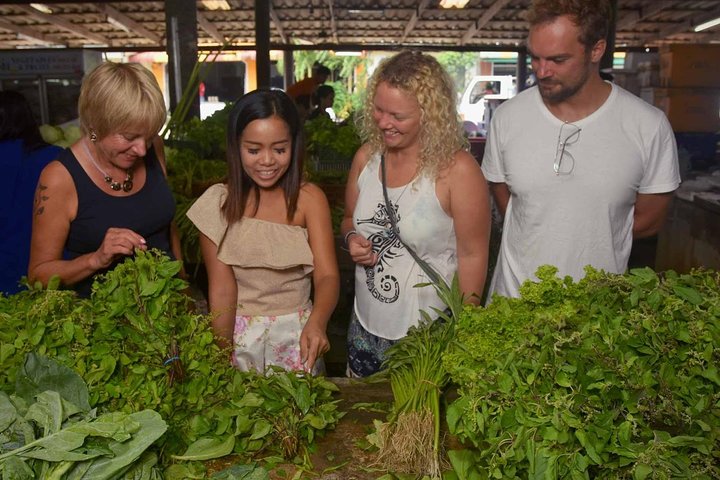
Cooking Class by Samui Native Instructor Geng and O Family
4 hours
From AUD 111.17
Damnoen Saduak is the floating market that put Thailand's canal trade on the world map, and despite its reputation for crowds and tourist coaches, there's still something genuinely stirring about arriving at dawn to find wooden boats stacked with tropical fruit, noodle pots steaming on open flames, and vendors in wide-brimmed hats paddling through narrow khlong channels edged with green vegetation.
The market sits about 100 kilometres southwest of Bangkok in Ratchaburi province, and most visitors join an organised day trip or catch a minivan from Victory Monument. Getting here independently is possible but adds effort — shared minivans run regularly from around 6am, which is exactly when you want to arrive.
By 10am the main Ton Khem canal is thick with tourist boats and the atmosphere shifts from lively commerce to something more theatrical. That's not necessarily a deal-breaker, but it does change the feeling significantly.
Hire a long-tail boat to explore the smaller side canals beyond the main strip — that's where you'll find local vendors still going about ordinary business and where the photographic interest is far richer. Bargaining is expected, though prices have crept up considerably over the years. Watch your bags on the boats, and keep cash handy as card machines don't really feature here.
Wear light, breathable clothing and closed-toe shoes if you can manage it, since the wooden dock boards can be slippery.
The food is a genuine highlight — boat noodles, pad thai cooked fresh on floating stoves, and fruit you can eat straight from the vendor's hand. Skip the souvenir stalls lining the upper walkways; they add nothing.
Arrive before 8am on a weekday to get the most authentic version of what this place once was.
When Priya from our BugBitten team arrived at Damnoen Saduak just before seven on a Tuesday morning, the light was still low and golden, cutting sideways through the palm fronds that lean over the khlong edges. She'd taken a shared minivan from Victory Monument, dozed most of the two-hour journey, and stepped out onto a wooden dock to find the main canal already alive — vendors poling narrow wooden boats laden with dragonfruit, rambutan, green papaya, and plastic bags of mango sticky rice sealed tight with rubber bands. A woman in a conical ngob hat was ladling broth from a pot balanced on a clay stove at the bow of her boat, her movements unhurried, completely uninterested in the cameras already pointing at her from the walkway above.
That image — the steam rising off the broth, the fruit colours almost too saturated against the dark water, the absolute focus of a person doing a job — is what stays with you. Damnoen Saduak has a complicated reputation. It's been on every tourist itinerary for Bangkok day trips since the 1970s, it gets overrun, it can feel like a performance by mid-morning. But arrive early enough, push past the main strip, hire a long-tail boat into the side channels, and you'll find something that still has a pulse. This is Priya's honest account of what to expect, what to eat, and how to make the most of a place that rewards the early riser and punishes the sleep-in.
There are floating markets scattered across central Thailand that make quieter, more photogenic claims on your attention — Amphawa on weekend evenings, Taling Chan on weekend mornings. So why bother with Damnoen Saduak, the one everybody knows, the one the coaches descend on?
Because scale, for all its complications, has its own kind of energy.
Damnoen Saduak is not one canal. It's a network of khlongs that stretch across flat paddy country in Ratchaburi province, roughly 100 kilometres southwest of Bangkok. The market originally evolved as a working trade route — canal commerce was the backbone of central Thai life before roads displaced it, and vendors have been selling produce from boats along these waterways since the 1860s. The main Ton Khem canal, lined with wooden shophouses and elevated walkways, is what most visitors see. But the canal system fans out considerably beyond that, and once you leave the main drag on a long-tail boat, the density of tourists drops sharply.
What you find in those quieter channels is harder to photograph but more interesting to experience. Local women still paddle out to sell fish, lotus flowers, and bundles of fresh herbs to people who live in the stilted houses along the bank. Kids cycle along the narrow paths beside the water. The commerce feels less curated. Prices are lower. Nobody is particularly concerned with you.
The food is the clearest reason to come. Boat noodles — a small, intensely flavoured broth with pork or beef, rice noodles, morning glory, and a hit of dried chilli — are cooked fresh on floating stoves and served in portions small enough that you can eat three without regret. Pad thai comes straight from a wok. Fresh-cut fruit is offered by vendors who'll pare a pineapple in front of you in about twelve seconds flat. The flavours are real and the produce is genuinely fresh in the morning hours. By contrast, the fixed stalls and souvenir shops that line the upper walkways are easy to ignore and deserve to be.
Ratchaburi province doesn't get much attention from travellers who mostly stay glued to the Bangkok-Chiang Mai-islands triangle. That's a loss. The province is flat, agricultural, and crossed with irrigation channels that have been managed for centuries. Approaching Damnoen Saduak by road, you pass through low-lying farmland — rice paddies, orchards of tropical fruit, the occasional spirit house draped in marigold garlands. The landscape isn't dramatic but it has a calm, working quality that feels genuinely far from the city, even though you're not.
The town of Damnoen Saduak itself is small and functional. There are a handful of local restaurants, a temple, and the kind of streetscape that exists entirely for reasons other than tourism. The market district begins about a kilometre from the town centre and is clearly signposted. By the time you arrive early in the morning, the area around the main pier feels purposeful — vendors loading boats, ice being delivered, the smell of frying garlic drifting from somewhere you can't quite locate.
By 10am, however, the atmosphere shifts dramatically. Tour coaches arrive in convoys, organised tourist boats fill the main canal, and the whole thing takes on a vaguely theatrical quality that is entertaining enough but feels very different from the working market of two hours earlier. Neither version is dishonest — both are real aspects of what Damnoen Saduak is in 2024 — but they are genuinely different experiences. If you only catch the later version, you haven't been deceived exactly, but you've missed the best of it.
If you're planning a broader trip through central Thailand or thinking about pairing this with island time, the contrast between the landlocked paddy province of Ratchaburi and the clear coastal waters of the Thailand (Similan & Surin Islands) is about as complete as Thailand gets — worth considering if you have the time.
This is not optional if you want to get anything meaningful from the visit. The long-tail boat tours that depart from the main pier take you into the smaller side canals beyond Ton Khem, and they typically run between 30 and 60 minutes depending on the route you negotiate. Prices hover around 300–500 baht per person, sometimes sold per boat. Bargain firmly but politely — this is expected on both sides. The boats are noisy, fast, and slightly alarming the first time the driver cuts under a low bridge, but the canal views from water level are substantially better than anything you see from the walkway.
The food quality is highest in the first two hours after vendors set up. Boat noodle broth has been simmering since before dawn and is at its most complex early. Fruit cut fresh from just-arrived produce is colder and crisper than the stuff that's been sitting in the heat for hours. Order by pointing, carry small bills (20s and 50s work best), and don't worry about hygiene theatre — the stalls are well-maintained and the turnover is fast.
After the boat ride and breakfast, take twenty minutes to walk the residential paths that run parallel to the smaller khlongs. You'll pass orchid nurseries, vegetable gardens growing right to the water's edge, cats sleeping on boats tied to front porches. It's not structured or signposted, which is precisely why it's worth doing.
The raised walkway above the main canal is lined with stalls selling carved wooden elephants, fridge magnets, cotton fisherman pants, and packaged durian chips. None of this is specific to Ratchaburi or particularly well-priced. Save your energy.
The short answer: weekday, before 8am, outside of Chinese New Year and Songkran.
Weekday mornings between Tuesday and Thursday are the least-trafficked option. Saturdays and Sundays bring Thai domestic tourists on top of the international tour groups, which compounds the crowding significantly.
The best months to visit are November through February, when the weather is cooler, humidity is more tolerable, and morning temperatures are genuinely pleasant — around 22–25°C at dawn. March through May is brutally hot. June through October is wet season, which doesn't necessarily ruin the trip (the vegetation looks extraordinary in the rain and boat traffic drops), but downpours can be intense and the canal paths get slippery.
The Tourism Authority of Thailand publishes regional festival calendars that are worth checking before you book — some local temple festivals in Ratchaburi do temporarily draw additional visitors to the area in ways that can affect accommodation and transport.
Avoid arriving after 10am on any day if experiencing the working market matters to you. By 11am the fruit vendors have largely sold out, the broth pots are running low, and the atmosphere is predominantly tourist-boat traffic and souvenir shopping.
By minivan from Bangkok: The most practical independent option. Shared aircon minivans run from Victory Monument BTS station (Ratchathewi area) from approximately 6am, with departures roughly every 20–30 minutes. Journey time is around 1.5 to 2 hours depending on Bangkok traffic. Cost is typically 80–100 baht. Ask the driver to drop you at the market — most know it well. Return minivans run until late afternoon from near the main market entrance.
By organised tour: Most Bangkok guesthouses and hotels can arrange day tours that combine Damnoen Saduak with a visit to the nearby Maeklong Railway Market (the famous train-track market in Samut Songkhram). These are more expensive but take the logistical planning out of it. Quality varies; read recent reviews before booking.
By private car or driver: If you're two or more people, hiring a driver from Bangkok for the day works out at a reasonable per-head cost and gives you full control over timing — useful given how much arrival time matters here.
Nearby: The Maeklong Railway Market is about 30 kilometres north and worth combining if you have a half day remaining. For something more out-of-the-ordinary around Bangkok proper, Safari World offers a completely different kind of animal encounter for families or anyone with a spare morning. And if you want to get a broader sense of the region's attractions beyond the market itself, take a look at more places in Ratchaburi — the province has cave temples, pottery villages, and river towns that most day-trippers never reach.
Let's be straight about the downsides, because there are real ones.
The crowds are intense after 9am. The main canal becomes genuinely difficult to move through by 10am, with tourist long-tails creating wash that rocks the vendor boats, vendors competing loudly for your attention, and the footbridges over the main canal clogging with selfie-takers. If you're someone who finds crowded tourist attractions dispiriting, you need to either arrive early or manage your expectations carefully.
Pricing has climbed. This is not a budget market anymore in the way some travellers expect it to be. Vendor prices on the water are higher than the equivalent food in Bangkok street markets, and they know it. Bargaining is still part of the culture but it won't get you anywhere near local prices. Come for the experience, not for cheap eating.
The tourist boat traffic degrades the canal atmosphere. Long-tail boats full of camera-wielding day-trippers buzzing past wooden vendor boats is the defining visual by mid-morning, not peaceful commerce. It's not fake — both groups are really there, really doing what they're doing — but it's a different scene from the postcard version.
Access isn't always accessible. Wooden dock boards are uneven and can be genuinely slippery in humidity. There are no railings in many places. People with mobility considerations should be aware that the site is not configured with accessibility in mind, and boats involve stepping across unstable surfaces.
Card payments are essentially non-existent. Bring cash in small denominations. ATMs are not plentiful in the immediate market vicinity. Sort your baht before you leave Bangkok.
While the market's cultural significance to Thai canal trade history is undeniable, it's worth noting that the broader Ratchaburi region contains sites with deeper heritage connections — some waterway communities in central Thailand have been proposed for consideration under frameworks similar to those tracked by the UNESCO World Heritage List, though Damnoen Saduak itself holds its value more as living cultural practice than as a formally recognised monument.
Damnoen Saduak is not the secret it once was — there's no pretending otherwise. It gets busy, it gets noisy, and the version of it that exists at 11am on a Saturday in February involves more tourist hardware than most travellers bargain for.
But the version that exists at 6:45am on a weekday — the broth pots steaming in cool morning light, the fruit boats jostling for position, a long-tail boat taking you into quiet channels where someone is still selling lotus blossoms to a woman in her kitchen — that version is genuinely worth the early alarm. Thailand's canal trade was a way of life for centuries before it became a photo opportunity, and enough of that reality survives at Damnoen Saduak in the early hours to make the trip meaningful rather than merely photogenic.
Go early. Hire the boat. Eat the noodles. Skip the carved elephants.
And if you need help planning anything else around the Bangkok region or beyond, you know where to find us — the BugBitten team has been there, done the legwork, and will always tell you what we actually found rather than what you want to hear.