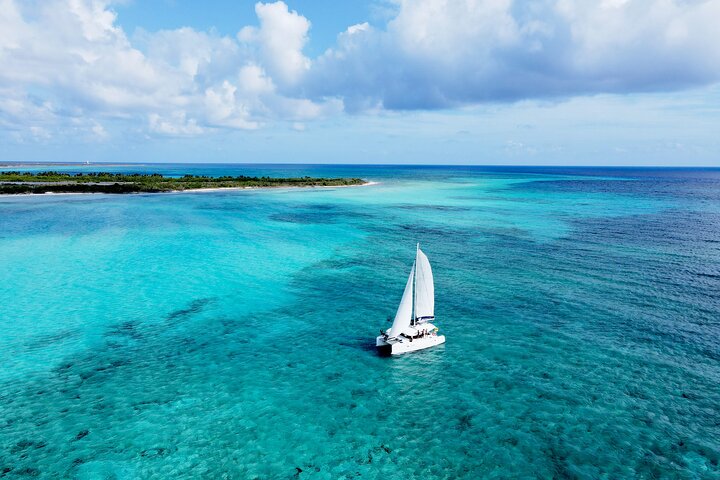
Lagoon 39ft Private Catamaran 5hr - El Cielo Full Experience
5 hours
From AUD 3091.47
Laguna de Nichupté sits just behind the Cancún Hotel Zone, a sprawling mangrove-fringed lagoon that most visitors completely overlook in favour of the open Caribbean reefs. That's a mistake worth correcting. The lagoon is shallow throughout — rarely more than four metres at its deepest channels — which makes it genuinely accessible to snorkellers and absolute beginners strapping on fins for the first time.
Visibility is the honest caveat here. Unlike the crystalline Caribbean side, Nichupté runs murky from tannin-stained mangrove runoff and boat traffic, often dropping to two or three metres on a poor day and perhaps six on a calm, clear morning. You're not coming here for panoramic underwater vistas.
What you do get is an unexpectedly diverse cast of reef fish sheltering around the lagoon's patchy seagrass beds and mangrove roots — snappers, grunts, needlefish, and the occasional juvenile tarpon moving through the shallows. Sea turtles pass through regularly, particularly near the quieter southern reaches away from jet ski corridors.
Currents are negligible, making this one of the safest water environments in the Cancún area. Dozens of resort-based operators and independent dive shops along Kukulcán Boulevard offer guided snorkel tours by small panga boat; this is firmly day-boat territory with no liveaboard infrastructure. Scuba diving is possible but largely pointless given the depths — snorkelling genuinely delivers more here.
Most operators run two-hour guided trips and will take complete non-swimmers with flotation aids.
Reef health isn't really the conversation at Nichupté — the lagoon faces pressure from runoff and recreational boat traffic, and it lacks the coral structure of the outer reefs — but its accessibility and wildlife surprises make it a worthwhile addition to any Cancún itinerary.
Best visited October through April when winds are calmer and visibility improves; no certification required.
When Maya from our BugBitten team pulled up to the dock near the mangrove fringe of Nichupté at half-past seven, the lagoon was still and grey-green, the kind of water that doesn't immediately scream "come in, the snorkelling's brilliant." A cluster of boats bobbed at anchor, their skippers sipping coffee and scanning the cloudless sky above. Maya had skipped the glitzy Hotel Zone reefs — the ones everyone photographs — deliberately choosing this overlooked slice of water sandwiched between the mangroves and Cancún's sprawl. She wasn't expecting crystalline visibility or postcard-perfect coral gardens. What she found instead was something quieter and far more rewarding: a working lagoon full of actual wildlife, where you could genuinely see fish behaving like fish, not just posing for tourists.
Within twenty minutes of boarding a small panga with perhaps six other snorkellers, she was floating above seagrass beds watching juvenile tarpons the length of her forearm ghost through the shallows like silver shadows. The water was murky — true to form — but not useless. Three or four metres of visibility on a decent morning means you can work. A snapper school materialised out of the haze. Needlefish darted between the reeds. In the two hours that followed, she didn't see a single coral head worth remarking on, but she did see something far rarer at Cancún: an ecosystem that felt alive and unpretentious, full of moments that didn't feel manufactured for visitors. That's what makes Laguna de Nichupté worth the slight detour from the main tourist circuit.
Most people who fly into Cancún head straight for the outer reef system — Cozumel, the PADI blue holes, the famous dive sites with names they've already Googled. There's nothing wrong with that. But Nichupté offers something different: the chance to see reef fish diversity in their nursery grounds, where juvenile species congregate and hunt in shallow water that doesn't require a certification card or nerves of steel.
The lagoon's shallow profile — rarely deeper than four metres in the working channels — is precisely what makes it invaluable for snorkellers who aren't confident swimmers, haven't snorkelled before, or who simply want to avoid the complications of deeper diving. Every operator running boats here will fit you with a flotation belt if you ask. You can touch bottom. You can stand up if you panic. That accessibility is rare in Mexican coastal snorkelling, where most decent reefs require either a boat ride to distant breaks or a climb down to deeper channels.
The fish life is also genuinely surprising. Snappers, grunts, and parrotfish use these seagrass beds as feeding grounds. Needlefish — those strange, needle-nosed predators — hunt in the shallows. Jacks cruise through in loose schools. Sea turtles, particularly juvenile hawksbills and greens, move through the southern reaches of the lagoon during cooler months. You're watching reef fish behave as they actually do, not hanging motionless in front of a camera. That's the real payoff. Nichupté isn't a museum; it's a working nursery for the reef system, and being in the water there feels purposeful in a way that even good snorkelling often doesn't.
The currents here are negligible. There's no swell to speak of. The water is warm year-round. These things add up to what's arguably the safest snorkelling environment in the Cancún area — no rips, no surge, no surprises except the ones that swim past you. That matters if you're nervous or new to the activity.
Nichupté doesn't feel like a tourist attraction, and that's deliberate on your part if you choose to go. The lagoon sits in a zone of tension: backed by dense mangrove forest (some of it protected, some of it under development pressure), fronted by the sprawling Cancún Hotel Zone on the other side, and crossed constantly by small recreational boats, jet skis, and the occasional tour operator's panga.
The mangrove fringe itself is genuinely striking. Red mangrove roots create a tangle of arches and caverns just above the waterline — nursery habitat for countless juvenile fish and crustaceans. Push into the shallows near the roots and you're not in a groomed tourist environment. You're in habitat. The water smells faintly of tannins and salt, not chlorine. The light filters through in a way that feels private, almost enclosed, despite the fact that you're minutes from high-rise hotels.
The boat rides are utilitarian. You won't get the luxury catamaran experience or the Instagram-friendly aesthetic of the open Caribbean. You get a working panga with perhaps a dozen other people, a skipper who knows the channels by heart, and genuine quiet between dive sites. There's something refreshing about that — snorkelling without the performance of it, without the sense that you're part of a conveyor belt moving from selfie point to selfie point.
The overall atmosphere is low-key to the point of being almost subdued. You might see a handful of other boats on the water, but you won't see crowds. The people on your boat are usually a mix of hotel guests who stumbled onto the recommendation and repeat visitors to Cancún who've done the main reefs already. There's far less chatter about underwater photography and far more genuine curiosity about what's actually in the water. That ethos shapes the experience: less crowded, more observant, more real.
Your visit to Nichupté will be structured almost entirely around a guided snorkel tour, and that's the right approach. Every resort along Kukulcán Boulevard has partnerships with dive shops, and independent operators run boats from public marinas near the Hotel Zone entrance. A standard tour runs two to three hours, includes perhaps two snorkel sites within the lagoon, provides mask and fins, and costs between 450–800 pesos (roughly £20–35 AUD) depending on the operator and whether you're booking direct or through your hotel's concierge.
Once you're in the water, the approach is straightforward: you'll drift over seagrass beds, stop to observe clusters of fish, and the guide will point out anything interesting — usually with hand signals underwater. Some operators have underwater fish identification cards; others don't. If you want to identify what you're seeing, bring a waterproof fish guide for the Caribbean, or download an offline species guide on your phone before you go.
The best sites within Nichupté tend to be the central and southern channels, where mangrove density is high and boat traffic is lower. These are where you're most likely to see sea turtles, tarpon, and undisturbed fish behaviour. The northern sections near the Hotel Zone get noisier and see less interesting life; if your operator wants to push north, ask to go south instead.
Bring your own snorkel gear if you have it — most tour operators provide it, but personal gear fits better and doesn't smell like a thousand previous visitors' mouths. A rash guard or thin wetsuit is optional depending on your sensitivity; the water is warm, but if you're snorkelling for two hours, any sun protection helps. Sunscreen is essential, though use reef-safe options (zinc oxide, not oxybenzone or octinoxate).
Photography is possible but challenging. Visibility means that any photos you take will have a murky, greenish cast — fine if that's your aesthetic, frustrating if you're chasing Instagrammable moments. Underwater camera settings need to favour shutter speed over clarity to freeze fish movement in low light. Phone photography works better here than on clearer reefs because the murkiness actually reduces backscatter.
If you want to add a second activity, kayaking through the mangrove channels is available through some operators and is genuinely worthwhile — you'll see different wildlife, move more slowly, and access channels too shallow for motorised boats. Book these as separate half-day excursions rather than trying to combine them.
October through April is the clear window. Hurricane season (June–November, peaking August–October) means rougher seas, lower visibility, and occasional closure of tour operations. Dry season also brings calmer conditions, and the tannin-stained water tends to clear slightly when rainfall decreases. Visibility during these months typically sits at four to six metres on decent days, compared to two to three metres during the wet season.
January and February see peak tourism in Cancún, which means more boats on the water and higher prices for tours. September and October are generally quieter and cheaper, though weather is less predictable. If your primary goal is wildlife spotting — particularly sea turtles — December through February is ideal, as cooler water temperatures push turtles into shallower lagoon areas.
Avoid visiting during mid-morning heat (roughly 10am–2pm) unless you have excellent sun protection. The lack of shade on the boats means you're exposed for the entire tour. Early morning starts (7–8am) are far more comfortable and often produce better visibility because the water hasn't been churned up yet by other boat traffic.
Weekly timing doesn't matter much at Nichupté — unlike ocean reefs where weekday vs. weekend can mean significant differences in crowd levels, the lagoon absorbs tour boats reasonably well across all days. That said, Monday–Thursday tends to be quieter than Friday–Sunday simply because more tourists are active on weekends.
Laguna de Nichupté sits immediately behind the Cancún Hotel Zone, sandwiched between Kukulcán Boulevard and the mangrove forest. If you're staying in the Hotel Zone itself, you're minutes away by taxi. Most tour operators have desks in hotel lobbies or direct relationships with concierges — you can book through your accommodation without any research. If you're staying in downtown Cancún or Puerto Morelos, allow 20–30 minutes by taxi to reach the departure points.
You can also book tours directly through independent operators in the Hotel Zone. Cozumel-based dive shops sometimes run Nichupté trips as a secondary offering when Caribbean reefs are closed by weather. That's worth asking about if you're comparing prices, though it usually means less flexibility on timing.
The lagoon sits within convenient striking distance of other Mexico attractions if you're planning a broader Riviera Maya itinerary. Puerto Morelos (25 minutes south) has better snorkelling than Nichupté if you want to compare, and the cenotes of the inland Yucatán Peninsula are roughly 45 minutes to an hour away. If you're building a full trip, you can easily combine Nichupté with cenote swims and other coastal snorkelling in a single itinerary.
For booking tours, search Tours in Mexico or ask your hotel concierge directly — most resorts have relationships with three or four operators and can advise on the best fit for your skill level and preferences. The official Visit Mexico tourism site also lists registered tour operators, though it's less detailed.
The lagoon is a protected area — it's not formally a UNESCO World Heritage site, though parts of the Mesoamerican reef system are internationally recognised, and Nichupté sits within broader conservation zones. Respect for the habitat is important: don't touch the seagrass or mangrove roots, don't chase fish, and follow your guide's instructions regarding where you can and can't go.
Visibility is the primary caveat, and it's worth understanding clearly. On a calm morning, you'll get four to six metres. On a rougher day or after rainfall, visibility drops to two or three metres — enough to see fish, but not enough for the panoramic reef views people often expect. If your mental image of "reef snorkelling" involves Caribbean postcard clarity, Nichupté will disappoint. The water is always slightly murky, tinged greenish-brown from tannin runoff and suspended sediment. That's a feature, not a bug — it's what makes the wildlife accessible — but it's not what Instagram has prepared you for.
Water quality has declined in recent years due to runoff from Cancún's rapid development and increased boat traffic through the lagoon. You probably won't notice this while snorkelling, but it's worth acknowledging that Nichupté isn't a pristine ecosystem. The seagrass beds are healthy, the fish are present, but the overall health of the lagoon is under pressure. This isn't the Caribbean equivalent of visiting an untouched reef — it's visiting a working, stressed ecosystem that's still worth seeing.
Jet skis are a genuine nuisance, particularly in the northern sections and on weekends. They're loud, they churn up the water, they scare fish, and they represent a safety issue if operators aren't paying attention to where snorkellers are positioned. Reputable tour operators will route away from jet ski zones and will choose quieter sites, but there's no guarantee you won't encounter them.
The mangrove environment attracts mosquitoes and sandflies (the tiny biters that cause itching far worse than their size suggests). Wear long sleeves on the boat if you're sensitive to insects, or apply insect repellent to exposed skin before departure. The dock areas and mangrove fringe are where these are most problematic, not while you're in the water.
Tannin staining means your white towel will not remain white, and any light-coloured clothing will pick up marks. Bring a dark towel or accept that laundry will happen. Some people find the murky water slightly claustrophobic compared to clear-water snorkelling. If you're someone who needs to see far to feel comfortable, this might not be your trip.
Finally, accessibility for people with mobility issues is limited. The boats have ladders for entry and exit, and the docks aren't particularly wheelchair-accessible. If you have specific mobility needs, contact operators directly before booking.
Laguna de Nichupté won't appear in your Cancún guidebook's headline attractions. It won't give you the Instagram moments of the outer reefs or the Caribbean's famous dive sites. What it will give you is something quieter: the genuine experience of watching reef fish behave as they do when nobody's performing for the camera, in water so shallow you can touch bottom and safe enough to relax completely.
That's become increasingly rare in heavily touristed coral destinations. Most reef snorkelling in Mexico has evolved toward spectacle — boats, crowds, guides pointing at the same fish everyone else has already seen. Nichupté sidesteps that because nobody's marketing it aggressively. You get there by accident or deliberate choice, not by following a trail. The fish are more abundant because they're less habituated to divers. The boats are smaller. The atmosphere is genuinely quieter.
If you're in Cancún and haven't already done the main reefs, you could absolutely start here. The accessibility and safety make it ideal for snorkelling first-timers. If you're a repeat visitor or someone who's already done the Caribbean classics, Nichupté is worth revisiting specifically because it's different — less curated, more alive, genuinely worthwhile.
The BugBitten team's take is this: book a morning tour, get on the water early, expect murky visibility and surprise yourself anyway. Bring a fish identification guide. Watch the tarpons. Hope for a sea turtle. Don't expect perfection; expect something real instead. That's what Nichupté delivers.


