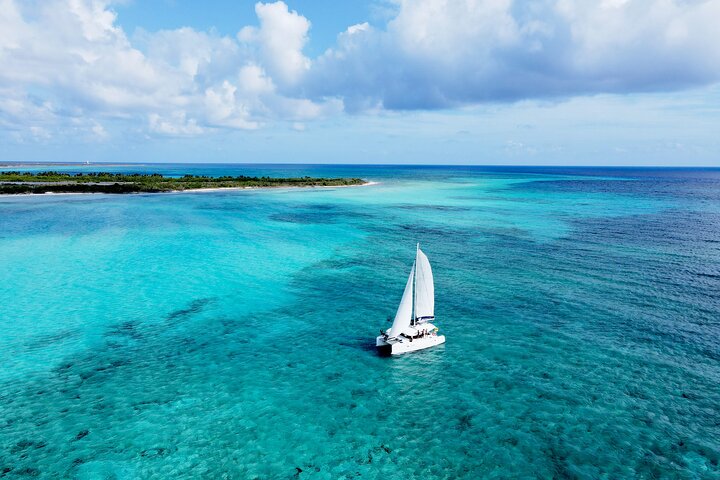
Lagoon 39ft Private Catamaran 5hr - El Cielo Full Experience
5 hours
From AUD 3091.47
Cancún divides neatly into two very different worlds, and understanding that split is the key to getting the most out of your visit. The Hotel Zone — a long, narrow strip of land curving between the Caribbean Sea and Laguna Nichupté — is where the all-inclusive resorts, rooftop clubs, and spring break energy concentrate. It is loud, glittering, and deliberately international.
If that is not your scene, head inland to Ciudad Cancún, the actual city where locals eat, shop, and live. Parque Las Palapas is a good anchor point there, with street food stalls serving poc chuc, marquesitas, and tlayudas well into the evening.
The beaches along Boulevard Kukulcán are genuinely stunning — powdery white sand and that extraordinary turquoise water are not exaggerated in photographs. Playa Delfines at the southern end of the Hotel Zone tends to be less crowded than the hotel-fronted stretches and has a public car park. The undertow can be surprisingly strong, so always check the flag system before swimming.
Getting around is easier than it looks. Public buses run the length of the Hotel Zone for a few pesos and are perfectly safe during daylight hours. Taxis are plentiful but negotiate the fare before you get in. For day trips, Cancún sits within striking distance of Isla Mujeres by ferry, the ruins at Tulum, and the cenotes of the Yucatán interior — none of which require a tour group.
What sets Cancún apart from Playa del Carmen or Tulum is sheer scale and infrastructure. Flights are frequent and affordable, accommodation options range from budget hostels in the city centre to sprawling resort complexes, and the international airport handles arrivals smoothly. It is not the most atmospheric destination on the Riviera Maya, but it is often the most practical starting point.
Go between December and April to avoid the summer heat and hurricane season; bring reef-safe sunscreen and a light layer for aggressively air-conditioned restaurants.
Voilà — I shall be honest. Cancún was not on my list. I went the first time in 2019 only because my niece Sophie had won a small lottery prize from a French magazine — three nights in one of the hotel-zone resorts — and asked me to come along. I expected to dislike it. I did, somewhat. And yet, in the years since, I have returned twice on my own and the truth is more complicated than I had assumed.
Cancún is two cities, really. There is the famous one — the Zona Hotelera, a long thin barrier island lined with twenty-storey resorts and the kind of clubs where the music does not stop until the sun is well up. And there is the other one — Cancún Centro, the working city of about a million people on the mainland behind the resorts, where almost no tourists go and where a substantial part of the actual Yucatán culture continues much as it always has. The two are separated by a lagoon and by the most extraordinary class divide one sees in the Americas.
[IMAGE: https://images.unsplash.com/photo-1560577827-22c25e5fe9c6?w=1600&q=80&auto=format&fit=crop | The white-sand beach of Cancún at golden hour, with the turquoise Caribbean shading into deep blue offshore]
The Zona Hotelera is, in essence, a long sandbar — about twenty-two kilometres in a sort of question-mark shape, separating the Caribbean Sea from the Nichupté Lagoon. The whole strip is a single avenue (Boulevard Kukulcán) with all the resorts running off it. The northern end is closest to the airport and the city; the southern end, around Punta Nizuc, is quieter and has the better water.
The actual city of Cancún sits on the mainland behind the lagoon. To get there from the hotel zone, one takes the R1 or R2 bus along the boulevard — about 12 pesos, twenty minutes. One ought to do this at least once.
The all-inclusive model has done many things to many places, but in Cancún it has produced an unusually thorough kind of tourist enclosure — most visitors arrive at the airport, are bussed directly to a resort, never leave the resort except for a single day-trip to a managed attraction, and fly home having seen nothing of Mexico at all. This is, of course, by design. But it is a great pity, because the actual city behind the lagoon has its own pleasures.
The Mercado 28 in the city centre is a proper Mexican market — handicrafts and silver from the wholesale traders, food stalls where one can eat very well for very little, and a general absence of the cruise-ship-pier inflation. The Parque de las Palapas, in the Centro, is the social heart of the working city — every evening locals gather for street food, music, paseo. The food carts here serve what the city actually eats.
For the architectural pilgrim — and I confess myself one — the colonial-era Mérida is two and a half hours west by bus and well worth a side trip; the Yucatán's true colonial capital, with the Catedral de San Ildefonso (1561), the old governor's palace, and a network of small boutique hotels in restored haciendas. One can do Mérida as a long day-trip from Cancún, though it deserves more.
I shall not pretend otherwise — the beaches are the headline and they are extraordinary. The sand is the famous fine white kind that does not get hot under the foot (it is a coral-derived sand, which has a high reflectivity and a low thermal mass — Sophie was very interested in this fact). The water is the colour one sees in postcards and assumes is exaggerated; it is not.
The free-access public beaches — in addition to the hotel-zone strips — include Playa Delfines, Playa Marlin, and Playa Las Perlas. Playa Delfines is the most photographed (the famous Cancún sign sits here) and has the best swimming. Playa Marlin is quieter. Playa Las Perlas is at the very north end of the boulevard and is more of a family-and-locals beach.
The water is warm year-round (around 26-28 degrees). The seaweed (sargassum) problem in May-September has been a recurring difficulty since 2018; in some years certain beaches have been carpeted with it. The hotels send daily teams to rake it; the public beaches less so. If sargassum is a concern for your dates, the more sheltered beaches at Isla Mujeres (a 20-minute ferry from the city) are usually clearer.
Most resorts will pitch you a great many tours. Some are worth doing. Some are not.
Chichén Itzá. The most famous Mayan archaeological site in the Yucatán. Two hours by bus from Cancún. UNESCO listed. The pyramid (El Castillo) is everything one imagines. Go early — the site opens at 8am and the crowds are immense by 11. A guided tour gives one the historical context that the site itself, with very little signage, does not provide.
Tulum. A coastal Mayan site about ninety minutes south. Smaller than Chichén Itzá but the setting — temples on a low cliff above turquoise water — is unmatched.
Isla Mujeres. The small island twenty minutes by ferry off Cancún's north shore. Quieter, much smaller, with one main town and several lovely beaches. A day-trip works; an overnight stay is better. One can rent a golf cart for the day to circle the island.
The cenotes. The freshwater sinkholes inland from the coast — there are over six thousand of them in the Yucatán, formed by the same comet impact that ended the dinosaurs (the Chicxulub impact, sixty-six million years ago, which fractured the limestone shelf and gave rise to the cave system). The cenotes Ik Kil and Suytun near Chichén Itzá are the most photographed; the smaller cenotes around Valladolid town are less crowded and just as extraordinary.
A swim with the whale sharks. From May to September the largest fish in the ocean migrate past Isla Holbox just north of Cancún. A boat trip from the city (or, better, an overnight stay on Holbox) lets one swim with them. About 150 USD per person. A genuine wonder.
If one eats only at the resort, one will eat what the resorts cook — which is, mostly, mediocre international hotel food with a Mexican veneer. One must venture out.
In the hotel zone itself, La Habichuela Sunset (Caribbean-Mexican, well-regarded since 1977) is the safer upper-end choice. Lorenzillo's, on the lagoon, has the live-lobster tradition.
In the Centro, Peter's Restaurante for proper local Yucatecan food (cochinita pibil, sopa de lima, papadzules), and El Galeón del Caribe for fresh seafood at half the hotel-zone price.
For street food — and one ought to — the Parque de las Palapas tacos al pastor in the evening are excellent.
If one must do the resort experience, the smaller boutique-style places at the southern (Punta Nizuc) end of the hotel zone are far better than the mega-resorts in the middle. NIZUC and Le Blanc are in this bracket.
Better — stay in the city. Casa Tortugas Boutique Hotel and the Cancún Plaza Hotel are central, walkable to the markets and the parks, around a third of the resort price.
Best — stay at Isla Mujeres or Holbox or Tulum, and use Cancún only as a transport hub. This is what I have done both times since the original visit.
December through April is the dry season — warm, breezy, low humidity, low rain, peak tourist season. May-November is the wet season; the rain comes in afternoon storms, the air is heavy, the sargassum problem peaks. Hurricane season runs June-November and a serious storm can disrupt a trip — book travel insurance.
September-October is the lowest tourist season and rates fall by half. The trade-off is the weather. I went in late October on the second visit and it was largely fine, with one day lost to a storm.
The Yucatán is set up for an easy week-long road trip. From Cancún, one might do: two days in the city or at Isla Mujeres; two days at Akumal Bay for the turtle swim; two days at Tulum for the ruins and the cenotes; one final day in the lovely colonial town of Valladolid. The Mexico country guide covers the wider routes; for guided multi-day options, browse tours in Mexico.
The Visit Mexico tourism site for Cancún has practical visitor information, and the INAH (National Institute of Anthropology and History) site is the authoritative source on opening hours and ticket information for Chichén Itzá and Tulum.
I shall not pretend Cancún is a place of subtle pleasures. The hotel zone is what it is — designed, very effectively, for a particular kind of holiday and not at all for the inquisitive traveller. But the city behind the lagoon, the beaches at first light, and above all the wider Yucatán that opens out from it — these are real, and they are wonderful, and they are a pity to miss because one assumed they were not there.
Sophie has been back twice now without me, on her own terms, with a backpack instead of a resort wristband. I take some satisfaction in that. Bien sûr.


