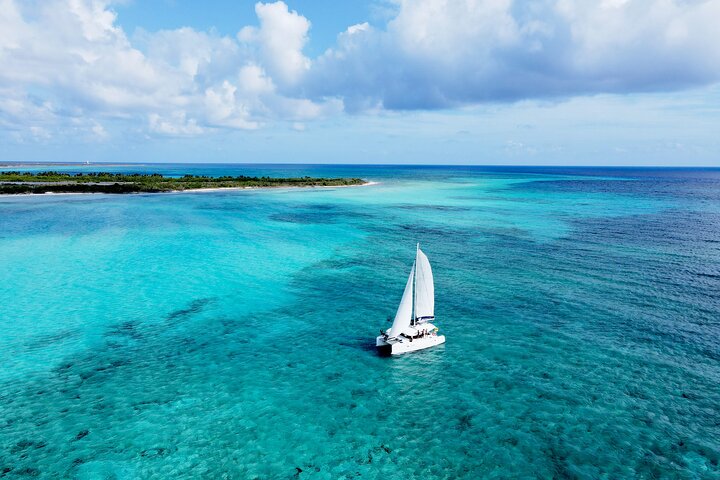
Lagoon 39ft Private Catamaran 5hr - El Cielo Full Experience
5 hours
From AUD 3091.47
Standing among the pyramids of Teotihuacán is one of those experiences that genuinely stops you in your tracks. The scale is hard to grasp until you're actually there — the Pyramid of the Sun alone rises 65 metres above the valley floor, and the Avenue of the Dead stretches over two kilometres through the ancient city.
This was once one of the largest urban centres in the pre-Columbian world, and that weight of history settles over you as you walk between the structures, especially in the quieter early morning hours before the tour buses arrive.
The site sits about 50 kilometres northeast of Mexico City, and getting there is straightforward. Buses depart regularly from Terminal del Norte (Metro Autobuses del Norte, Line 5) and drop you close to Gate 1, which is the most convenient entry point near the Pyramid of the Sun. The journey takes roughly an hour depending on traffic.
Alternatively, organised tours from the city are widely available and often include transport and a guide, which genuinely adds context to what you're seeing.
Crowds are the main challenge, particularly on weekends and Mexican public holidays when the site becomes extremely busy. Weekday mornings, arriving close to the 9am opening time, give you the best chance of a calmer visit. The high-altitude sun is fierce here — bring sunscreen, a hat, and more water than you think you'll need. Comfortable shoes with decent grip matter because the pyramid steps are steep and uneven.
Street vendors are persistent but generally good-natured; a polite but firm response works well.
Go on a Tuesday to Friday morning between November and February for cooler temperatures, thinner crowds, and the clearest skies.
When Priya from our BugBitten team arrived at the gates of Teotihuacán just before nine on a Tuesday morning in January, she expected to be impressed. What she didn't expect was to feel genuinely small. Not metaphorically small — physically small, the way you feel standing at the base of something that has absolutely no interest in acknowledging your presence. The Pyramid of the Sun rose ahead of her in the pale morning light, its stepped flanks catching the low angle of the sun, and the Avenue of the Dead stretched away to the north like a road that had been built for giants. There were maybe forty other people in sight. The vendors were still setting up their stalls. A dog trotted purposefully between the stones and disappeared somewhere behind a low wall. For about twenty minutes, before the first tour groups arrived, the place was as close to silent as a 2,000-year-old city in central Mexico ever gets.
That twenty-minute window, she said later, was the whole point. Everything else — the history, the archaeology, the sheer engineering audacity of the place — built from that opening image. It's the kind of arrival that reorients you for the rest of the day.
San Juan Teotihuacán is the modern municipality that surrounds the archaeological zone. Most travellers use the names interchangeably, though technically the ruins are the Teotihuacán Archaeological Zone, while the town itself is a quiet, working community of around 60,000 people. The site sits roughly 50 kilometres northeast of Mexico City in the State of Mexico — a detail worth noting because many visitors assume it falls within the capital's boundaries. It doesn't, and that distinction matters when you're planning transport and timing.
There are archaeological sites you visit because they're famous and sites you visit because they genuinely change your frame of reference. Teotihuacán manages both, which is rarer than it sounds.
At its height, between roughly 100 CE and 550 CE, Teotihuacán was one of the largest cities on the planet. Estimates of its population range from 100,000 to 200,000 people — figures that would have made it comparable to imperial Rome or Han dynasty Luoyang at the same period. The city was planned on a grid, oriented with deliberate astronomical precision, and built with a scale that speaks to a highly organised, centrally directed society. Who exactly ran this society remains one of the great open questions of Mesoamerican archaeology. No royal tombs have been found. No decipherable script has survived. The people who built this place left their monuments but not their names, which gives the site an odd, affecting quality that you don't get at, say, Chichén Itzá, where the Maya historical record is considerably fuller.
The three major structures — the Pyramid of the Sun, the Pyramid of the Moon, and the Temple of Quetzalcóatl — are remarkable individually, but the Avenue of the Dead is what ties the scale together. Walking its full length of roughly two kilometres, with structures rising on either side, you start to feel the logic of the city's layout in your legs rather than just your head. That's when the numbers — 65 metres tall, 2 kilometres long, 83,000 square metres of main pyramid base — stop being statistics and become something you're actually inside.
Teotihuacán is inscribed on the UNESCO World Heritage List and has been since 1987. The listing recognises not just the physical monuments but the site's outstanding universal value as evidence of a pre-Columbian urban civilisation that influenced cultures across Mesoamerica for centuries after its decline. That influence extended as far as the Maya lowlands, the Gulf Coast, and the highlands of Oaxaca — a reach that makes the city's anonymity all the more striking.
The archaeological zone itself is enormous — around 83 square kilometres in total protected area, though the core walking zone covers a more manageable stretch. The ground is uneven in places, the stone pathways worn smooth by millions of visitors over decades, and the sun has absolutely nothing between it and your hat. But the atmosphere, particularly in the early hours, is genuinely remarkable.
The surrounding landscape is high plateau — the site sits at about 2,300 metres above sea level — ringed by low mountains and the kind of sky that only exists at altitude, a very particular shade of deep blue that makes the stone structures look almost theatrical against it. In the dry season, the vegetation is scrubby and sparse, the colours muted to ochres and dusty greens, which works in the site's favour: nothing competes visually with the pyramids.
The town of San Juan Teotihuacán itself is a short distance from the main gates and is worth a brief look if you have time. There's a market, a church built partly from stones salvaged from the ruins (a fairly common occurrence across colonial Mexico), and a handful of restaurants that do a decent job of feeding post-pyramid appetites. It's not a tourist village in the manicured sense — it's a functioning Mexican town that happens to have one of the world's great archaeological sites on its doorstep, and it reads that way.
Both the Pyramid of the Sun and the Pyramid of the Moon are climbable, and you should do both if your knees allow. The steps are steep, irregular in height, and — on the Sun pyramid especially — quite daunting from below. Take them slowly and pause on the landings. The view from the summit of the Pyramid of the Sun looks directly down the Avenue of the Dead toward the Pyramid of the Moon, and it reframes the entire layout of the city in a way that no ground-level view can match.
The Pyramid of the Moon, while shorter (46 metres to the Sun's 65), arguably offers a better panorama because you're looking back down the full length of the avenue with the Sun pyramid to your right. It's also typically slightly less crowded at the top.
The Ciudadela compound, which contains the Temple of the Feathered Serpent (Quetzalcóatl), sits toward the southern end of the site and gets considerably less foot traffic than the pyramids. This is a mistake on the part of most visitors. The carved façade, with its alternating feathered serpent heads and rain deity masks, is among the finest surviving decorative stonework in Mesoamerica. Recent tunnel excavations beneath the temple have uncovered extraordinary ritual deposits — jade, obsidian, pyrite mirrors, and the remains of sacrificial offerings — that have substantially revised understanding of Teotihuacán's ceremonial practices. The on-site information boards explain the findings well.
There's a good archaeological museum within the site boundary, near Gate 5, that provides context for what you're seeing above ground. The scale model of the ancient city is particularly useful for orienting yourself before or after walking the avenue. Budget an hour here.
Some of the most satisfying time at Teotihuacán is spent slightly off the main axis, poking around the residential palace complexes — particularly Tetitla and Atetelco, which require a short walk west of the main zone — where beautifully preserved murals survive in protected rooms. These complexes cost a small additional entry fee and see a fraction of the visitor numbers. If you're comparing Teotihuacán to the coastal beaches at Akumal Bay or the resort energy of somewhere like Baja (Cabo San Lucas), the contrast couldn't be sharper — this is archaeological Mexico at its most demanding and most rewarding.
The honest answer is: Tuesday to Friday, between November and February, arriving as close to opening time (9am) as you can manage. This combination gets you cooler temperatures — the site can be brutal in the April–June dry season heat, with ground temperatures amplified by stone surfaces — and substantially thinner crowds. Mexican school holidays, Semana Santa (Holy Week), and long weekends see visitor numbers spike sharply. On a busy Saturday in peak season, the Avenue of the Dead can feel less like an ancient city and more like a slow-moving queue.
The rainy season (June through September) brings afternoon thunderstorms that can roll in fast. Mornings are generally clear, but the weather can change without much warning, and wet pyramid steps become genuinely hazardous.
The Visit Mexico official website maintains current information on public holidays and site conditions, and is worth checking before you book transport.
Winter mornings carry a chill at altitude, so a light layer is useful at entry — you'll shed it within an hour of walking, but the 7–8am journey from Mexico City can be cold. Bring sunscreen regardless of season. The UV index at 2,300 metres is significantly higher than at sea level, and many visitors underestimate it.
From Mexico City, the most straightforward option is the bus from Terminal del Norte (Metro Autobuses del Norte, Line 5). Buses to Teotihuacán depart regularly, the journey takes around an hour in reasonable traffic, and they drop you at or near Gate 1, which puts you conveniently close to the Pyramid of the Sun. Return buses operate from the same point. The entire journey is affordable — bus fares are a fraction of what you'd pay for a tour, though they come without commentary.
Organised tours from Mexico City are widely available and range from budget group trips to small-group or private options that include a guide, transport, and occasionally lunch. A knowledgeable guide makes a material difference here — the site is large and the archaeological context is genuinely complex. If you have a serious interest in pre-Columbian history, the guided option is worth the extra cost.
There are several decent restaurants clustered near the site gates, particularly around Gate 1 and Gate 3. The food is standard tourist-adjacent Mexican — not the most exciting you'll eat in the country, but functional after a few hours in the sun.
If you're travelling through the region, there's reasonable day-trip logic in combining Teotihuacán with the nearby town of Acolman, which has a 16th-century Augustinian monastery worth a brief stop. For broader regional context, explore more places in State of Mexico to see what else sits within reach of the capital.
Let's be direct. Teotihuacán has some genuine friction points that no amount of enthusiasm should obscure.
The vendor situation is persistent. Obsidian figurines, feathered serpent replicas, jaguar masks, and novelty flutes will be offered to you at regular intervals across the site. The vendors are generally not aggressive, but they are consistent, and on a busy day the repetition wears on you. A firm, polite "no gracias" — delivered without breaking stride — is the standard local protocol.
The sun and scale combination catches people off guard. The site is large, the ground is hard underfoot, and the elevation means UV exposure is significantly more intense than it looks. Sunburn, dehydration, and sore feet are the three most common visitor complaints, and all three are entirely preventable with basic preparation. Wear proper shoes. Not sandals. Not new shoes. Something with grip and a sole that will still be comfortable after six or seven kilometres of walking on stone.
The site is not wheelchair accessible in any meaningful sense. The terrain is uneven, the pyramid steps are obviously inaccessible, and even the main avenue has surfaces that present real difficulty for anyone with limited mobility. This is simply the nature of a 2,000-year-old city on uneven ground, but it's worth knowing before you arrive.
Queues at the gates on busy days can be slow. The ticketing infrastructure at a site of this size and visitor volume is functional but not fast. Budget extra time on weekends.
Teotihuacán is not comfortable tourism. It's hot, it's large, it asks something of you physically, and the vendors will find you no matter how purposefully you walk. None of that should put you off.
What Priya brought back from that January morning — and what we hear consistently from travellers who make the journey — is that the place justifies the effort in a way that few archaeological sites do. There's something about the combination of scale, anonymity, and physical presence here that resists easy packaging. You can't fully absorb Teotihuacán from photographs. You have to stand at the base of something enormous and built by people whose names nobody knows, and work out what that feels like in your body rather than just your imagination.
Go on a weekday morning in winter. Bring water, sunscreen, and shoes with proper grip. Skip the first hour of sleep if you need to. Get there before the crowds do. It's one of the most extraordinary places in the Americas, and the BugBitten team means that without qualification.


