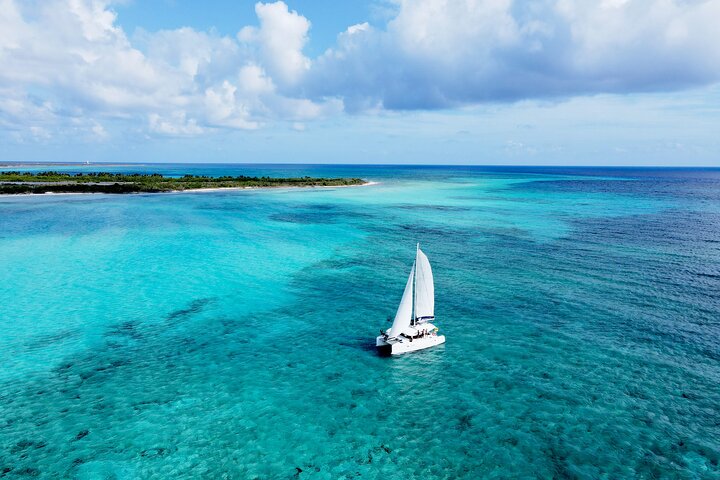
Lagoon 39ft Private Catamaran 5hr - El Cielo Full Experience
5 hours
From AUD 3091.47
Few ancient sites anywhere in the world carry the sheer weight of presence that Chichén Itzá does. Standing before El Castillo — the stepped pyramid of Kukulcán rising 30 metres from the flat Yucatán scrubland — is genuinely arresting, even when you're sharing the moment with a thousand other visitors.
The site covers a wide area, and beyond the famous pyramid there's real depth to explore: the vast Great Ball Court, the eerie Sacred Cenote, the circular observatory known as El Caracol, and the intricate carvings of the Temple of the Warriors. Give yourself a minimum of three hours to do it justice.
The crowds, however, are relentless and worth planning around. Tour buses from Cancún, Playa del Carmen, and Mérida typically arrive between 10am and 2pm, turning the main plaza into a scrum. Arriving at opening time (8am) or in the late afternoon gives you noticeably more breathing room. Vendors line every path selling trinkets and will follow you persistently — a polite but firm "no gracias" works fine.
You cannot climb El Castillo since 2006, which disappoints some visitors but genuinely protects the structure.
Getting there is straightforward. First-class ADO buses run directly from Mérida (around two hours) and Cancún (around three), and the journey is comfortable. Car hire gives you flexibility and lets you stop at Valladolid on the way. The entrance fee is split between federal (around 573 pesos) and state (around 572 pesos) charges, paid separately at the gate.
The Yucatán heat is serious business even in winter, so bring at least two litres of water, sunscreen, and a wide-brimmed hat; arrive at opening time in the dry season between November and March for the most manageable conditions.
When Sarah from our BugBitten team arrived at the Chichén Itzá site entrance at five minutes past eight on a Tuesday morning in late November, she expected some degree of quiet. What she didn't quite expect was the particular quality of that quiet — the way the flat Yucatán scrub stretches away in every direction, the air already warm and thick even before nine, and then the pyramid itself materialising through the trees. El Castillo doesn't ease you in. It just appears, enormous and perfectly proportioned, and the effect is a kind of full-stop silence in the brain. She stood there for a good two minutes doing nothing useful at all.
By half past ten, that particular silence was gone. Tour buses had begun filing into the car park in relays, their passengers fanning out across the main plaza with selfie sticks extended, and the vendors along the pathways had warmed to their task with real enthusiasm. But those first ninety minutes — that's the version of Chichén Itzá that makes the trip worthwhile. And there are plenty of ways to get yourself into that version, if you plan ahead.
The short answer is that El Castillo — properly called the Temple of Kukulcán — is simply one of the most impressive structures humans have ever built, and no photograph prepares you for the actual proportions of the thing. It stands around 30 metres tall from the flat scrubland floor, with four stairways of 91 steps each (plus the shared top platform step, totalling 365 — one for each day of the Haab solar calendar), and it was built with a mathematical precision that still baffles engineers today. The Maya aligned it so that during the spring and autumn equinoxes, the late-afternoon sun casts a shadow along the northern balustrade that looks exactly like a serpent descending the steps. That's not an accident.
But if you allow El Castillo to be the only thing you see, you've short-changed yourself considerably. The site covers roughly six square kilometres of what was once a major political and religious centre of the Late Classic and Early Postclassic Maya civilisation, home to a population that archaeological estimates put in the tens of thousands. Walking the full breadth of it — past the Temple of the Warriors with its forest of carved columns, past the Platform of the Eagles and Jaguars with its bas-relief skulls, and eventually out to the circular observatory known as El Caracol — gives you a sense of a functioning city, not just a monument.
The Great Ball Court alone stops most visitors in their tracks. It's the largest in the Americas — roughly 168 metres long — and its acoustics are genuinely uncanny. A clap or a sharp word spoken at one end of the court is audible at the other end with a clarity that seems to defy physics. The game played here was not recreational sport in any sense we'd recognise; players likely represented cosmic forces, and there's evidence suggesting the losing captain — or possibly the winning one, depending on how you read the carvings — was ritually decapitated. The carved stone rings fixed high on each wall give the court a haunting symmetry.
Chichén Itzá was inscribed on the UNESCO World Heritage List in 1988, recognised for its outstanding universal value as one of the best-preserved examples of Maya architecture and urban planning on the continent.
The Yucatán Peninsula has its own texture. The landscape around Chichén Itzá is low, flat, and scrubby — a dry deciduous jungle of thorny trees and limestone karst that looks sparse at first glance but is absolutely alive once your eyes adjust. There are no rivers here; the Maya relied entirely on cenotes, those extraordinary sinkholes in the limestone bedrock, for their water supply. The Sacred Cenote at Chichén Itzá, a roughly circular pool about 60 metres across and 20 metres deep, was not a swimming hole. Archaeologists have recovered gold, jade, pottery, and human skeletal remains from its depths — evidence of ceremonial offerings made over several centuries.
The light in this part of Mexico is punishing in the best possible way. By midmorning it falls near-vertical and brutally white, bleaching the limestone structures to an almost painful brightness. In the early morning or the late afternoon it turns golden and raking, throwing the carved friezes on every wall into sharp relief. If you're taking photographs — and you will be taking photographs — timing matters enormously.
The town of Pisté, which sits just two kilometres west of the ruins entrance, is where most of the guesthouses, local restaurants, and budget accommodation cluster. It's a functional rather than pretty settlement, but the comida corrida lunches at the smaller local spots off the main road are proper Yucatecan cooking — cochinita pibil, sopa de lima, poc chuc — at prices that feel almost embarrassingly cheap compared to the tourist-facing eateries right beside the park entrance.
Give yourself a minimum of three hours inside the site, and four is more comfortable. The standard circuit takes in El Castillo, the Great Ball Court, the Temple of Warriors, the Group of a Thousand Columns, and the Sacred Cenote. The southern section of the site — the older Puuc-influenced structures including El Caracol, the Nunnery, and the Church — is often overlooked by visitors who run low on energy or time, which is a shame because El Caracol in particular is architecturally distinctive; it's one of the few round structures in Maya architecture and shows evidence of slots in the walls aligned with the movements of Venus.
Audio guides are available for hire at the entrance, and they're useful — the signage inside the park is somewhat sparse in terms of contextual information. Alternatively, licensed guides can be hired at the main gate, and a good one will substantially deepen what you're seeing. Don't hire anyone who approaches you in the car park before you've entered; the licensed guides operate from inside the gate.
You cannot climb El Castillo. Access to the pyramid was permanently prohibited in 2006 following an American tourist's fatal fall down the northern staircase. This frustrates some visitors, but standing at the base and looking up, it's not entirely hard to understand — the steps are steep, narrow, and offer very little to grip. And the pyramid itself is more than impressive enough at ground level.
There is an evening sound-and-light show at the site during certain seasons. The production quality is variable and the viewing conditions are crowded. BugBitten's honest take: skip it unless you have a particular interest in son et lumière productions. Your time in the late afternoon, watching the sun drop over the scrub and the pyramid go amber and long-shadowed, is a better experience.
Roughly three kilometres east of the main site, Ik Kil is a privately operated cenote that's become extremely popular as a swimming stop. It's undeniably beautiful — a roughly circular sinkhole with hanging roots trailing from the rim to the water surface, about 26 metres down. It's also crowded to the point of disappointment through most of the midday period. If you go, go early or skip it and find a less trafficked cenote near Valladolid instead.
The dry season — broadly November through March — offers the most manageable visiting conditions. Temperatures in this period still reach the low to mid-30s Celsius by midday, but humidity is lower and there's no threat of afternoon tropical downpours. The equinoxes in late March and late September draw significant crowds specifically to watch the serpent shadow effect on El Castillo's staircase; if you want to see it, book accommodation months in advance and brace for a particularly congested site.
April, May, and October can be very hot and humid. June through September is technically the wet season, bringing afternoon storms and higher humidity; the site is less crowded during these months, but conditions can be genuinely uncomfortable and some tour services run reduced schedules. There's also the practical issue that wet limestone paths get slippery.
The Visit Mexico official website has seasonal information and current entrance requirements, which are worth checking before you travel as fees and procedures update periodically.
Whatever month you visit, arrive at the 8am opening time. The difference between 8am and 10am at this site is not marginal — it's the difference between having space to look at what you've come to look at, and navigating a dense crowd. The tour buses from Cancún and Playa del Carmen typically arrive between 10am and 1pm and the transformation of the main plaza during that window is remarkable. Plan your morning accordingly.
By bus: First-class ADO buses run directly to Chichén Itzá from Mérida in roughly two hours and from Cancún in roughly three. The Mérida route is particularly straightforward and comfortable. The drop-off is directly adjacent to the western entrance of the site.
By car: Hiring a car from Mérida or Cancún gives you the flexibility to set your own schedule and stop at Valladolid on the way. Valladolid, roughly 40 kilometres east of the ruins, is an underrated colonial city with good food, a central park worth lingering over, and access to the Zací cenote right in the middle of town. It also makes a significantly more atmospheric base than the guesthouses at Pisté, if you can manage the logistics.
From Pisté: If you're staying in Pisté, the site entrance is walkable in about 20 minutes or a short tuk-tuk ride.
Entry fees: The entrance is split between a federal charge and a state charge, paid at separate windows. At time of writing these are approximately 573 pesos (federal) and 572 pesos (state). Cash or card is generally accepted but confirm this before arriving with only one payment method. The total in Australian dollars fluctuates with the exchange rate but tends to come in around $45–$55 AUD all up.
If you're exploring the wider region, the more places in Yucatán section of the BugBitten site has a solid overview of what else the peninsula has to offer beyond the main archaeological circuit.
Let's be straightforward about this. Chichén Itzá is one of the most heavily visited tourist sites in Mexico — somewhere north of two million visitors annually — and the infrastructure inside the site has not kept pace with that volume. The main plaza around El Castillo on a busy day is an uncomfortable scrum. The vendors inside the site boundaries are persistent in a way that some travellers find draining: they will follow you, they will lower their price incrementally as you walk away, and they will keep going. A polite but clear "no gracias" is the move, and avoiding eye contact helps. The practice is sanctioned and they have as much right to be there as you do, but it does colour the experience.
The food directly adjacent to the site — both inside and in the immediate tourist area outside the gate — is mediocre and expensive. Eat in Pisté or pack something. The shade inside the archaeological zone is genuinely limited; there are trees in some sections but the main plaza is almost entirely exposed. People underestimate the heat and pay for it. Bring at least two litres of water per person, proper sunscreen, and a wide-brimmed hat. These are not optional suggestions.
The road from Cancún tends to attract operators running day-trip packages that bundle Chichén Itzá with a cenote and a beach stop and try to fit it all into eight hours. This is too much. You'll get an hour at the ruins feeling harried, and none of it will be satisfying. If you're coming from the Riviera Maya side, either do it as a dedicated day with your own transport, or go via bus with a night's stay.
For those who want a genuinely different perspective on the Yucatán landscape — something off the main archaeological circuit — Maya Jungle Trail Cycling is worth considering as a complement to any ruins visit. And if you're after something quiet and coastal at the end of a trip, Dzilam de Bravo on the northern coast is about as far removed from Chichén Itzá's crowds as the peninsula gets.
Chichén Itzá has earned a degree of scepticism from experienced travellers who've heard it described as overrated, over-touristed, or somehow diminished by its own fame. That scepticism is understandable, and it's not entirely wrong — visit at the wrong time of day and you'll spend most of your hours there fighting the crowd rather than engaging with the site. But get the logistics right, and what you're left with is a genuinely extraordinary piece of human history in one of the most geographically unusual landscapes on the continent.
El Castillo at eight in the morning, with the light still soft and oblique and most of the plaza still quiet, is an experience that earns every bit of the four-hour round trip from Mérida. Go in November or February. Arrive at opening time. Eat in Pisté. Say no gracias with a smile and mean it. And then give yourself the time to walk the full site — all the way to El Caracol and back — because the thing about Chichén Itzá is that it's not really just a pyramid. It's a city, and it rewards the people who treat it like one.


