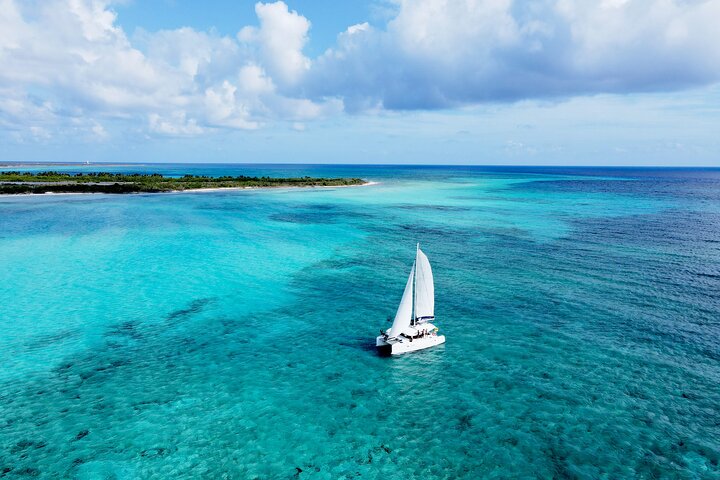
Lagoon 39ft Private Catamaran 5hr - El Cielo Full Experience
5 hours
From AUD 3091.47
Cenote Suytun is one of those places that stops you mid-step. Located about eight kilometres outside Valladolid along the road to Ticuch, it sits inside a low limestone cave where a stone walkway extends out over still, turquoise water — the kind of scene that looks almost fabricated until you're standing in the middle of it, light filtering down from a single circular opening in the ceiling above.
On a clear morning, that shaft of sunlight hits the water directly, creating a glow that photographers chase from across the country.
The cenote is privately owned and charges an entrance fee of around 150–200 pesos per person, which typically includes access to a small site with changing rooms and basic facilities. The walkway itself is narrow, so when tour groups arrive — and they do, in numbers, particularly between 10am and 2pm — it can feel crowded and rushed.
If you want the cenote largely to yourself, aim to arrive right when it opens, usually around 9am. The light is softer then and the coaches haven't arrived yet.
Swimming is allowed, and the water is cool and clear. Wear your swimmers under your clothes and bring a dry bag for your things, as storage space is limited. You can reach Suytun by taxi or colectivo from Valladolid's centre, with the journey taking roughly fifteen to twenty minutes.
Some visitors combine it with Cenote Xkeken, located just next door, which has a more open, cavernous feel and is well worth the short walk between the two.
The dry season, roughly November through April, offers the best light conditions and more reliable access — visit on a weekday if you can to avoid the weekend rush.
When Sarah from our BugBitten team pulled up to Cenote Suytun just before nine on a Tuesday morning in February, the gravel car park held exactly two vehicles and a dog that seemed unsure of its own agenda. The humidity was already doing its thing — that particular Yucatán brand of warmth that settles on your shoulders the moment you step out of an air-conditioned cab — and the entrance looked modest enough that she nearly second-guessed the address. A low structure, a small booth, some painted signage. Nothing that prepares you for what's waiting underground.
She paid the entrance fee, walked through the changing rooms without needing them (swimmers already on under her clothes, as recommended by basically everyone who'd been before), and followed the concrete path down into the earth. Then she stopped. Not because someone told her to. Not because there was a sign. She just stopped, the way you do when something lands differently than your brain anticipated.
A stone walkway stretches out across the water — narrow, deliberate, almost ceremonial — and at the end of it, a column of light falls from a circular hole in the cave ceiling directly onto the pool below. The water sits completely still. It is the colour of shallow Caribbean ocean, that blue-green that reads as computer-generated until you're staring straight at it. In that early-morning window, before the tour coaches creak into the car park and the walkway fills with people queueing for the same photograph, the place feels genuinely private. Like finding a room in someone else's house that wasn't on the floor plan.
That's the version of Cenote Suytun that most visitors are chasing. Whether or not they catch it depends almost entirely on what time they arrive.
There are hundreds of cenotes scattered across the Yucatán Peninsula — sinkholes and semi-open caves and open-air swimming holes that dot the limestone shelf this part of Mexico sits on. Many of them are beautiful. Several are genuinely spectacular. But Suytun has something that most of the others don't quite replicate: a single architectural quality that makes it feel almost designed.
That quality is the light column. The circular opening in the ceiling functions like a natural skylight, and on mornings when the sun is at the right angle — roughly between 9am and 11am during the dry season — it sends a defined shaft of light directly down onto the water's surface and the stone walkway beneath it. The effect is dramatic without being theatrical. The cave walls absorb the rest of the light in a way that deepens the contrast, so the illuminated patch of water and stone almost seems to float in the dimness around it.
The cenote itself isn't massive. It isn't one of those great cathedral caves that you can spend an hour exploring from different angles. The experience here is concentrated, almost singular — you walk the walkway, you stand in the light, you get in the water if you're swimming, and you sit with it for as long as the crowds allow. That sounds like a limitation, and perhaps it is. But it also means the experience doesn't get diluted. There's no ambiguity about what you came for, and on a quiet morning, it delivers that thing completely.
Swimming is permitted and the water is cold in the most refreshing possible sense — spring-fed, clear enough to see the bottom from the walkway above, and genuinely comfortable to be in once you've adjusted. It's not a large swimming area, so it doesn't take many people before it starts to feel congested, which is another good reason to arrive early.
The entry fee — typically somewhere between 150 and 200 Mexican pesos per person at time of writing — is reasonable for what you get, and the site includes basic facilities including changing rooms and lockers. Nothing flash, but functional.
Cenote Suytun sits about eight kilometres from Valladolid along the road towards Ticuch — close enough to the town that it functions well as a morning excursion, far enough that it sits in genuinely rural surroundings. The road out there is flat and straight in the way that most Yucatán roads are, flanked by low scrub and the occasional small farm. There's no dramatic approach, no sense that you're being funnelled towards a tourist attraction. It just appears.
Valladolid itself is one of the more underrated colonial towns in this part of Mexico — a grid of coloured facades, a central square with a 16th-century cathedral, and a food market that rewards early-morning visits. It sits roughly halfway between Chichén-Itzá and the coast, which makes it a logical base for anyone exploring the broader Yucatán region without wanting to stay in either of those more touristy hubs. The town has a slower pace than Mérida, warmer days than Cancún, and a locals-to-visitors ratio that still feels roughly balanced.
The landscape around Suytun doesn't announce itself. There's no viewpoint on the way, no scenic overlook. The Yucatán Peninsula is almost entirely flat, and the cenotes exist because the limestone surface has collapsed inward over thousands of years — it's a geological story that plays out underground rather than on the horizon. That underground world is genuinely extraordinary, but you have to commit to going down into it to understand what all the fuss is about.
Around the cenote itself, the grounds are managed and relatively tidy. There's a small area with seating, the facilities are looked after, and the staff are present without being overbearing. During peak hours, the operation runs efficiently because it has to — when six tour coaches arrive in the same ninety-minute window, crowd management becomes its own skill set.
The central activity is obvious: walk the stone causeway, stand in the light, swim in the water. But there are a few adjacent decisions worth making before you arrive.
Get in. Seriously. The temptation, particularly if you've arrived in dry clothes and are worried about your camera, is to treat Suytun as a photography stop rather than a swimming spot. That's understandable, and the photographs are genuinely worth having. But the water changes the experience — the way the light filters through it from below, the cold shock of it after the walk down, the altered perspective you get of the cave from the surface of the pool. Wear your swimmers under your clothes, bring a dry bag for your valuables and phone, and give yourself permission to actually get in.
Directly adjacent to Suytun — a two-minute walk — is Cenote Xkeken, which operates on the same site and is usually bundled into a combined ticket or offered at a small additional cost. Where Suytun is intimate and focused, Xkeken is broader and more cavernous, with stalactite formations hanging from the ceiling and a larger swimming area. The two complement each other well and visiting both on the same morning makes obvious sense. Don't leave without checking whether your ticket covers entry to both.
The light column at Suytun shifts as the morning progresses. If you're specifically there for the photograph — the one with the golden shaft falling onto the circular walkway — you'll want to be in position between roughly 9.30am and 10.30am. Bring a wide lens if you have one. The cave is dim and your phone camera will struggle with the contrast, though modern smartphones with a night mode can handle it better than you'd expect.
If you're spending more than a day in the area, consider pairing the cenote visit with something more active. The Maya Jungle Trail Cycling route is one of the better ways to see the surrounding landscape, and it adds physical context to an otherwise geology-focused morning.
The dry season in the Yucatán runs roughly from November through to April, and this is when Suytun performs at its best. The skies are clearer, the light shaft is more reliable, and the cenote itself is more accessible — heavy rains during the wet season (May through October) can affect water levels and, occasionally, site access.
Within the dry season, weekdays are strongly preferable to weekends. The cenote is well-established on the Yucatán tourist circuit, which means weekend visitor numbers can be significant. If you arrive at 9am on a Saturday, you'll have a better experience than arriving at 11am on a Wednesday, but the inverse — arriving at 9am on a Wednesday — is the clear winner.
The worst window of any given day is roughly 10am to 2pm, when tour groups from Valladolid, Mérida, and the Riviera Maya all tend to converge. The walkway is narrow enough that this creates genuine queuing and jostling. The magic of the quiet morning becomes a very different proposition when twenty people are waiting behind you for their turn in front of the light.
If you're travelling during a Mexican school holiday period — Semana Santa in particular, which runs in late March or early April — build in significant extra patience or consider whether the timing is right for this kind of place. The cenote doesn't expand to accommodate the demand.
Cenote Suytun sits at Carretera Ticuch Km 8, about eight kilometres from Valladolid's town centre. Getting there from Valladolid is straightforward.
By taxi: From the central square, a taxi to Suytun should cost roughly 100–150 pesos each way. Agree the price before you get in. Ask the driver if they'll wait, or arrange a return pick-up time — some will, for a reasonable fee, which saves you fussing about the return trip.
By colectivo: Shared minivans (colectivos) run from Valladolid towards Ticuch and pass near the cenote entrance. The fare is minimal — typically 20–30 pesos — and the journey takes fifteen to twenty minutes. This is the local option, and it works fine, though timings aren't always predictable.
By rental car or scooter: If you're mobile, driving yourself gives you the most control over timing, which matters here more than most places. Parking at the site is easy and free.
Nearby stops: Cenote Xkeken is on the same site, so that's a given. Further afield, the ruins of more places in Yucatán are worth building into a broader regional itinerary. Valladolid's Cenote Zaci, located right in the town centre, is a useful add-on if you finish at Suytun earlier than expected — it's a completely different environment, open-air and urban, and the contrast is interesting.
The broader context for travel in this region is well-covered by Visit Mexico (official), which has practical information on transport, accommodation, and regional itineraries for the Yucatán Peninsula.
It would be dishonest to write about Suytun without being direct about the crowd situation. This cenote has circulated widely on travel photography platforms, and that visibility has consequences. On busy days, the walkway — which is genuinely narrow, perhaps enough for two people side by side in places — becomes a slow shuffle. The serenity that makes the early-morning visit so good is essentially absent from the mid-morning version. You're still seeing the same physical place, but the experience is substantially different.
The site facilities are functional rather than comfortable. Changing rooms are available but small, and storage options are limited — bringing a dry bag for your valuables and keeping your setup simple is the practical approach. There are no cafés or food options on site, so if you're planning to spend a couple of hours between Suytun and Xkeken, bring water and something to eat.
The entrance fee is reasonable, but it has crept upward in recent years and may continue to do so as visitor numbers increase. Check current pricing before you go — 150 to 200 pesos is a guide, not a guarantee.
The Yucatán Peninsula's broader significance — both ecologically and culturally — means these cenotes exist in a complex context. Many of them are on the UNESCO World Heritage List through their association with the broader Mesoamerican cultural and natural landscape, and they're also part of a delicate freshwater system that faces pressure from tourism and development. Worth keeping in mind that visiting responsibly — no sunscreen before swimming, no littering, not climbing on formations — genuinely matters here.
Finally: the cenote is beautiful, but it is small. Visitors who arrive expecting a sprawling cave system may feel the experience is briefer than anticipated. It's best understood as a single, concentrated moment rather than a half-day adventure. Pair it with Xkeken and Valladolid itself, and you've got a very solid morning.
Cenote Suytun is the kind of place that earns its reputation on honest terms. The light shaft is real. The water is as clear as advertised. The walkway moment — standing at the end of that narrow stone causeway with the circular glow falling around you — is genuinely affecting in a way that's difficult to replicate anywhere else in the Yucatán.
What it asks in return is timing. Arrive early, arrive on a weekday, swim rather than just photograph, and walk next door to Xkeken before the coaches fill the car park. Do those things, and Suytun pays off entirely. Miss the window and it's still fine — still worth the fare from Valladolid, still worth the entry fee — but it becomes a very different proposition.
Sarah came back to the BugBitten office with water still in her ears and a phone full of imperfect photographs that somehow still communicate exactly what it felt like to stand in that cave at nine in the morning with the light doing its work on the water below. That's the version to aim for. Go early. Get in the water. Stay long enough to let the place settle on you before the crowd arrives.


