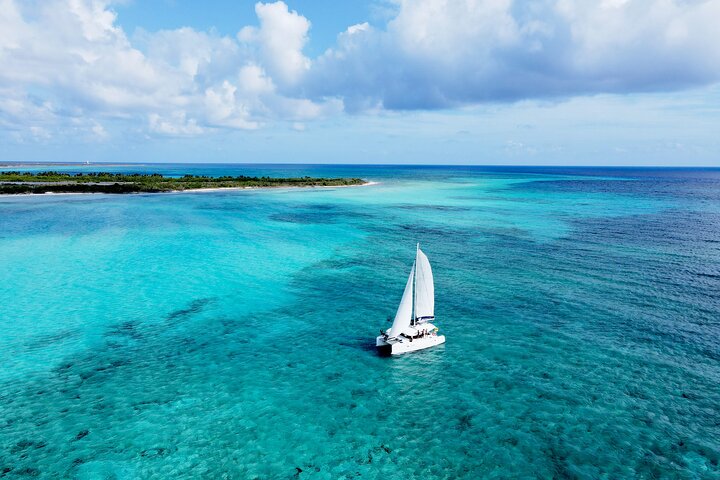
Lagoon 39ft Private Catamaran 5hr - El Cielo Full Experience
5 hours
From AUD 3091.47
Few buildings in Latin America stop you in your tracks quite like the Palacio de Bellas Artes. Rising at the western edge of the Centro Histórico near Alameda Central, this marble and onyx palace is simultaneously an art museum, an opera house, and one of the most architecturally striking structures on the continent.
The exterior blends Italian Art Nouveau with pre-Hispanic motifs, while the interior shifts dramatically into Art Deco — all polished stone, sweeping staircases, and stained glass that bathes the lobby in warm colour on a sunny afternoon.
The upper floors house some of Mexico's most significant murals, with works by Diego Rivera, José Clemente Orozco, and David Alfaro Siqueiros displayed across multiple levels. Rivera's reproduction of the famous Rockefeller Center mural, *Man at the Crossroads*, is genuinely worth lingering over.
Museum entry is around 90 pesos for the permanent collection, though Sundays are free for Mexican nationals, which means the building gets considerably busier — worth knowing if you prefer a quieter experience.
Getting there is straightforward. The Bellas Artes metro station sits directly outside, served by Lines 2 and 8. Taxis and ride-share apps drop you right at the corner of Avenida Juárez. The surrounding streets can feel overwhelming at peak hours, with vendors and heavy foot traffic, so keep an eye on bags in the crowd.
Dress comfortably but note that performances and evening events often carry a smarter dress code if you plan to attend the theatre.
Aim to visit on a weekday morning when light floods the interior and crowds are thin — bring a little cash for tickets and allow at least two hours to do it justice.
When Sarah from our BugBitten team stepped out of the Bellas Artes metro station on a Tuesday morning in March, she wasn't entirely prepared for what was waiting above ground. She'd seen photographs, of course — everyone who's researched Mexico City has seen photographs — but photographs do a genuinely poor job of communicating the sheer physical presence of this building. It sits at the western edge of the Centro Histórico like something that belongs to a different century, possibly a different continent, and yet it feels completely and unmistakably Mexican. The white Carrara marble catches the early morning light and throws it back at you. The green copper dome rises above the smog and the street noise. Vendors were already setting up along Avenida Juárez, and the traffic was building, but for a long moment Sarah just stood there on the footpath and looked at it.
She was there to see the murals, primarily. She'd been working her way through Mexico for three weeks — coastal reef systems like Isla Mujeres Reefs, the cenote-riddled Yucatán, the colonial cities of the interior — and Mexico City was her final stop. The Palacio de Bellas Artes had been on the list from the beginning, but she'd deliberately saved it. You should, she said afterwards, save the things that matter. Get the lay of the land first. Then come back to the things you actually want to understand.
She was inside by 9:15 am, before the tour groups arrived, and she stayed for nearly three hours.
There are buildings in the world that serve a single purpose well, and there are buildings that try to do too many things and end up doing none of them particularly convincingly. The Palacio de Bellas Artes is neither. It is, without exaggeration, three serious institutions occupying one extraordinary shell — an art museum of genuine national significance, a concert hall and opera house that hosts some of the finest performances in Latin America, and an architectural monument that draws visitors from every corner of the world. The fact that it manages all three with coherence and even a degree of elegance is the first thing worth understanding about it.
Construction began in 1904 under the direction of Italian architect Adamo Boari, who designed the exterior in the Art Nouveau style that was fashionable in Europe at the time. The building was interrupted by the Mexican Revolution, resumed later, and finally completed in 1934 under Mexican architect Federico Mariscal, who finished the interior in the Art Deco idiom that had since become dominant. The result of this interrupted, multi-decade construction is a building with a split personality — one that somehow works. The exterior is all organic curves, ornamental ironwork, and pre-Hispanic sculptural motifs worked into European decorative vocabulary. Step inside and everything shifts: clean geometric lines, polished stone in deep ochres and greens, sweeping staircases, and an interior that feels more like a cathedral than a theatre.
The building also sits on marshy subsoil typical of the ancient lake bed Mexico City occupies, which means it has sunk approximately four metres since construction began. Rather than making it feel precarious, this somehow adds to the sense that the place is thoroughly embedded in the city — literally and metaphorically.
For anyone interested in Mexican history, art, or architecture, this is not an optional detour. It is a primary destination.
The Centro Histórico is one of the most densely layered urban environments in the Americas, and the blocks surrounding the Palacio de Bellas Artes reflect that compression of history and daily life in ways that can feel exhilarating or exhausting depending on your temperament and time of day.
The Alameda Central park sits directly to the west of the building — a formal garden that dates to the late sixteenth century, making it the oldest public park in the Americas. In the mornings, it fills with workers cutting through on their commute, retirees on benches, and couples walking before the heat builds. Ice cream carts appear by mid-morning. On weekends it gets genuinely crowded but retains a neighbourhood feel that the more tourist-heavy Zócalo area sometimes lacks.
Avenida Juárez runs along the southern edge of both the park and the Palacio, and it's a proper city boulevard — wide, noisy, flanked by a mix of grand nineteenth-century buildings, post-earthquake reconstructions from the 1980s, and the occasional gleaming modern tower. Street food vendors work the footpaths from early morning. Taco stands, fresh juice stalls, and roving sellers of everything from phone chargers to lottery tickets create a continuous low-level hum that is quintessentially chilango, the slang term for Mexico City residents.
The Eje Central runs north-south nearby, and the pedestrian street of Madero connects the area eastward to the Zócalo. Walk it in either direction and you're passing through one of the most significant stretches of historic urban fabric in the country — buildings that have been standing, in some form, since the colonial period.
It's worth knowing that this area also concentrates a lot of foot traffic, which means pickpocketing is a real concern rather than a theoretical one. Keep bags in front of you, don't have your phone out unnecessarily, and be conscious of your surroundings. This is standard advice for central areas of most large cities, but it applies here with particular force.
The permanent collection of murals on the upper floors is the primary reason most visitors come, and it fully justifies the entry fee, which sits at around 90 pesos for adults. Diego Rivera, José Clemente Orozco, David Alfaro Siqueiros, and Roberto Montenegro all have significant works here, spread across the second and third floors.
Rivera's Man at the Crossroads — technically a reproduction, as the original was destroyed at Rockefeller Center in 1934 after Nelson Rockefeller objected to the inclusion of Lenin's face — is displayed on the third floor and rewards extended looking. It's a dense, ambitious painting that tries to compress the entire political and technological condition of the twentieth century into a single composition. Whether you find it convincing or overwrought, you can't really look away from it.
Orozco's Katharsis on the second floor is darker and more unsettling — a churning mass of figures that reads as a denunciation of violence, capitalism, and moral corruption simultaneously. Siqueiros's work here is characteristically aggressive in its use of perspective and scale. Spend time with each of these rather than moving quickly. They're large enough that you need to stand at different distances to take them in properly.
Even without entering the museum proper, the lobby and ground floor spaces are worth your time. The Tiffany stained-glass curtain — designed to lower in front of the stage for certain performances — depicts scenes from Mexican landscapes including the volcanoes Popocatépetl and Iztaccíhuatl. You can view it on special occasions when it's lowered, though checking the performance schedule in advance is necessary for this.
The staircases, the stonework, and the detailing throughout the interior are worth examining slowly. This isn't a building that rushes you.
The Bellas Artes hosts opera, ballet, the Ballet Folklórico de México, and classical concerts throughout the year. The Ballet Folklórico performances, which present traditional regional dances from across Mexico's states, have been running here since 1952 and are a legitimate cultural experience rather than a tourist production. Tickets sell out; book ahead through the official channels. If you're going to a performance, note that the dress code leans formal — this is a proper venue with a proper audience.
Weekday mornings between roughly 9 am and noon are the clear sweet spot. The light that comes through the lobby on a sunny morning is genuinely spectacular, and the crowd at that hour is thin enough that you can stand in front of murals without jostling for position.
Sundays are free entry for Mexican nationals, which is a genuinely good policy from a civic perspective but does mean the building is substantially busier. If you're visiting on a Sunday, arrive when doors open or expect company.
The broader museum district and city centre, along with attractions like the Cenote Suytun and other natural landmarks across the country, sees its peak tourist season between December and April, when the weather is dry and temperatures are manageable. The Mexico City rainy season runs roughly from May through October, and while afternoon downpours are common, mornings are usually clear. The Palacio is an indoor destination in large part, so rain doesn't disqualify a visit — but navigating the Centro in a heavy afternoon storm while also watching your bags is a lot to manage at once.
Avoid major national holidays if you're averse to crowds — Día de los Muertos in late October and early November, Semana Santa, and Mexican Independence Day on the 15th and 16th of September all bring significant numbers of domestic tourists into the centre.
Getting to the Palacio is straightforward. The Bellas Artes metro station sits directly outside and is served by Lines 2 and 8, making it accessible from a wide range of points across the city. The metro is cheap, reasonably reliable in the central sections, and runs frequently during peak hours. The trip from Roma Norte or Condesa, two popular neighbourhoods for visitors, involves a short bus or taxi leg to connect to the metro, or a ride-share directly to the front of the building.
Ride-share apps including Uber and DiDi work well in Mexico City and are generally considered safer than hailing taxis on the street, though registered taxis from designated stands are also fine. Traffic in the Centro is severe during morning and evening rush hours, so if you're coming by car, factor in significant buffer time.
Once you're at the Palacio, the surrounding area offers a full day's worth of further exploration. The Museo Franz Mayer, which houses decorative arts from the colonial period, sits on the northern side of the Alameda. The Museo Nacional de Arte (MUNAL) is a few blocks east and covers Mexican fine arts from the sixteenth century through the mid-twentieth. The Zócalo, Mexico City's main plaza and one of the largest public squares in the world, is a fifteen-minute walk east along Madero.
For a broader itinerary covering the city's major sites, the BugBitten guide to more places in Mexico City is a useful reference point for building out your time in the capital.
The Visit Mexico official website also maintains current information on opening hours, event schedules, and ticketing for cultural venues across the country, which is worth checking before you travel since hours and prices do change.
Let's be honest about some things, because every place has them.
The crowds on weekends and public holidays are genuinely difficult. This isn't a building where you can easily find a quiet corner to sit with the murals — the spaces are defined by broad corridors and open floors, which means when it's full, it feels full. If you're sensitive to noise and jostling, a busy Sunday afternoon here will frustrate you.
The surrounding streets require a level of alertness that some travellers find draining. The Centro Histórico is not a dangerous area by the standards of a city this size, but it is a densely populated urban environment with significant foot traffic, and that combination creates opportunities for theft. This shouldn't stop you going — it should just inform how you prepare.
The building itself has ongoing maintenance challenges. The sinking foundation is a structural reality that Mexican engineers have worked to stabilise, but it means parts of the building occasionally show the wear of a century on unstable ground. Some restoration work is ongoing; don't be surprised if a section is temporarily inaccessible.
Finally, signage within the museum is in Spanish. If your Spanish is limited, a guidebook or a downloaded translation app will help you get more from the mural collection, where context significantly deepens the experience. Audio guides are available but limited in what they cover.
The Palacio de Bellas Artes is one of those places that earns its reputation without effort. It isn't trading on nostalgia or brand recognition — it's simply a building of exceptional quality that houses art of genuine importance, in a city that has more layers of history per square metre than almost anywhere on earth. Mexico City's historic centre is listed among the UNESCO World Heritage sites of the world, and spending time at the Palacio gives you a concrete sense of why that designation exists — not as bureaucratic recognition, but as an acknowledgement that something irreplaceable is here.
Go on a weekday morning. Buy the ticket for the permanent collection. Stand in front of Rivera's mural for longer than feels comfortable. Let the lobby light do what it does on a sunny day. If you can get tickets to a Ballet Folklórico performance, do that too — it's a different and equally worthwhile experience of the same building.
Sarah left at just after noon, back out onto Avenida Juárez into the noise and heat and movement of the city. She said it was the best three hours she'd spent in a building in years. We don't think she was exaggerating.


