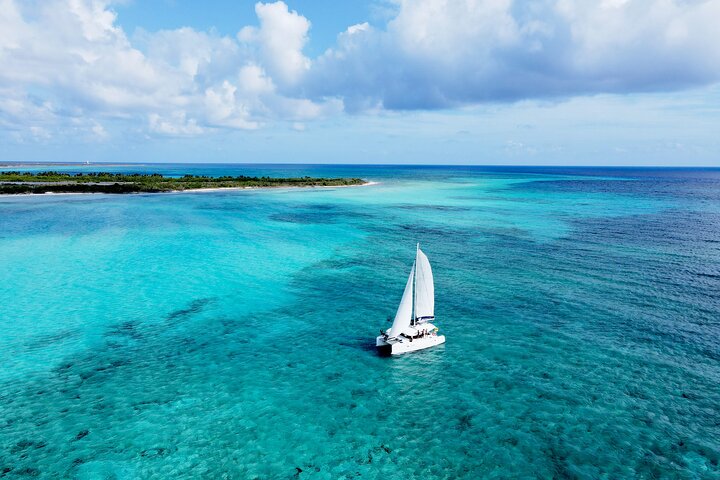
Lagoon 39ft Private Catamaran 5hr - El Cielo Full Experience
5 hours
From AUD 3091.47
Birding Sierra Gorda feels like working through several countries at once. The reserve stretches across a dramatic altitudinal gradient in northern Querétaro, dropping from pine-oak highlands above 3,000 metres down through cloud forest, tropical dry forest, and riparian corridors into semi-arid scrub at the canyon floors.
That mosaic means your species list can look almost contradictory by mid-morning — highland endemics before breakfast, lowland specialists by the time the heat builds.
Dawn is your most productive window, particularly along the forested slopes above Jalpan de Serra and in the cloud forest patches near Pinal de Amoles. The Bearded Wood-Partridge requires patience and an early start on steep, leaf-littered trails — you're more likely to hear it than see it, so go slowly.
Military Macaws are less elusive; scan the limestone cliff faces and listen for their raucous calls echoing through the gorges. The Blue-capped Hummingbird, a Mexican endemic, shows best at flowering scrub in the transitional zones. The White-throated Robin turns up as a scarce winter visitor, so timing matters.
Access is straightforward via Highway 120 from Querétaro city, roughly three hours. Community ecotourism infrastructure is genuine rather than cosmetic — local guides based in Jalpan and the ejido communities know the trails well and are worth hiring for their knowledge of roost sites and flowering patterns. Accommodation ranges from basic guesthouses in Jalpan to a handful of comfortable ecolodges. Roads into higher elevations can deteriorate badly after summer rains.
The reserve is genuinely undervisited by international birders, which means trails are quiet and competition for scope views is not something you'll have to worry about.
Go October to March for the best variety; bring rubber boots after September, a scope for cliff-face macaw watching, and strong repellent for the lower canyons.
Listen, my friend — I am going to tell you about a place most travellers to Mexico never go, and which is, in my view, one of the most architecturally and ecologically extraordinary regions in the whole of North America. The Sierra Gorda. Northeast Mexico. State of Querétaro. UNESCO Biosphere Reserve since 2001. Five 17th-century Franciscan missions, also UNESCO listed since 2003. Cloud forest, semi-desert, oak forest, tropical evergreen, all stacked in the same range.
I went twice — once in 2019 with Tobi on a road trip, once in 2023 alone for a four-day architectural research stint. Both times I left thinking the same thing — how does almost nobody know about this place?
[IMAGE: https://images.unsplash.com/photo-1518105779142-d975f22f1b0a?w=1600&q=80&auto=format&fit=crop | Limestone karst peaks rising above cloud forest in the Sierra Gorda]
The Sierra Gorda is a portion of the eastern Sierra Madre, sitting on the borders of Querétaro, Guanajuato, Hidalgo and San Luis Potosí states. About 384,000 hectares of biosphere-protected land. Elevation runs from 300 metres in the canyons to 3,100 metres in the high country. The geology is folded marine limestone, riddled with caves, sinkholes (sotanos), and karst springs. The biological diversity is extraordinary — 15 different vegetation types, 600+ bird species, 110+ mammals (including jaguars, ocelots, black bears, the rare white-eared hummingbird), and a substantial endemic flora that exists nowhere else on Earth.
This is the only biosphere reserve in Latin America that was created and continues to be run primarily by local people — the Grupo Ecológico Sierra Gorda, founded by Martha "Pati" Ruiz Corzo, has managed it for over thirty years. The community-led model is itself something to study. Pati got the Order of the British Empire for it.
From Mexico City, drive northeast to Querétaro city (2.5 hours on the toll road), then east into the Sierra (3-4 more hours on increasingly windy mountain roads). The main town in the reserve is Jalpan de Serra — about 6 hours total from Mexico City. You need a car. Bus connections to Jalpan exist but they're slow and they don't help you reach the trailheads.
The roads through the Sierra are steep, narrow, and beautiful. Drive in daylight. Drive slowly.
Five missions, built between 1751 and 1768 under the direction of Franciscan friar Junípero Serra (who would later go on to build the California mission chain). They sit in the four small towns of Jalpan, Concá, Landa de Matamoros, Tilaco, and Tancoyol. Each is built around a Baroque facade carved by indigenous Pame artisans, which is the part that makes them extraordinary — the facades are a complete fusion of European Baroque iconography and indigenous Pame symbolism. Saint Francis stands next to Aztec eagle warriors. Christian angels carry calabash gourds. The Virgin Mary is rendered in the same compositional style as pre-Hispanic stone goddesses.
I have seen a lot of churches in this life — Brasilia, Sicily, Goa, the Niemeyer cathedral — and these Sierra Gorda facades are some of the most moving syncretic religious art anywhere. Bring a notebook. Bring a camera. Spend 20-30 minutes at each facade. The carving is on a scale that rewards patient looking.
Jalpan mission — the biggest, the most complete. Start here. The town of Jalpan is the regional capital of the reserve so you can base yourself here for 2-3 nights.
Concá — smaller, the oldest, in a hot tropical valley to the north. The frieze of angels playing indigenous instruments is the detail I'd send you for.
Landa de Matamoros — the most ornate of the five facades. Pure carved exuberance.
Tilaco — high up in the cloud forest, the most remote. The drive there is also the headline. Two hours each way on mountain roads from Jalpan.
Tancoyol — the smallest. The most personal. The facade has a tenderness the others lack.
After the missions, the wilderness. A few highlights.
Sótano del Barro — one of the deepest open-pit sinkholes in the world. 410 metres straight down. You can walk to a viewpoint on the rim at dawn and watch military macaws (red-fronted parrots) fly up out of the pit to feed. One of the great wildlife moments in Mexico. Genuinely uncrowded.
Las Adjuntas — confluence of the Jalpan and Santa Maria rivers, with limestone canyons towering above. Walking trails, swimming holes, easy half-day hike from a parking lot above the rivers.
Pinal de Amoles — high-altitude town surrounded by cloud forest. The Puente de Dios trail leads to a natural rock arch over a waterfall. Three-hour return walk.
Cueva de los Riscos — a substantial cave system accessible with a guide. Stalactites, underground rivers, bat colonies. Touristy but worth doing once.
Hike at Cerro de la Pingüica — for serious walkers, this is a full-day strenuous ascent to one of the highest summits in the reserve. Sunrise from the top is the photograph.
October-April is the dry season — best for hiking, clearest air, coldest nights (down to 5°C in the high country, bring layers).
May-September is wet — daily afternoon storms, the cloud forest is at its lushest and most green, but the dirt roads to some trailheads become impassable. Hummingbird and butterfly density is highest in August-September.
I went in November and April. Both excellent.
Jalpan has half a dozen small family kitchens and one or two slightly fancier places.
Enchiladas serranas — fat corn tortillas, mole verde, soft cheese, raw onion. The regional specialty. Try at Doña Polita.
Cabrito — slow-roasted kid (young goat). Sundays only at the bigger restaurants. Worth planning for.
Trucha del río — river trout, grilled. The trout in the Sierra Gorda are farmed in cold spring water from the karst. Excellent.
Pulque — fermented agave drink, predates Spanish arrival, pre-Hispanic. An acquired taste. Worth one glass.
Jalpan has a handful of small posadas around 50-80 USD a night, breakfast included. Hotel Misión Jalpan is the comfortable choice; Posada Concá and the ecolodges run by the Grupo Ecológico Sierra Gorda are the better choice if you want to support the conservation model.
The Grupo Ecológico's own ecolodges (Cuatropalos, Joya del Hielo) are in the deeper forest, simpler, perfect base for serious hiking. Book through their site.
Sierra Gorda pairs well with the rest of the Bajío region — Querétaro city (a beautiful UNESCO colonial centre, three hours' drive), San Miguel de Allende (the famous expat town, a half-day further), Guanajuato (the silver-mining UNESCO town). A 10-day trip combining Sierra Gorda with these three is one of the best mid-Mexico itineraries I know. The Mexico country guide covers the wider routes, and tours in Mexico lists multi-region options. For a contrast trip with proper beach time, the Akumal Bay snorkel area on the Yucatan is an easy onward flight.
The Grupo Ecológico Sierra Gorda site is the authoritative source for trails, ecolodges, and current conservation programmes. UNESCO's Franciscan Missions inscription covers the architectural history if you want the long version.
My friend — I have travelled a lot. I have written about a great many extraordinary places on BugBitten over the years, from the Brasilia cathedrals to Marrakech medinas to the Niemeyer pilgrimage. The Sierra Gorda is in a small group of places that I think about often and want to return to. The combination of those Baroque-Pame mission facades and the cloud forest and the community-led conservation model and the genuine remoteness — there is nowhere else like it.
Four days minimum. Ideally seven. Drive slowly. Bring layers. Spend an unhurried hour at each mission. Take Tobi if you can, this is a place teenagers genuinely engage with. Look at that.
I want to spend a little more time on the Grupo Ecológico Sierra Gorda because it is, my friend, one of the more important things happening in conservation anywhere in Latin America. Pati Ruiz Corzo and her family moved to the Sierra Gorda in the early 1980s, lived in the forest, started a small environmental education programme for the indigenous communities. Over forty years that work has become a complete community-led conservation model — payments for environmental services, eco-tourism enterprises, sustainable agriculture, school programmes, fire management, land trusts. The reserve is not government-managed; it is community-managed under federal designation. The biodiversity outcomes have been measurable.
I went there in part because I wanted to study the model. As an architect I am interested in how communities organise space and resources. The Grupo Ecológico has built a federation of dozens of small village-level conservation groups, each running its own piece of the reserve, coordinated through a regional office in Jalpan. It is a serious organisational achievement.
If you visit, support them. Stay in their ecolodges. Take their guided tours. Buy crafts from their cooperatives. The economic incentives need to keep flowing back into the conservation work — that is the whole point of the model.
Tobi (my eldest) is at the age now where he is starting to argue with me about architecture. We spent an evening in Jalpan in 2019 sitting in the church plaza after dinner, arguing about whether the indigenous symbolism in the Jalpan facade was "appropriated" or "celebrated" by the friars who commissioned it. He took the harder position. He won the argument. I have not forgotten that evening.

