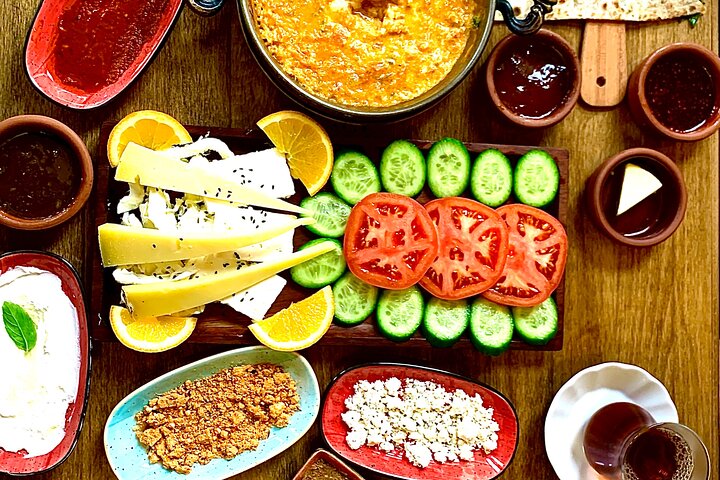
Hidden Beyoğlu Tour
4 hours – 5 hours
From AUD 203.76
The Blue Mosque — officially Sultan Ahmed Camii — is one of those places that genuinely earns its reputation. Built between 1609 and 1616, it dominates the Sultanahmet skyline with six minarets and a cascade of domes that seem to multiply the closer you get.
Step inside and the scale hits you immediately: the interior soars overhead, washed in cool blue light filtering through more than 200 stained-glass windows and reflecting off tens of thousands of hand-painted Iznik tiles. It is, without question, one of the most beautiful interiors in the world.
Getting in is straightforward but requires patience. The mosque is still an active place of worship, so entry is free but timed around the five daily prayer sessions — the site closes to tourists for around 90 minutes each time. Queues can be long between 10am and 3pm, particularly in summer when tour groups arrive in waves.
Coming early morning or late afternoon tends to be far quieter, and the light at those hours is particularly good for photographs.
Dress modestly — shoulders and knees covered for everyone, and women will need a headscarf, which you can borrow at the entrance for free. Shoes come off before you enter, so slip-ons make life easier. Watch out for touts around the entrance offering "free tours" that inevitably lead to carpet shops.
The mosque sits directly across from Hagia Sophia in Sultanahmet, making it easy to combine both in a single morning. Tram line T1 stops at Sultanahmet station, a two-minute walk away. Avoid visiting on a Friday midday when Friday prayers draw the largest local crowds and tourist access is restricted for longer than usual.
When Priya from our BugBitten team arrived at Sultanahmet Square just after seven in the morning, the city was still deciding whether it wanted to wake up. The tea vendors were setting out their glasses, pigeons were making their usual territorial arguments on the cobblestones, and the Blue Mosque — Sultan Ahmed Camii, to give it its proper name — was catching the low eastern light in a way that made the domes look painted rather than built. She stood there for a solid few minutes just taking it in. Not because she felt compelled to, or because some travel article had told her to pause and appreciate it, but because the building physically stopped her in her tracks. Six minarets, a cascading stack of semi-domes leading up to the great central dome, and the whole structure just hovering there above the roofline like something dreamed rather than constructed.
She'd been to Istanbul twice before and had somehow managed to skip the Blue Mosque both times — once because the queues looked too long, once because she'd spent too long at a waterfront meyhane the night before and the morning had gotten away from her. Third visit, no excuses. She joined the short queue at the tourist entrance, removed her shoes, borrowed a headscarf from the basket at the door, and walked inside.
That first moment in the interior is genuinely hard to prepare for. The scale doesn't register from outside, not fully. Suddenly you're beneath a dome that climbs more than 40 metres overhead, the walls are sheeted in tens of thousands of hand-painted Iznik tiles in every shade of cobalt and turquoise and white, and the light coming through more than two hundred stained-glass windows turns everything inside a particular cool shade of blue. Priya said later it was the quietest she'd felt in years, which is saying something given that there were perhaps sixty other visitors in there at the same time.
There is a version of this conversation where we just say "it's very beautiful, go see it" and leave it there. That would be honest. But it wouldn't explain why the Blue Mosque earns its reputation in a way that so many famous monuments don't quite manage.
The building was commissioned by Sultan Ahmed I, who began construction in 1609 at the age of nineteen — unusually young for a sultan to be undertaking something this ambitious. The architect was Sedefkâr Mehmed Ağa, a student of the legendary Mimar Sinan, and the completed mosque took seven years to build. The six minarets caused controversy at the time: only the mosque in Mecca had six, and Sultan Ahmed's decision to match that number was considered presumptuous enough that he reportedly funded a seventh minaret in Mecca to restore the distinction. Whether that story is entirely accurate or somewhat embellished by the centuries, it tells you something useful about how seriously this building was taken from the very beginning.
The Iznik tiles are worth pausing on specifically. There are somewhere around twenty thousand of them inside, and they were produced by craftsmen in the city of İznik during what historians now recognise as the peak period of Ottoman tile-making. The designs are extraordinarily detailed — floral patterns, geometric borders, arabesques — and the blue and white palette that dominates the interior is where the mosque's popular nickname comes from, though the tiles themselves span a much wider range of colour than the name suggests. Looking up and around at those walls, knowing each tile was hand-painted, is one of those moments where the scale of human effort involved becomes almost incomprehensible.
The mosque sits within the UNESCO World Heritage-listed Historic Areas of Istanbul, which covers Sultanahmet and the surrounding peninsula. That designation exists for good reason: this is one of the densest concentrations of significant architecture anywhere on earth.
Sultanahmet is tourist-heavy in a way that requires a bit of honest preparation. The square between the Blue Mosque and Hagia Sophia has the energy of a place that knows exactly what it is — there are tour groups, selfie sticks, souvenir stands, and a persistent category of local men who will attempt to strike up a "friendly conversation" that somehow always ends with an invitation to visit their cousin's carpet shop. None of this is catastrophic, and Istanbul is experienced enough at tourism to have functioning infrastructure around it: public toilets, signposted routes, accessible queuing systems.
What makes the area worth navigating is that just a short walk in any direction, the tourist density drops considerably. The streets behind the mosque, heading down toward the waterfront and the neighbourhood of Cankurtaran, are genuinely residential. There are small neighbourhood restaurants serving lunch to locals, corner shops, cats sleeping on warm stone walls. Istanbul doesn't entirely separate its lived-in self from its monumental one in Sultanahmet — they exist a few streets apart from each other, which is part of what makes the neighbourhood interesting rather than merely impressive.
The square itself, the old Hippodrome of Constantinople, is also worth walking properly. The Obelisk of Theodosius, which dates to roughly 1450 BC and was brought from Egypt in the fourth century AD, stands there next to the Serpent Column from Delphi and the Constantine Column, and most visitors walk straight past all three on their way to the mosques. Don't do that.
The primary thing, obviously, is to go inside. Entry is free, and the experience of the interior is the point. Give yourself at least forty-five minutes inside — more if it's quiet and you're the kind of person who wants to actually look at things rather than photograph them and move on. The carpets are thick underfoot, the lighting changes as clouds move outside, and the proportions of the space reward slow movement.
Bring a small bag rather than a large one. You'll be carrying your shoes once you remove them, and navigating a crowded interior while managing a large backpack is awkward for you and irritating for everyone around you. Slip-on shoes are genuinely worth wearing for this visit specifically — the shoe removal and replacement process happens in a bottleneck at the entrance, and fumbling with laces while twenty people queue behind you is a particular kind of minor stress that's easy to avoid.
After the interior, walk the perimeter of the building outside. The exterior is perhaps even more striking at ground level than the interior, particularly looking up at the cascade of domes from the garden courtyard. Early morning light hits the western façade well; late afternoon light is better on the eastern side facing Hagia Sophia.
The combination with Hagia Sophia directly across the square is obvious and worth doing — the two buildings are in direct conversation with each other architecturally and historically. For a third stop, the Topkapi Palace Museum is a fifteen-minute walk up the hill and represents a full half-day on its own. Plan accordingly.
Early morning is the answer, almost unconditionally. Before nine in the morning, the queues are short or nonexistent, the light inside is excellent, and the number of tour groups in the interior is dramatically lower. The mosque opens to tourists after the Fajr (dawn) prayer, which in summer means you can be inside by six-thirty or seven.
The prayer closure times are worth knowing before you visit: the mosque closes to tourists for approximately ninety minutes around each of the five daily prayer times. The midday and afternoon closures tend to cause the most disruption to visitor flow because they fall right in the middle of peak tourist hours, which is why queues between 10am and 3pm can be genuinely long. Check current prayer times on the day of your visit — they shift considerably between summer and winter.
Friday is the one day to approach with specific caution. The Friday midday prayer draws the largest local congregation, and the tourist closure is longer than usual. If Friday is the day you have available, visit in the morning before noon or in the late afternoon.
Summer (June through August) is the peak crowd period. Spring — particularly April and May — offers much more manageable visitor numbers, comfortable temperatures, and the added pleasure of the city being generally less exhausted by tourists. October is also excellent. December through February is cold and occasionally wet but extremely quiet, and seeing the Blue Mosque on a grey winter morning with almost nobody around is a genuinely different experience from the summer version.
Tram line T1 is the most straightforward approach. The Sultanahmet stop is a two-minute walk from the mosque entrance — you'll see the minarets from the tram stop. Trams run frequently, the Istanbulkart (the city's reloadable transit card) works on them, and the journey from Karaköy or Eminönü takes under ten minutes.
Walking from the Grand Bazaar takes about fifteen minutes through genuinely interesting streets. Walking from Karaköy across the Galata Bridge adds another ten minutes to that, but the bridge and the Golden Horn crossing are worth doing at least once.
Taxis and ride-shares work fine but offer no time advantage given traffic in the old city. The tram is faster and cheaper.
Nearby stops worth building into the same visit: Hagia Sophia (directly across the square, allow two hours minimum), the Basilica Cistern (five minutes on foot, underground and atmospheric, recently renovated), Topkapi Palace, and the Archaeological Museum complex a short walk further along the peninsula. For food, the streets behind the Arasta Bazaar adjacent to the mosque have a cluster of small restaurants that are decent without being tourist-trap priced — ask to see a menu before sitting down.
For broader planning across the city, the Go Türkiye official tourism site has current practical information including any closures or special event restrictions that might affect access during your visit.
Let's be straight about the less pleasant aspects. The tout situation around the entrance is persistent and occasionally aggressive — men stationed near the doors who will approach with variations of "mosque is closed, come this way, I show you" or "free tour, no obligation." The mosque is almost never actually closed during tourist hours except for prayer times, and the "free tours" uniformly end at carpet shops or leather goods stores. A firm "no thank you" and continued walking is the appropriate response, and it works.
The queues during peak hours are genuinely tedious. The management system is functional but not elegant — there's a single entrance point and the queue moves at whatever pace the interior crowd allows. On a busy summer afternoon, a forty-five minute wait is not unusual. The early morning visit largely eliminates this, which is the most useful piece of practical advice in this entire article.
The interior can feel rushed when it's crowded. There are no timed ticketing windows and no crowd-flow management once you're inside, which means on a busy day you'll be navigating around tour groups clustered at various points while a guide speaks loudly in seven languages. This is manageable but worth knowing going in.
Shoe storage is self-managed — you carry your shoes in a plastic bag provided at the entrance. Keep an eye on your bag if you put it down. There are no lockers.
The Blue Mosque is one of those places that gets described as "touristy" in a tone that implies it's therefore not worth bothering with. That framing is wrong. The building is extraordinary, the interior experience is genuinely moving even if you have limited interest in religious architecture, and the historical context of Sultanahmet square — with the Hippodrome, Hagia Sophia, the underground cistern, and the palace complex all within walking distance — is dense enough to occupy a full and satisfying day.
Go early. Wear slip-on shoes. Ignore the touts. Give the Iznik tiles the attention they deserve. Walk the perimeter before you leave. Come back in the evening if you're staying nearby, because the exterior lit up after dark is worth a second look.
The BugBitten team will say plainly: if you're in Istanbul and you skip the Blue Mosque, you've made a mistake. There are plenty of more places in Istanbul that deserve your time, and several of them are genuinely less visited and more surprising than Sultanahmet. But the Blue Mosque earns the reputation. Go see for yourself.