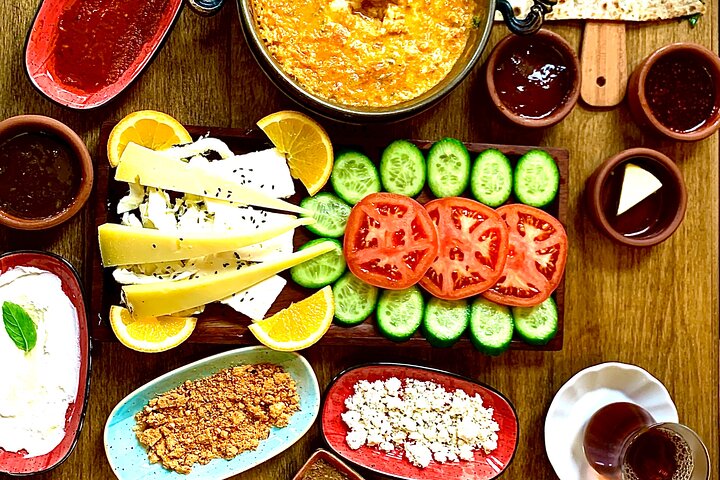
Private and Guided Istanbul Food Tour: Taste of Two Continents
5 hours – 6 hours
From AUD 393.46
Topkapi Palace sits at the very tip of the old city peninsula, commanding views over the Bosphorus, the Golden Horn, and the Sea of Marmara all at once. For roughly four centuries this was the nerve centre of the Ottoman Empire, and walking through its layered courtyards — each one grander and more guarded than the last — gives you a genuine sense of that weight.
The tiled rooms of the Harem, the glittering Treasury with Spoonmaker's Diamond and the Topkapi Dagger, and the sacred relics in the Pavilion of the Holy Mantle are genuinely extraordinary; this is not a place that disappoints on substance.
That said, it is vast and can feel overwhelming without a loose plan. The Harem requires a separate ticket purchased on site, and queues build quickly by mid-morning in summer. Arrive at opening (09:00) on a weekday if you can, especially between June and August when tour groups arrive in waves. The site spreads across several hectares, so comfortable shoes matter more than you might expect.
Parts of the complex are exposed to full sun with limited shade, making a hat and water essential in warmer months.
Getting here is straightforward — tram line T1 stops at Gülhane, a short walk uphill through the park to the palace gate. Sultanahmet station is equally close. The main entrance on Babı Hümayun Caddesi is easy to find, though the ticket windows are just inside the first courtyard rather than at the outer gate, which catches people off guard.
The combination ticket covering the palace and Harem is worth the extra cost; budget at least three hours, more if you want to linger properly. Avoid visiting on Tuesdays when the museum is closed.
When Sarah from our BugBitten team stepped through the Imperial Gate just after nine on a Tuesday morning — and immediately had to turn back because the palace is closed on Tuesdays — she came back the following Wednesday with a different kind of resolve. The second attempt started in near-darkness, a strong glass of çay consumed at a street stall on Babı Hümayun Caddesi while the first tram of the morning rattled past on the cobblestones below. By the time the gate swung open at nine, she was fourth in the queue, the Bosphorus glinting silver and gold through the trees of Gülhane Park below, the first light catching the palace's lead-domed silhouettes against a pale sky.
That first courtyard — wide, tree-lined, surprisingly calm — doesn't give much away. Ambulances used to park here historically; it functioned as a kind of public forecourt to the empire. The real weight of the place only announces itself as you move deeper in, ticket in hand, past the Gate of Salutation and into the second courtyard, where the kitchens and the divan — the Ottoman imperial council chamber — line the colonnaded walls and the scale of what you're standing inside starts to register properly. This is not a palace in the European sense, not a single theatrical building designed to impress from the outside. It's a walled city within a city, built up and added to across four centuries by some of the most powerful rulers on earth. The weight of that is cumulative. It lands slowly.
Topkapi Palace held the operational centre of the Ottoman Empire from roughly the 1460s through to the 1850s, when Sultan Abdülmecid I relocated his household to the newly built Dolmabahçe Palace on the Bosphorus shore. For nearly four hundred years, the decisions that shaped southeastern Europe, the Middle East, and North Africa — wars, alliances, trade routes, religious edicts — were made inside these walls. Walking through the complex knowing that context changes the experience significantly; it becomes less a museum visit and more a slow piece of reading.
The Treasury alone would justify the admission price for most visitors. The Spoonmaker's Diamond — 86 carats, pear-shaped, surrounded by a double row of smaller diamonds — sits in a case and looks, honestly, slightly unreal under the lighting, as though someone has propped up a large piece of glass for a joke. The Topkapi Dagger, with its three enormous emeralds set into the hilt and a watch hidden inside the pommel, is simultaneously an object of extraordinary craftsmanship and a kind of absurdist flex. The room doesn't feel like a museum display; it feels like someone left in a hurry and forgot to take anything with them.
The Pavilion of the Holy Mantle, in the fourth courtyard, houses relics associated with the Prophet Muhammad — a cloak, a sword, hairs from his beard, an impression of his footprint. For Muslim visitors, this section carries an emotional charge that's palpable and worth understanding regardless of your own background. The rooms are smaller here, more intimate, and visitors move through them with a different quality of attention.
Outside, the fourth courtyard's garden terraces offer the view that appears in every photograph: three bodies of water visible simultaneously, the Bosphorus, the Golden Horn, and the Sea of Marmara, meeting in a panorama that explains exactly why Mehmed II chose this particular promontory as the site of his new palace in 1459.
The Sultanahmet district around Topkapi doesn't let you forget that you're in one of the most historically dense neighbourhoods on the planet. Within a short walk of the palace gate sit the Blue Mosque, the Hagia Sophia, the Basilica Cistern, and the Hippodrome — a concentration of significant sites that can start to feel slightly numbing if you try to hit all of them in a single day. The streets in the immediate area have organised themselves around tourism in the way that ancient city centres often do: carpet shops, leather goods, baklava stalls, and restaurants with laminated menus in six languages occupy every available frontage.
This is not a criticism, exactly — the food is often genuinely good, and the carpet shop conversations are occasionally fascinating — but it does mean that Sultanahmet operates at a particular pitch of intensity that some travellers find exhausting. The palace itself, once you're inside, offers relief from that. The courtyards are large enough to absorb significant crowds without feeling claustrophobic, and the views from the terraces give you moments of genuine quiet, the city spread below and the water catching the light.
Early morning or late afternoon, the quality of light on the tiled surfaces inside the Harem is something else entirely. The Iznik tiles — deep cobalt blues, turquoise, coral red, white — were produced in the sixteenth and seventeenth centuries at their technical peak, and the colour hasn't faded in the way you might expect. In low-angle sunlight through the narrow windows, the walls seem to generate their own illumination.
Budget your time deliberately, because the palace is large enough that vague wandering tends to result in fatigue before completion, and there are sections worth seeing that get skipped.
The Harem requires a separate ticket purchased at the booth inside the complex — not at the main entrance. Do this first, before you explore anything else, because the timed entry slots fill up by mid-morning on busy days, and you don't want to find yourself ticketed for an entry time three hours away. The Harem is not the salacious soap-opera space that Ottoman-era European travellers imagined and then wrote about extensively; it was the private residential quarters of the imperial household, with a complex internal hierarchy of concubines, wives, mothers, and household staff numbering in the hundreds. The rooms range from relatively modest working spaces to the extraordinary Imperial Hall, with its painted ceilings and golden throne dais. Plan at least ninety minutes here.
Allow a full hour for the Treasury, more if you're reading the display panels carefully. The Armoury collection — chain mail, ceremonial swords, Ottoman bows — occupies an adjacent building and is frequently undervisited because people are tired by the time they reach it. It's worth the energy.
The fourth courtyard gardens are genuinely beautiful and frequently overlooked because they sit at the far end of the complex, past the sections that draw the biggest crowds. The kiosks and pavilions scattered through the gardens — the Revan Kiosk, the Baghdad Kiosk — are architectural confections that reward a slower look. Find a bench near the terrace edge and eat whatever you bought from the stall outside the gate.
Istanbul rewards exactly this kind of layered exploration — one major site done properly rather than three sites done in fragments.
Summer — June through August — is the busiest period, and the crowds between ten in the morning and three in the afternoon are significant. Tour groups arrive in coordinated waves, the Harem queues build quickly, and the exposed sections of the site (which is most of it) can become genuinely punishing in the heat. That said, summer also gives you the clearest skies for the Bosphorus views, and the longer days mean you're not rushing against the light.
Spring (April–May) and autumn (September–October) are the practical sweet spots. Temperatures are manageable, the light is generally good, and while the palace is never empty, the density of the crowd is noticeably lower. April in particular, with the tulip festival running across the city's parks, gives the grounds a particular pleasantness.
Winter visits have their own appeal — dramatically lower crowds, the possibility of seeing the rooftops dusted with snow, and a particular quality of cold-clear-sky light on the water. Several interior sections are closed or partially closed for restoration during winter months, so check the official museum listings before planning your dates. The Go Türkiye official site maintains current opening information and seasonal notes worth checking before you book flights.
Avoid Tuesdays. The museum is closed. Sarah learned this the hard way.
The T1 tram line from Eminönü or Kabakaş runs directly to Gülhane stop, a short walk uphill through the park to the palace's outer gate. Sultanahmet stop is equally close from the other direction, slightly more convenient for the Blue Mosque and Hagia Sophia if you're combining visits. The tram is cheap, runs frequently, and doesn't require any particular navigation skill — the route is straightforward.
Taxis from most central Istanbul hotels are a reasonable option in the morning before traffic builds, but the afternoon return is another matter; the streets around Sultanahmet in peak hours can be deeply frustrating, and the tram will move faster.
The palace sits at the tip of the old city peninsula, meaning that immediately around it you have the Gülhane Park (a genuinely pleasant space for a post-visit decompress), the Istanbul Archaeology Museums (attached to the palace complex, often missed, genuinely excellent), and within a ten-minute walk the full spread of more places in Istanbul that make Sultanahmet one of the most concentrated areas of significant sites anywhere in the world.
The complex is part of the Historic Areas of Istanbul inscribed on the UNESCO World Heritage List, which puts it in documented company with the Hagia Sophia and the surrounding Byzantine and Ottoman urban fabric — useful context if you're trying to explain to someone why spending two days in this one neighbourhood is not excessive.
Let's be direct. The signage inside the palace is inconsistent — excellent in some sections, absent or misleading in others. The English-language information panels vary wildly in quality and completeness, and the layout logic of the complex is not immediately intuitive. A paper map from the ticket counter is worth having; the in-app navigation that various tourist apps offer works to a point but drops you in the wrong courtyard often enough to be mildly maddening.
The café options inside the complex are mediocre and expensive for what they are. The terrace café in the fourth courtyard has a genuinely spectacular view and genuinely average food at genuinely inflated prices. If you're planning a long visit, bring your own water — the fountains are decorative, not drinking water — and eat before you enter or after you leave. The stalls and restaurants on Babı Hümayun Caddesi and across in Sultanahmet Square are considerably better value.
Accessibility is limited. The complex involves uneven cobblestone surfaces throughout, significant level changes between courtyards, and steps that cannot be avoided in many sections. Wheelchairs and prams are manageable in parts but will hit genuine obstacles in others, particularly inside the Harem. The palace makes an effort but the site's age and construction make universal access difficult.
Pickpocketing in the crowds, particularly around the busy Treasury section in the middle of the day, is not unknown. Keep your bag in front of you in the densest sections.
Audio guides are available and are worth the cost if you're visiting without a guide; they fill in substantial context that the static panels miss.
Topkapi Palace is the kind of place that rewards the effort put into approaching it properly. Turn up at opening, do the Harem ticket first, walk the fourth courtyard slowly, look at the water from the terrace. Don't try to combine it with three other major sites in the same afternoon. Give it a full morning, ideally a morning plus.
It is a genuinely remarkable place — not because it's dramatic or theatrical, but because of what it represents and what it contains. The Treasury is extraordinary. The Harem is fascinating. The views are exactly as good as advertised. The historical accumulation of four centuries of imperial power sits in the tiles, the rooms, the proportions of the courtyards, in a way that doesn't ask you to interpret it; it simply presents itself, and if you move through it with some patience and some prior reading, it will offer you more than most sites manage.
Sarah came back a third time, on her last day in Istanbul, to sit on the fourth courtyard terrace and drink another glass of overpriced tea while watching the light shift on the Bosphorus. Some places earn that.


