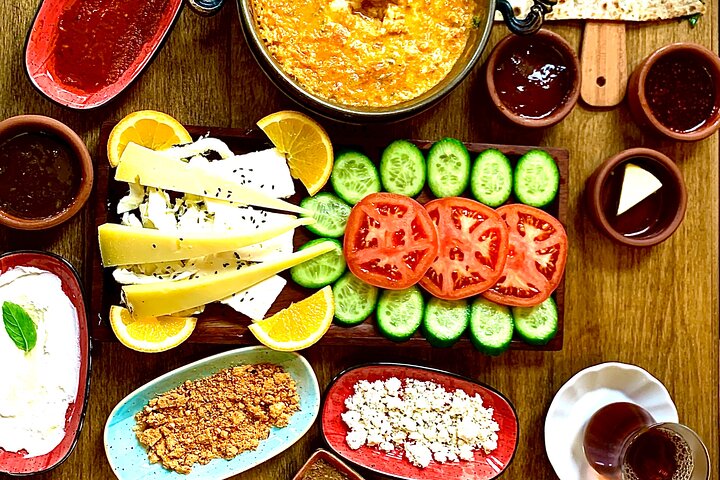
Private and Guided Istanbul Food Tour: Taste of Two Continents
5 hours – 6 hours
From AUD 393.46
Few places on earth match the sensory overload of Istanbul's Grand Bazaar. One of the world's oldest and largest covered markets, it sprawls across the Beyazıt neighbourhood of Fatih with over 4,000 shops packed into a labyrinth of vaulted stone corridors. Lanterns, carpets, ceramics, spices, leather goods, and gold jewellery compete for your attention at every turn, and the air carries a heady mix of perfume, tea, and polished wood.
It is genuinely spectacular — and genuinely chaotic.
Navigating it takes patience. The bazaar has around 60 named streets inside, and getting briefly lost is almost inevitable on a first visit. That said, wandering without a strict agenda is often the most rewarding approach. The central Kalpakçılar Caddesi is the main artery and the most tourist-heavy stretch, so push into the quieter side lanes for a less pressured browse.
Shopkeepers are persistent but rarely aggressive — a polite "no thank you" is enough. Bargaining is expected for most goods; starting around half the asking price is a reasonable approach, and walking away often brings the price down further.
Getting there is straightforward. Tram line T1 stops at Beyazıt-Kapalıçarşı, just a two-minute walk from the main entrance on Çarşıkapı Street. Wear comfortable shoes — the cobbled floors are uneven and you will cover considerable distance. Keep your bag close and zipped, especially in the denser sections near the main gates, as pickpocketing does occur.
The bazaar is closed on Sundays and public holidays, which is worth checking before you go. Visit on a weekday morning, ideally before 11am, to experience it before the tour groups arrive in full force.
When Priya from our BugBitten team arrived at the Grand Bazaar on a Tuesday in late October, she had given herself one job: buy a decent spice blend for her mum's kitchen back in Melbourne. She left two and a half hours later with the spices, a hand-painted ceramic bowl she hadn't planned on, a glass of apple tea she'd been given gratis by a shopkeeper who clearly had no expectation of a sale, and an entirely revised mental map of what a market could actually be.
That's the thing about the Grand Bazaar. You don't visit it the way you visit a museum or a lookout. You get absorbed by it. The place is less a shopping destination and more a self-contained neighbourhood that happens to sit beneath a vaulted stone roof — one that has been drawing merchants, travellers, diplomats, thieves, and wide-eyed tourists since the mid-fifteenth century. Walking through it for the first time, even with a map in hand, you'll understand within about ten minutes that orientation is largely irrelevant. What matters is slowing down enough to actually look.
The Grand Bazaar — known locally as the Kapalıçarşı, meaning "Covered Market" — is one of the oldest continuously operating markets in the world. Construction began under Sultan Mehmed II in 1455, not long after the Ottoman conquest of Constantinople, and the complex grew steadily over the following centuries as merchants from across the empire converged on Istanbul to trade. What you walk through today is the result of six centuries of expansion, earthquake damage, fire, and rebuilding — a patchwork of architecture that somehow coheres into something both monumental and intimate.
The numbers are staggering without even trying to be impressive. There are roughly 4,000 shops inside the bazaar, distributed across around 60 named streets. The complex covers approximately 30,000 square metres. On a busy day, somewhere between 250,000 and 400,000 people pass through. And yet, despite those figures, it does not feel like a shopping centre. The stone corridors, the low arched ceilings painted in blue and red, the natural light filtering in through occasional domed skylights — these architectural details give the space a quality that modern retail design simply cannot manufacture.
Beyond the physical structure, what makes the Grand Bazaar worth your time is the density of craft and trade knowledge concentrated inside it. There are jewellers here who can size a ring on the spot, carpet dealers who can explain the regional differences between a Kilim and an Anatolian pile rug in detail you never asked for, spice merchants who will let you smell every jar on the shelf before you commit to a single gram. The commercial transaction is almost secondary to the encounter. Whether or not you buy anything — and you absolutely do not have to buy anything — the Grand Bazaar offers a kind of living education in the material culture of Turkey and the broader region.
The Beyazıt neighbourhood that surrounds the Grand Bazaar is one of Istanbul's most historically dense quarters. Within walking distance you'll find the Beyazıt Mosque, one of the city's oldest Ottoman mosques, the grounds of Istanbul University, and the secondhand book market at Sahaflar Çarşısı — a small, shaded courtyard full of stalls selling everything from academic texts to old maps to paperback novels in six languages. It's a genuinely useful twenty minutes to spend before or after the bazaar, and far quieter.
The streets immediately outside the bazaar's gates are busy in a functional rather than theatrical way. There are lokanta restaurants with handwritten menus chalked on boards, tea houses where local tradespeople sit for long stretches of the morning, and pavement vendors selling roasted chestnuts and simit — the sesame-crusted bread ring that is as central to Istanbul street life as a flat white is to inner-city Melbourne. The cobblestones underfoot are uneven and polished smooth by decades of foot traffic, which gives the whole precinct a worn, lived-in quality that is genuinely appealing once you've got your footing.
The Fatih district more broadly has a strong local character. This is not a sanitised tourist quarter. The mosques fill at prayer times, the market traders are selling to local buyers as much as to visitors, and the pace of life has a different rhythm to the Sultanahmet tourist circuit a few minutes' walk to the east. If you're visiting The Blue Mosque on the same day — which is very easy to combine — the contrast between the two experiences is instructive. One is reverential and contained; the other is commercial and sprawling. Both are essential Istanbul.
The single best piece of practical advice for the Grand Bazaar is to resist the urge to plan it too tightly. Yes, you should know roughly what you're after — a rug, ceramics, leather, textiles, spices, jewellery, or just the experience itself — but the side streets that branch off the main artery of Kalpakçılar Caddesi are where the most interesting browsing happens. The central drag is the most tourist-heavy stretch, with prices adjusted accordingly. Push left and right into the quieter lanes and you'll find workshops where craftspeople are actually working, wholesale sections not really aimed at tourists at all, and the occasional shop that's been run by the same family for three or four generations.
Bargaining is expected for most goods, and shopkeepers are not offended by negotiation — they'd be more surprised if you didn't try. A reasonable starting position is roughly half the asking price, moving upward from there. Walking away slowly often brings the price down further. What doesn't work: aggressive lowballing, rudeness, or taking up significant time and energy from a shopkeeper you have no intention of buying from. The convention is that serious interest warrants negotiation; window shopping is fine but shouldn't be disguised as purchasing intent.
There are small cafés and tea houses tucked inside the bazaar itself. Accepting a glass of çay (black tea) or apple tea from a shopkeeper is a common social courtesy; it carries no obligation to purchase, but it's polite to stay for the tea and the conversation. For a proper meal, exit the bazaar and look for a lokanta in the surrounding streets — these neighbourhood restaurants serve daily-changing cooked food from steam trays, typically very reasonably priced and genuinely good. The bazaar's interior options tend to be tourist-priced and mediocre.
The Egyptian Bazaar (Mısır Çarşısı), Istanbul's dedicated spice market, is technically a separate structure near the Eminönü waterfront — about a fifteen-minute walk from the Grand Bazaar. The two are often combined in a single outing, which makes sense. If spices, dried fruit, Turkish delight, and nuts are your primary interest, the Egyptian Bazaar is more tightly focused. The Grand Bazaar is broader and more overwhelming. Both repay a visit.
The single most important logistical fact about visiting the Grand Bazaar is this: it is closed on Sundays and on Turkish public holidays. This is non-negotiable and catches visitors out more often than it should. Check the calendar before you build your itinerary around a Sunday morning visit.
Weekday mornings before 11am are the ideal window. The bazaar officially opens around 8:30am, and the first couple of hours are genuinely calmer — shopkeepers are setting up, tour groups haven't arrived yet, and the corridors have some breathing room. By midday on a busy day in peak season (May through August), it can feel genuinely overwhelming in the most-visited sections. Saturday mornings are viable but busier than weekdays.
The shoulder seasons — March to May and September to November — offer more comfortable temperatures and smaller crowds. Istanbul summers are hot and humid, and a covered stone market in July with 300,000 people in it is not the most comfortable environment. If you're visiting in summer, go early and leave before noon. The Go Türkiye official tourism website has current information on public holidays and seasonal events that can affect your visit, and it's worth a quick check before you travel.
Winter visits have their own quiet appeal. The crowds thin considerably in January and February, the city is cooler and greyer, and the bazaar's warm interior feels genuinely welcoming rather than stifling. Prices in the surrounding hotels and restaurants drop too.
Getting to the Grand Bazaar is straightforward from most parts of central Istanbul. The tram line T1, which runs along the waterfront from Kabataş and through Sultanahmet, has a dedicated stop at Beyazıt-Kapalıçarşı. From Sultanahmet it's one stop; from Eminönü, two stops. The walk from the tram stop to the main entrance on Çarşıkapı Street takes about two minutes.
If you're coming from the Bosphorus ferry terminals at Eminönü or Karaköy, a tram connection is straightforward, or the walk uphill through the old city takes about fifteen to twenty minutes and passes through some of the more interesting working-class commercial streets in Fatih. Worth doing at least one way.
The historic area that encompasses the Grand Bazaar and its surroundings forms part of the broader Historic Areas of Istanbul, which holds recognition on the UNESCO World Heritage List — a designation that covers the Topkapı Palace, the city's historic walls, the Süleymaniye complex, and much of the Fatih district. This context matters practically: the whole precinct rewards slow exploration on foot, and the Grand Bazaar is one node in a much larger network of significant sites. Plan your time accordingly. You can find more places in Istanbul on BugBitten to help structure your wider itinerary.
Let's be honest about what the Grand Bazaar is not. It is not a place to find bargain-basement prices on authentic artisan goods if you don't know what you're looking at. A significant proportion of the ceramics, textiles, and leather goods sold inside the bazaar are mass-produced, sometimes in factories far from the artisan traditions they're visually referencing. The tourist-facing lanes are particularly heavy on this. If you care about provenance — if you want a rug actually woven in Cappadocia or a ceramic pot made in İznik — you'll need to ask direct questions about origin and be prepared for evasive answers.
The sales pressure in the central sections can be tiring over time. Individual shopkeepers are generally professional and a firm "hayır, teşekkürler" (no, thank you) is respected. But when you've heard the same opening line from forty shops in a row — "where are you from?", "just looking is free" — it starts to grind. This is not unique to Istanbul, and it is considerably less aggressive than markets in parts of Morocco or Egypt, but it's real and worth knowing about in advance so it doesn't sour the experience.
Navigation is genuinely difficult on a first visit. The maps available at the entrances are helpful but the named streets inside the bazaar are not always clearly signposted. Getting turned around is part of the experience, not a failure, but if you're time-limited and have a specific section to find, budget extra time for reorientation.
Finally: the food and drink options inside the bazaar are not its strong suit. Eat before you go or plan to step outside.
The Grand Bazaar earns its reputation not through glamour or Instagram perfection — it's a bit worn, a bit overwhelming, frequently chaotic — but through sheer accumulated weight of history and human activity. Six centuries of commerce have happened under those painted vaulted ceilings, and that accumulation gives the place a texture that no purpose-built retail precinct can touch.
Come with low expectations for bargain hunting and high expectations for sensory engagement. Come prepared to say no comfortably, to walk further than you planned, and to end up with at least one thing you didn't come for. Come on a weekday morning, with good shoes and a zipped bag, and give yourself at least two hours.
Priya still has that ceramic bowl on her kitchen bench. Her mum got the spices. Both, she maintains, were worth every minute of being mildly lost somewhere near Kalpakçılar Caddesi on a Tuesday morning in October.


