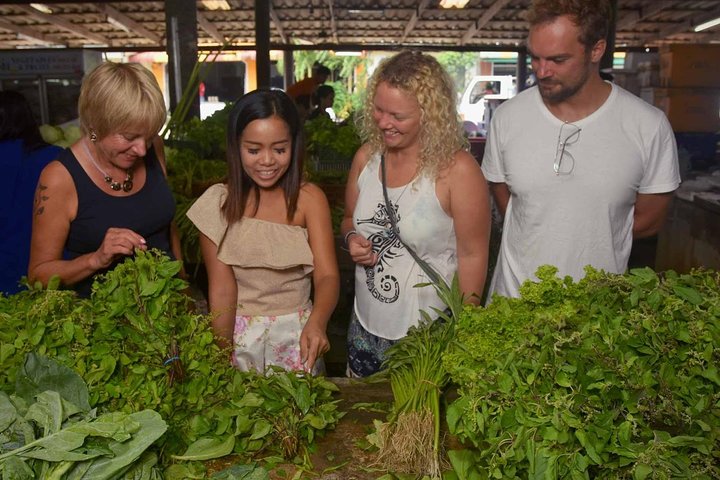
Cooking Class by Samui Native Instructor Geng and O Family
4 hours
From AUD 111.17
Pai's Walking Street is the lively heart of this little mountain town in northern Thailand. Each evening from around 5pm, the main road through town closes to traffic and fills with stalls selling cheap Thai street food, handmade jewellery, fresh juices, and an oddly high concentration of hippie-leaning crafts.
The food is the highlight — pad thai, mango sticky rice, grilled skewers, banana roti, fresh coconut everything. Eat slowly and grazing-style; portions are small and prices are tiny. Live music spills out of bars along the side streets, ranging from passable acoustic covers to genuinely good local musicians. The crowd is a mix of backpackers, expats, and weekend Thai travellers.
It's easy to lose a few hours here. Start with dinner from the stalls, browse the crafts (some good, some forgettable), and end up at one of the riverside bars for a Chang or a cocktail. Pai itself is small enough that everything is within a walk; rent a scooter to explore the surrounding waterfalls and viewpoints during the day, then come back for the Walking Street in the evening.
When Jess from our BugBitten team first rocked up to Pai after a three-hour minivan ride from Chiang Mai — white-knuckling through 762 curves in the road, as the locals cheerfully count them — she was hungry, slightly motion-sick, and in need of a reason to remember why she'd bothered. She found it on Chai Songkhram Road just after dusk, when the barriers went up, the motorbikes peeled away, and the stalls unfolded like a very delicious pop-up city. Thirty minutes of slow grazing later, banana roti in one hand and a fresh coconut in the other, she'd completely forgiven the mountain roads.
That's the thing about Pai Walking Street. It doesn't ask much of you. It's not a spectacle you have to work to appreciate, and it won't demand a booking or a dress code. It just opens up every evening, fills with light and smoke and the smell of grilled pork, and lets you figure out the rest on your own terms.
Pai itself is a small town — you can walk end to end in about twenty minutes — but it punches well above its weight when it comes to atmosphere. The Walking Street is the reason most backpackers stick around for longer than they planned. What starts as a quick look at the stalls usually turns into two hours of eating, browsing, and drifting between bars, and nobody seems to be in any particular hurry to leave.
The food is the obvious headline. Pad thai cooked fresh in blackened woks. Grilled corn slathered in butter and chilli. Mango sticky rice wrapped in banana leaf. Pork skewers with a dark, slightly sweet glaze that you will think about on the plane home. The prices are genuinely small — you can eat well for 150 to 200 Thai baht if you're selective, or spend 400 and be completely stuffed. Portions are intentionally modest, which is actually a feature rather than a fault: it means you can try six different things without committing to any one of them.
Beyond the food, there's a particular kind of easy energy here that's hard to manufacture. The crowd is a proper mix — Thai families with kids on their shoulders, backpackers fresh off the minivan, long-term expats who've lived in Pai for years, and weekend travellers up from Chiang Mai. Nobody's performing for anyone else. The live music coming out of the side-street bars ranges from earnest acoustic covers to genuinely accomplished local musicians, and you rarely have to walk far before you find a sound you want to linger near.
The craft stalls are variable, honestly — more on that in the not-so-good section — but among the sea of dreamcatchers and hemp bracelets there are artisans doing interesting work. Handmade silver jewellery, carved wooden items, woven textiles from hill tribe communities. The key is to walk the whole length before buying anything.
Pai sits in a valley in Mae Hong Son Province at around 800 metres elevation, and the surrounding mountains give the town a contained, bowl-shaped quality that makes it feel a little separate from the rest of the world. In the evening, when the Walking Street is open, the air is noticeably cooler than lowland Thailand — comfortable rather than cold in most months, and genuinely chilly from November through to February. The valley mist sometimes rolls in over the hills after dark, softening the string lights above the stalls into something that looks almost cinematic.
The town has had a hippie-backpacker reputation for decades, and while that flavour is still present — there are more Grateful Dead T-shirts per square kilometre here than anywhere else in Thailand — it's mellowed into something more relaxed than self-conscious. The Walking Street reflects that. It's lively without being rowdy, busy without feeling crushed. On a Friday or Saturday night the numbers swell, but the road is wide enough to handle it.
If you're travelling after exploring northern Thailand's cultural sites — perhaps you've already visited Wat Chinorasaram Worawihan (Wat Chinorot) and want a more casual evening contrast — the Walking Street offers exactly that kind of shift in register. Temples in the afternoon, banana roti at 7pm.
Start at the top of Chai Songkhram Road and make a deliberate pass of the whole stretch before buying anything. You'll get a map of what's on offer — the stalls don't shift position much from night to night — and you'll avoid loading up on pad thai before you spot the exceptional khao soi stall three-quarters of the way down. Come hungry, come with small bills, and graze slowly.
Look specifically for banana roti, which is a street-food staple done particularly well in Pai. The roti is fried thin and crispy, folded around ripe banana and condensed milk, and it's almost absurdly good for what it costs. Mango sticky rice is another non-negotiable if the season is right (more on timing below). Fresh-squeezed juices and smoothies are everywhere; the passionfruit and pineapple blends are worth hunting down.
The crafts section is genuinely worth a walk even if you're not a big shopper, because the range is wider than it looks from a distance. Mixed in with the generic souvenir stalls are vendors selling hand-stitched bags from Hmong artisans, delicate silver work from local jewellers, and hand-painted clothing that you won't find in Bangkok's night markets. Take your time, don't feel obligated to engage with every vendor, and know that gentle bargaining is normal but aggressive haggling is considered rude.
The side streets off Chai Songkhram Road are where the bars operate, and several of them host live music every night the Walking Street runs. The quality varies — some nights it's a solo guitarist working through an earnest Ed Sheeran catalogue, other nights it's a tight local band playing original material that stops you mid-stride. Walk both sides of the main road and follow your ears. A Chang beer from a bar stool on the street while a musician sets up ten metres away is one of those pleasures that doesn't need any further explanation.
November to February is widely considered the best window for Pai in general and the Walking Street in particular. The temperatures are cool, the air is clear, and the evenings have a crisp quality that makes outdoor eating genuinely pleasant. This is peak season, so expect more crowds — particularly on weekends when Thai domestic travellers come up from Chiang Mai in numbers.
March to May brings heat and, from late February onwards, smoke. The agricultural burning season across northern Thailand fills the valleys with haze that can become genuinely unpleasant, and Pai's bowl-shaped valley traps it badly. The Tourism Authority of Thailand advises travellers to check air quality conditions during this period before committing to the region.
June to October is the wet season. Rain usually falls in short, heavy bursts rather than all-day downpours, and the surrounding countryside turns a vivid, saturated green. The Walking Street still operates, though occasional heavy rain can thin the stalls and send everyone scrambling. If you're visiting during this period, go earlier in the evening when the weather is more likely to be cooperative.
Mango season peaks between April and June, which is a genuine reason to visit despite the heat and smoke — the mango sticky rice at that time of year is exceptional.
For those interested in exploring beyond Pai, northern Thailand has significant ecological and cultural depth. Wildlife sanctuaries like Phu Khieo Wildlife Sanctuary offer a completely different face of the region and are worth planning into a broader northern Thailand itinerary.
The main route to Pai from Chiang Mai is by minivan, which departs from Chiang Mai Arcade Bus Terminal and takes roughly three to four hours depending on traffic and how many stops are made along the way. The fare is inexpensive. Be aware that the road through the mountains — Route 1095 — is winding to a degree that affects a significant proportion of travellers; if you're prone to motion sickness, sit up front and take medication before you board.
Alternatively, you can rent a motorbike in Chiang Mai and ride the route yourself, which takes longer but allows stops at scenic viewpoints along the way. This is a popular choice among more experienced riders, but the road demands your full attention and is not recommended for nervous or inexperienced motorcyclists.
There is a small airport at Pai (PYY) with infrequent connections to Chiang Mai, but services are limited and not always reliable.
Once you're in Pai, the daytime options are strong: Pai Canyon for sunset views, Mo Paeng Waterfall for a swim, Tha Pai Hot Springs for sore legs after the minivan ride, and the bamboo bridge that stretches over the rice fields just outside town. If you want to go deeper into the cultural layer of northern Thailand, the region's temple heritage is significant — some of these sites are listed in the context of broader regional heritage conversations that include areas on the UNESCO World Heritage List. Browse more places in Pai to build out a full day itinerary before the Walking Street draws you back in the evening.
A scooter rental — widely available for 150 to 250 baht per day — gives you full flexibility for daytime exploration and is the standard way most visitors get around.
Let's be straight about a few things. The craft stalls are approximately sixty percent forgettable. Mass-produced dreamcatchers, generic printed T-shirts, and resin jewellery that will turn your wrist green in a fortnight take up a lot of space. If you've been to other Thai night markets you'll have seen most of it before. Walk past quickly and hold out for the genuinely handmade stuff.
The Walking Street operates Thursday through Sunday in most periods, though some vendors appear on quieter nights too. If you arrive on a Tuesday or Wednesday hoping for the full experience, you'll be disappointed. Check locally before assuming it's running.
Parking and scooter congestion in the approach to the street gets messy on busy nights. The barriers go up around 5pm but the surrounding roads fill with parked motorbikes well before that. Factor this in if you're arriving by scooter rather than on foot.
Finally, be aware that Pai attracts a particular brand of long-term traveller who has been there for some months and has opinions about it. You may end up in conversations at bar stools about how much better Pai was five years ago. Smile, buy them a beer, and draw your own conclusions.
Pai Walking Street is not trying to be anything it isn't. It's a mountain town's evening market, done well — affordable food, decent music, unhurried atmosphere, cool air. It won't suit travellers who need stimulation on a grand scale, and it won't have much patience for people in a rush. But if you arrive hungry, with loose plans and a willingness to follow the smoke from a good grill, you'll find yourself still there two hours later trying to decide between one more skewer or another mango roti.
That, in the BugBitten team's estimation, is exactly the kind of place worth putting on your map.