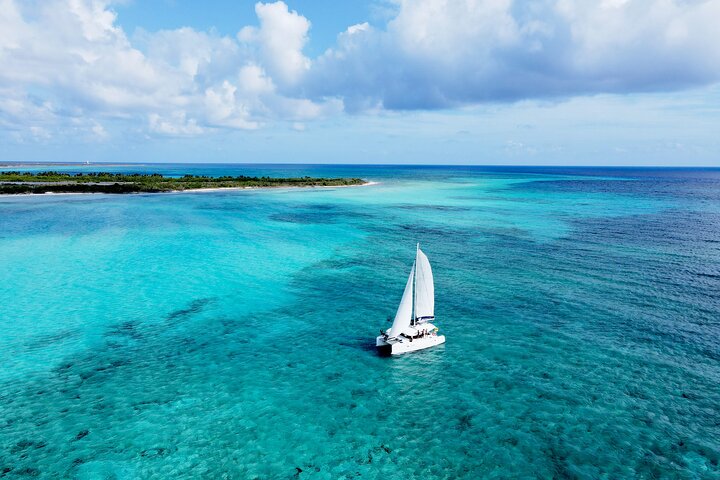
Lagoon 39ft Private Catamaran 5hr - El Cielo Full Experience
5 hours
From AUD 3091.47
Dzilam de Bravo sits at the far eastern end of a long, quiet stretch of Yucatán coast, where shallow lagoons bleed into mangrove channels and the Gulf water turns the colour of weak tea. Getting here already feels like an undertaking — the road from Mérida runs well over two hours through flat scrub and sisal fields — and that distance is precisely what keeps the bird life so good.
This is not a site you wander into casually.
Birding is done almost entirely by boat, and hiring a local fisherman-guide from the village is both straightforward and genuinely worthwhile. They know the channel mouths where American Flamingos gather in loose, shifting flocks of several hundred birds, and on a calm morning the pink mass reflected in the lagoon surface is genuinely arresting.
Roseate Spoonbills work the same shallow margins, and patient scanning of the mangrove edges can turn up Jabiru — never guaranteed, but the species is seen here regularly enough to justify real optimism. Yucatán Parrots are easier, often calling noisily over the village and surrounding scrub at dawn and dusk.
Dawn departures are essential; by mid-morning the heat presses down hard and birds pull back into shade. Accommodation in the village is basic — a handful of simple guesthouses and one or two family-run posadas — perfectly comfortable if your expectations are practical rather than plush. There is no high-end lodge here.
The lagoons are brackish and mosquito pressure builds from May onwards, so the window from December through April gives you cooler air, lower insects, and the best flamingo concentrations.
Pack a good scope, strong insect repellent, light waterproofs, and rubber boots for the boat landings; skip this entirely in hurricane season.
When Sarah from our BugBitten team pulled into Dzilam de Bravo just before 5 am, the village was almost entirely dark. A single bulb hung outside a tienda, a dog crossed the road without urgency, and somewhere in the blackness beyond the malecón came the low, flat sound of the Gulf pushing against the shore. She had driven from Mérida the afternoon before — over two hours on a road that cuts through flat scrub and ghost-pale sisal fields that seem to belong to no particular decade — and had taken a room in a small family posada run by a woman who left a jug of water and a working ceiling fan and asked nothing further. That was, Sarah reported, exactly right.
By five-thirty she was in a flat-bottomed boat with a local fisherman-guide named Alejandro, edging out through a mangrove channel in the pre-dawn murk. The water here is brackish, shallow, and the colour of very weak black tea where the lagoon meets the Gulf shallows — a consequence of tannins leaching out of the mangrove root systems over years. The torch beam caught the red eyeshine of a Black-crowned Night Heron hunkered on a low branch. Then the engine died to a put-put, and Alejandro pointed ahead. A pink smudge was gathering definition against the grey horizon: several hundred American Flamingos, standing in loose, shifting formation across the shallows, their reflections below them improbably perfect in the still water. It is the sort of sight that makes you want to say something and then decide not to.
That morning is what Dzilam de Bravo is for. Everything else — the getting here, the basic accommodation, the mosquitoes that arrive reliably in the warmer months — exists in service of those few hours on the water before the heat presses down and the birds retreat. It is not a comfortable destination by the usual measures. It is an honest one.
Dzilam de Bravo sits at the far eastern end of a long, quiet sweep of the Yucatán coast, bookended by the Dzilam de Bravo State Reserve — a protected area of mangrove forest, coastal lagoons, and brackish wetlands that runs for a considerable stretch along the shoreline. The reserve exists precisely because this coastline has not been developed in the way that other parts of the Yucatán Peninsula have been. There is no resort strip here, no cenote packaged for day-trippers, no zip-line outfit operating out of a former hacienda. What there is, in extraordinary numbers, is bird life.
The American Flamingo is the headline act, and deservedly so. Yucatán holds one of the more significant flamingo populations in the Americas, with Celestún on the western side of the peninsula getting most of the tourist traffic and Dzilam getting considerably less of it. That quieter profile is the point. The flocks here can number in the hundreds on a good morning, and because the boat traffic is modest compared to Celestún, the birds are less habituated to engines and more inclined to behave naturally — feeding, moving, doing flamingo things without the nervous edge that comes from being buzzed by fibreglass boats all day.
The Roseate Spoonbill is a close second in terms of spectacle. These birds work the same shallow margins as the flamingos, sweeping their spatula bills through the water in that distinctive side-to-side motion. The pink of a spoonbill is a different, deeper rose than a flamingo's washed-out coral, and seeing the two species together across the same flat water makes for a genuinely strange colour palette, as though someone has miscalibrated a screen.
For birders willing to sit patiently and scan mangrove edges with a scope, Jabiru storks turn up here with enough regularity to make them a realistic target rather than a fantasy species. The Jabiru is the tallest flying bird in the Americas — a massive, prehistoric-looking creature that stands over a metre tall and has a neck that looks like it was designed by a committee. Seeing one here is not guaranteed on any given day, but the species is recorded often enough that it belongs in any serious watch list for the site. Yucatán Parrots are easier and louder, calling in noisy groups over the village scrub at dawn and dusk, and Tri-coloured Herons, Boat-billed Herons, and various waders fill out the species count across the lagoon margins.
The village of Dzilam de Bravo has the quiet, practical character of a working fishing community that has not had to reinvent itself for outside visitors. The malecón — the seafront promenade — is modest and functional rather than picturesque. There are a few restaurants serving fresh fish, a market open in the mornings, and the kind of unhurried street life that happens when a place is not primarily organised around tourism. Children ride bikes. Men work on nets. Cats make decisions.
The surrounding landscape is flat in the way that the whole Yucatán Peninsula is flat — a limestone shelf barely above sea level, the topography expressed almost entirely in vegetation rather than landform. Inland from the coast, the scrub is dry and tangled, threaded with dusty roads and occasional small ranches. The drive in from Mérida is not scenic in any obvious sense, but it has a slow, hypnotic quality — the light changes dramatically through the day on that open flatness, and the sisal fields in particular have a silvery quality in the late afternoon that rewards attention.
On the water, the mood shifts completely. The mangrove channels are cool and enclosed, the root systems on either side filtering the light into something greenish and dim. Out in the open lagoon, the sky is enormous. Yucatán is famous for its sky — the flatness of the land means there is nothing to interrupt it — and on the water that sky comes at you from all directions at once, reflected below and open above. It is a genuinely disorienting experience the first time, and a pleasing one.
If you are travelling the broader region and planning to combine this with the spectacular archaeological sites that have made Yucatán famous — the great Maya ceremonial centres, including Chichén-Itzá with its extraordinary concentration of monumental architecture — it is worth building the coastal birding into a longer itinerary rather than a day trip. The distances are manageable but the early starts are non-negotiable, and arriving tired from a long drive the same morning you want to be on the water at five-thirty is not a good plan.
Virtually all of the serious birding at Dzilam de Bravo is done by boat. The village has a small cooperative of local fishermen who run guided tours through the lagoon and mangrove systems, and engaging one of these guides is both the most practical and most rewarding approach. These are men who have spent their working lives on this water and who know, with a precision that no written guide can replicate, exactly which channel mouths the flamingos are using on any given morning and which mangrove sections are worth a slow approach and which are not. Their English may be limited and your Spanish may be limited, but binoculars are a universal language and pointing works well in a flat boat on still water.
Tours typically run for two to three hours. Prices are reasonable — negotiate directly with the guides at the pier, and expect to pay in the region of a few hundred pesos for the boat and the morning. Given what you get for that, it is not a number to argue about.
The mangrove edges accessible on foot from the village can be productive, particularly in the early morning when Yucatán Parrots are moving through the scrub and the herons are still active along the water's edge. A slow walk along the malecón before sunrise, simply listening, will often turn up species before you even reach the boat.
The village itself is worth an hour of unhurried walking — not for any single attraction but for the texture of a working coastal community that has stayed largely itself. The fish market is worth seeing if you are up early enough.
The coast between Dzilam de Bravo and Celestún, running along the northern edge of the peninsula, passes through several other small fishing villages and stretches of protected coast. San Felipe, to the west, has a mangrove lagoon of its own and is a practical lunch stop on a longer driving day. The more places in Yucatán section of the BugBitten site covers several of these coastal stops in more detail for anyone piecing together a longer loop.
The honest answer is December through April, and specifically December through February if you want the best combination of flamingo concentrations, manageable heat, and low mosquito pressure. This is the dry season on the Yucatán Peninsula, and at Dzilam de Bravo it means cool mornings — cool enough to make the pre-dawn boat departure genuinely pleasant rather than merely tolerable — and air that has not yet acquired the thick, oppressive quality it takes on from May onwards.
The flamingo numbers are at their most impressive during this window. The birds are present year-round in the lagoon system, but they concentrate in larger flocks through the dry season when the water levels drop and the feeding grounds consolidate. Several hundred birds in a relatively compact area is a different experience from the same number dispersed across a wide shallow bay.
From May onwards, two things happen: the heat becomes serious — by mid-morning it is physically uncomfortable out on the open water with no shade, and the birding window effectively closes by eight or nine in the morning — and the mosquitoes build to a level that requires genuine attention. The insect pressure in a mangrove system in the Yucatán wet season is not trivial. Long sleeves, strong repellent, and covering exposed skin before dawn are not optional precautions; they are what stands between you and a miserable experience.
Hurricane season runs from June through November, and while Dzilam de Bravo is not on the Caribbean coast that takes the direct hits most frequently, the Gulf-facing northern coast can be affected by storms and tropical weather. The roads flood, the boat tours stop, and there is very little infrastructure to manage a difficult situation if one arises. Avoid hurricane season unless you have a specific reason not to.
The shoulder months of November and late April can work — the birding remains good and the crowds (such as they are) have not yet arrived or have already left. November in particular can have beautiful light and comfortable temperatures, though the flamingo concentrations may be slightly lower than their December-January peak.
There is no direct public transport to Dzilam de Bravo. The practical approach is to hire a car in Mérida and drive yourself — the road is straightforward if long, running east through Motul and then north to the coast. Allow at least two and a half hours from Mérida, more if you stop in Motul or along the way. Having your own vehicle also means you can leave for the pier at four-thirty in the morning without relying on anyone else's schedule.
Mérida is the logical base for the Yucatán region and is well served by flights from Mexico City, Cancún, and other Mexican cities, as well as direct international connections. From Mérida you can also reach the magnificent archaeological sites that define this region — the iconic El Castillo pyramid at Chichén Itzá, for instance, is under two hours' drive to the southeast, making it possible to combine a dawn flamingo run on the coast with an afternoon at the ruins on the same day if you are organised and willing to be tired.
For accommodation in Dzilam de Bravo itself, expect basic guesthouses and family-run posadas. There is nothing polished here. Rooms are clean and functional, fans work, and the fishing community keeps relatively early hours — which suits the birding schedule perfectly. Book ahead in the December-to-February high season, because the accommodation stock is small and fills up faster than you might expect for a place with no particular tourist infrastructure.
San Felipe, about an hour west along the coast road, has a slightly larger accommodation selection and makes a workable alternative base with day trips to Dzilam. The mangroves around San Felipe are birdy in their own right.
For planning the wider Yucatán trip, Visit Mexico has practical current entry requirements and general regional travel information that is worth checking ahead of departure.
Let's be direct about the difficulties, because they are real and they will affect some travellers more than others.
The drive is genuinely long and the road, while perfectly driveable, is not interesting for most of its length. If you are not bringing your own vehicle from Mérida, the logistics become complicated — there is no tour infrastructure here in the way that exists at Celestún, which has established operators running day trips from Mérida. Dzilam requires you to sort your own transport, which is fine if you are comfortable doing so and a genuine obstacle if you are not.
The accommodation is basic. If you need reliable hot water, air conditioning, and a restaurant attached to your room, Dzilam de Bravo will disappoint you. The posadas are clean but simple, and the food options in the village, while perfectly decent for fish and local cooking, are limited. Stock up on anything specific you need in Mérida before you leave.
The mosquitoes, as discussed, are not to be underestimated in the wet season. Even in the dry season, the pre-dawn boat departure into a mangrove system means you will want full coverage — long sleeves, long trousers, strong repellent on every exposed patch of skin. This is not a place for sandals and a T-shirt.
The boat rides, while generally stable on calm mornings, are in flat-bottomed fibreglass boats on water that can get choppy when the wind picks up. If you are prone to motion sickness, bring tablets. The boat landings can involve stepping into shallow water or soft mud, which is why rubber boots or old shoes you don't mind getting wet are genuinely useful rather than merely suggested.
Finally, and most importantly: the birds are not guaranteed. Birding is not a zoo. The flamingos are almost always present in some number during the right season, but "several hundred birds feeding twenty metres from the boat" is not a certainty on any given morning. Weather, wind direction, recent disturbance, and simple chance all factor in. Go with realistic expectations and the willingness to be surprised.
Dzilam de Bravo is the kind of place that rewards people who have consciously decided to make the effort — and doesn't pretend to be anything it isn't to attract people who haven't. The flamingos are real, the spoonbills are real, the Jabiru possibility is real, and the pre-dawn boat ride through a mangrove channel into a lagoon turning pink at the edges is a genuinely memorable experience that no amount of travel writing adequately conveys. But you have to drive a long way, get up very early, accept basic accommodation without complaint, and spray yourself thoroughly before the sun comes up.
If those conditions sound like the working parameters of a good trip rather than obstacles to one, then this part of the Yucatán coast deserves to be on your radar. The UNESCO World Heritage Committee's recognition of Yucatán's cultural and natural significance reflects what anyone who spends time here can feel — this is a region of genuine depth, and its coastal edges are as important as its celebrated ruins. Dzilam de Bravo sits at the quiet end of that world, unchanged and unhurried, and that is precisely why it's worth the petrol.


