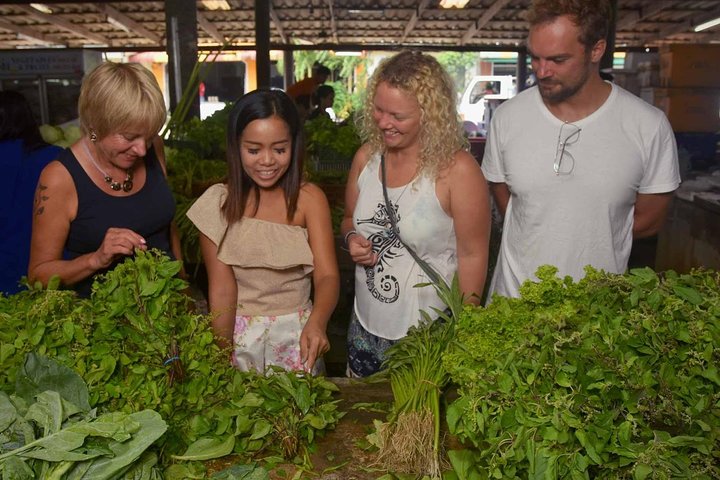
Cooking Class by Samui Native Instructor Geng and O Family
4 hours
From AUD 111.17
Patong is Phuket's busiest, brashest, and most unapologetically commercial beach. The 3km curve of sand is genuinely beautiful at sunrise, when it's quiet and the only people around are joggers and a few locals raking the beach. By mid-morning the sun loungers fill up, jet ski operators start their hustle, and the beach takes on its usual high-season energy.
The real action is just behind the beach. Bangla Road comes alive after dark with neon, music, and a frankly chaotic mix of bars, clubs, and street performers. It's not subtle. Whether that's appealing or appalling depends entirely on what you're looking for from a holiday.
If you're after a quieter Phuket, Patong isn't your beach — head to Karon, Kata, or quieter spots in the north of the island. But for first-time visitors who want easy access to nightlife, restaurants, and a wide stretch of sand, Patong delivers without pretence. Watch the undertow during monsoon season (May–October) — there are red flag days when swimming is genuinely dangerous and lifeguards aren't always present.
One should be honest at the outset: I did not expect to like Patong Beach. I went, originally, in 2018, mostly because my late wife Margaret had insisted that we ought, at least once in our lives, see what people meant when they spoke of Phuket. We landed at the airport, we took the taxi over the central spine of hills, and we descended into Patong on a Sunday evening with the sky pink behind the casuarinas and the road already throbbing with the noise of two million scooters and approximately seventeen open-air bars.
Margaret looked at me. I looked at Margaret. We agreed, without discussion, that we would give it forty-eight hours and then retreat to one of the quieter southern coves. We stayed eleven nights. I have been back twice since.
[IMAGE: https://images.unsplash.com/photo-1589394815804-964ed0be2eb5?w=1600&q=80&auto=format&fit=crop | Patong Beach in the late afternoon — long-tail boats lined along the sand and the headland of Kalim in the distance]
Patong has a reputation, and it is mostly deserved. Bangla Road, after dark, is essentially a working theme-park version of itself; one ought to wander down it once for the full assault on the senses, but one need not return. The beach itself, however — and this is the thing nobody tells you — is genuinely lovely. Three kilometres of bright white sand, gently shelving water, headlands at either end, the curve of the bay so neat it looks drawn with a compass.
The beach was largely cleared of the old beach-bar tat in the post-2015 cleanup; what you have now is a long strip of public sand with municipal-only sun loungers (200 baht for the day, including an umbrella), a few permitted vendors, and reasonable rules about jet-skis (which still get up to mischief, but less than they once did). Swim at the southern end, near the headland — the water is calmer and the sand drops gently. Avoid the centre of the beach in the November-to-April south-westerly swell when the riptides genuinely do bite.
The whole place is, in my view, transformed by being there at six in the morning. The bars are shuttered. The neon is off. The street vendors are setting up their carts of mango sticky rice and grilled chicken. The sand has been raked overnight by the council. Local fishermen are bringing in the long-tail boats with the night's catch. A few elderly Thais are doing morning exercises along the promenade. The sky is a cool pearl colour, turning gold.
Walk the full length of the bay. Stop for coffee at one of the small Thai-run cafes on Phra Barami Road, which charges 60 baht for an iced latte instead of the 220 you'll pay at the resort. Read for an hour. By 10am the speedboats and the parasailors are starting and the spell is over.
Margaret and I made a habit of those mornings. They are the bit of Patong I miss.
The first decision is which end. The southern end (towards Kalim and Tri Trang) is quieter, the streets are residential and the walk to the beach is only ten minutes. The central core — anywhere within a kilometre of Bangla Road — is loud until 3am, full stop. The northern end (Kalim) is technically a separate beach, more boutique, considerably better for sleep.
If I were going again I'd stay at one of the smaller hill-side hotels above Phra Barami Road — sea view, walking distance to the beach, 800 metres from the noise. There is a glut of rooms in May and June, which is the start of the wet season, and rates can be a third of high-season. October is the worst month — the south-westerly monsoon has not yet eased and the sea is brown with run-off.
I have, with effort, assembled a list of Patong attractions that one would feel comfortable telling one's children about:
The Sunday Market on Phra Barami Road, late afternoon, is enormous and proper — not the tourist-trap nonsense of Bangla Road but a real Thai market with food stalls, household goods, young families having dinner. Two hundred baht buys a feast.
Wat Suwankeereewong, the small wat tucked into the hill at the south end of the beach, is hardly visited and quietly lovely. Bring shoulder-covering clothes.
The viewpoint at Kalim Beach (a 20-minute walk up from Patong's north end) gives you the bay framed by two headlands and is the photograph everyone takes home.
A snorkel trip out to the Phi Phi islands — half-day, about 1,500 baht with a reasonable operator — is one of the better day-trips you can do from Phuket. Yes, the islands are over-touristed. Yes, you should go anyway. Maya Bay, since the closure and reopening, is genuinely managed now and limited to small numbers of visitors, which has been a pleasant change.
For a quieter alternative beach within Phuket, Railay Beach is only a couple of hours away by boat (technically Krabi, not Phuket, but it counts) and is a different experience entirely. The broader Thailand country guide covers the wider south, and the tours in Thailand listings have several Phuket-anchored snorkel and island-hop options.
The honest fact is that Patong is full of mediocre Thai food cooked for tourists who don't know any better. To eat well you need to walk three streets back from the beach. Areas around Soi Sansabai and Soi Phisitkoranee have the proper Thai kitchens — open-front, plastic stools, no English menus, food cooked to the customer's heat tolerance not to a Westerner-friendly default. A bowl of boat noodles or a plate of pad krapow with a fried egg, washed down with a Singha, will set you back about 120 baht and be the best meal of your trip.
The high-and-dry season is November to April. December–January is busiest and most expensive but also the most reliable weather; expect some crowding. February and March are perfect. The shoulder months of November and April are good value. May to October is wet — afternoon thunderstorms are guaranteed and some days the swell makes the beach unswimmable — but the rates fall by half and the place has a slightly dishevelled charm at that time of year.
The Tourism Authority of Thailand's Phuket pages cover safety, ferry timetables, and current weather guidance. UNESCO's World Heritage page for Ayutthaya is unrelated to Phuket but is what one ought to read on the long flight home if one is the sort of person who likes that kind of thing — and I am.
A small thing one might enjoy if one is the sort of person who likes to sit on a beach with a notebook and watch things happen: the long-tail boats at the southern end of Patong, near Tri Trang, are still operated by extended Thai-Muslim families who have fished and ferried out of this bay for generations. The wooden hulls, the long inboard engines mounted on a swing-arm with the propeller on a five-metre shaft, the painted bow garlands — these are working boats, not tourist props. In the early mornings you can sit at one of the small breakfast stalls and watch the boats come in, the catch sorted on the sand, the night's haul of squid and reef fish loaded onto motorbikes for the morning market. It is the bit of the bay that has not changed and probably will not. One could do worse than spend an hour over a Thai coffee watching it.
A practical note, since one ought to mention it: Patong's principal hazards are not what you would imagine. The riptides on the central beach during the south-west monsoon are genuinely serious — there are warning flags, please pay attention to them. The road traffic in town is the other main risk; pedestrians are not granted right of way and the scooter rentals are responsible for a steady stream of tourist injuries. If one is unfamiliar with riding a scooter in chaotic traffic, one ought not to start on the streets of Patong. Wear a helmet, decline the rental, take the songthaew bus or a Grab car instead.
Bag-snatching by passing scooters has been historically a problem along the beach road; one keeps one's bag on the inside shoulder.
Margaret used to say of Patong that it was the most embarrassing place she had genuinely enjoyed. I think that is correct. Skip Bangla Road, walk the beach at dawn, eat the food the locals are eating, get up the hill for a quieter view. There is a real and decent Patong underneath the show, and once you find it, one stays a few days more than one planned. Marvellous, in spite of itself.